

Ash-throated Crake vs Grey-cowled Wood-Rail
Mustelirallus albicollis versus Aramides cajaneus
Play a quiz with Ash-throated Crake and Grey-cowled Wood-Rail
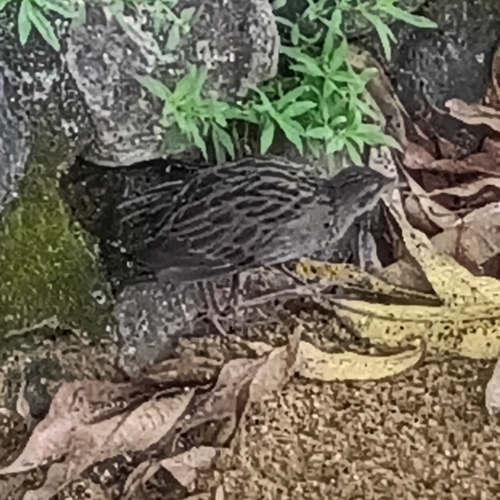 Ash-throated Crake
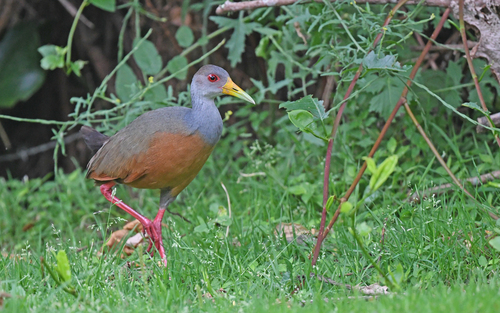 Grey-cowled Wood-Rail
In short
The most reliable field mark to separate Ash-throated Crake from Grey-cowled Wood-Rail is size: the wood-rail is dramatically larger and heavier, with a bulkier build and longer legs. In all plumages, the crake shows a pale gray throat and breast, black upperparts with brown feather edges, and distinctive black-and-white barring on the flanks and undertail. In contrast, the wood-rail is olive-brown above, with a medium-gray head and neck, rufous chest and flanks, and a black belly and tail. Bill and leg color also differ: crake has a short greenish bill and purplish-brown legs, while wood-rail sports a bright greenish-yellow bill and coral-red legs. Juvenile wood-rails are duller but still much larger than any crake. Both species may be found in wet habitats, but the wood-rail favors more forested or mangrove areas, while the crake is more likely in open marshes.
Identification tips
- Size is the first check: If the bird is nearly chicken-sized, it's a Grey-cowled Wood-Rail; if it's small and sparrow-like, it's Ash-throated Crake. This holds for all ages and sexes.
- Bill and leg color: Crake has a short greenish bill and purplish-brown legs; wood-rail has a bright greenish-yellow bill and coral-red legs. Juvenile wood-rails have dusky bills and legs, but still appear much larger and heavier than any crake.
- Throat and breast color: Ash-throated Crake always shows a pale gray throat, breast, and belly. Wood-rail has a medium-gray head and neck, but the chest and flanks are rufous, and the belly is black.
- Flank and undertail pattern: Crake's black-and-white barring on the flanks and undertail is unique and never matched by wood-rail of any age.
- Upperparts: Crake is black above with brown feather edges; wood-rail is olive-green to dark brown above, never black.
- Head pattern: Wood-rail has a medium-gray head and neck, often with a brown patch at the rear (except in A. c. avicenniae). Crake's head is not distinctly patterned beyond the pale gray throat.
- Belly and tail: Crake's belly is pale gray; wood-rail's is black, as is the rump and tail—look for this contrast if the bird is seen from behind or in flight.
- Eye color: Adult wood-rail has red eyes; crake's eye color is not specified but is not noted as red.
- Leg length and stance: Wood-rail stands tall on long legs; crake is much shorter-legged and lower to the ground.
- Behavior: Crake is extremely secretive, usually only glimpsed running between cover; wood-rail is more likely to walk openly, especially along water edges or in forested wetlands.
- Habitat: In open marsh or wet grassland, expect crake; in forest, mangrove, or swamp with trees, expect wood-rail.
- Juvenile confusion: Juvenile wood-rail is duller but still large, with sooty-black belly and buff flecks, dusky bill and legs; crake juveniles retain the pale gray throat and barred flanks, which are never present in wood-rail.
- Subspecies variation: Both have smaller, paler subspecies, but these do not overlap in key field marks—wood-rail subspecies may lack the brown nape patch but still never show flank barring.
- Flight views: If seen in flight, wood-rail's size, black rump and tail, and lack of barring are clues; crake's small size and barred flanks/undertail may be glimpsed if flushed.
- Voice: Not described in the sources, so do not rely on vocalizations for separation in this context.
Size
Ash-throated Crake is a small rail, 21–24 cm long and weighing 90–120 g. Grey-cowled Wood-Rail is much larger, at 33–40 cm and 320–465 g—about twice the length and three to four times the mass. Even at a distance, the wood-rail's size and long-legged, heavy-bodied stance are obvious compared to the compact, short-legged crake.
Plumage
- Juveniles: Juvenile Grey-cowled Wood-Rail is duller than adult, with sooty-black belly flecked with buff, dusky bill and legs, and brownish eyes. Juvenile Ash-throated Crake is not described in detail, but adults and young share the pale gray throat and black-and-white barred flanks, which are never present in wood-rail of any age.
- Adults: Ash-throated Crake: black upperparts with brown feather edges, pale gray throat/breast/belly, barred black-and-white flanks and undertail, short greenish bill, purplish-brown legs. Grey-cowled Wood-Rail: olive-green to dark brown upperparts, medium-gray head and neck (with brown patch at rear in nominate), rufous chest/flanks, black belly/rump/tail, bright greenish-yellow bill, coral-red legs, red eyes. No barring on flanks or undertail.
- Subspecies: Both have smaller, paler subspecies, but the wood-rail's A. c. avicenniae lacks the brown nape patch and is slightly paler below, but still never shows the crake's barred flanks.
Behaviour
Ash-throated Crake is a secretive skulker, typically staying hidden in dense marsh vegetation and rarely venturing into the open. It is more likely to be glimpsed running between cover or heard than seen well. Grey-cowled Wood-Rail, though also wary, is bolder and often walks openly along the edges of water or through mangroves and forested swamps, sometimes even feeding in daylight. Its long legs and upright gait contrast with the crake's low, compressed profile. Wood-rails may be seen in pairs year-round.
Habitat
Ash-throated Crake is found in open marshes and wet grasslands across most of South America (except Chile), favoring dense, low vegetation. Grey-cowled Wood-Rail prefers wetter, more wooded habitats: forests, mangroves, and swamps throughout Central and South America. If the bird is in a dense forest or mangrove, wood-rail is more likely; in open marsh, crake is favored.
Ash-throated Crake · Grey-cowled Wood-Rail · My Tricky Birds