

Ash-coloured Tapaculo vs Large-footed Tapaculo
Myornis senilis versus Scytalopus macropus
Play a quiz with Ash-coloured Tapaculo and Large-footed Tapaculo
 Ash-coloured Tapaculo
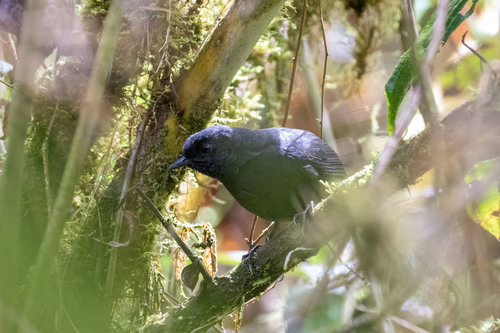 Large-footed Tapaculo
In short
The most reliable field mark for separating Ash-coloured Tapaculo from Large-footed Tapaculo is the overall plumage tone: Ash-coloured Tapaculo adults are medium to pale gray with some cinnamon on the flanks and crissum, while Large-footed Tapaculo adults are uniformly very dark gray. Juveniles are also distinct: Ash-coloured Tapaculo juveniles are reddish brown above and ochre brown below, whereas Large-footed Tapaculo juveniles are still dark gray, with brown and buff/off-white feather tips. Size is also a clue—Large-footed Tapaculo is much heavier and bulkier, though both are the same length. Range can help: Large-footed Tapaculo is endemic to Peru, while Ash-coloured Tapaculo ranges from Colombia to Peru.
Identification tips
- Juvenile plumage is the most decisive mark: If the bird is reddish brown above and ochre brown below, it is a juvenile Ash-coloured Tapaculo. If it is still dark gray overall with brown-tipped upperparts and buff/off-white below, it is a juvenile Large-footed Tapaculo. This is especially useful in late breeding season or when family groups are present.
- Overall darkness in adults: Adult Large-footed Tapaculo is always very dark gray, almost blackish, with no pale or warm patches. Ash-coloured Tapaculo is medium gray above and paler below, often with cinnamon on the flanks/crissum. In poor light, Large-footed Tapaculo will look like a dark lump, while Ash-coloured Tapaculo will show more contrast.
- Flank and crissum color: Cinnamon or rufous tones on the flanks and undertail (crissum) point to Ash-coloured Tapaculo. Large-footed Tapaculo never shows these warm tones.
- Uniformity: Large-footed Tapaculo is uniformly dark gray all over, with no contrast between upperparts and underparts. Ash-coloured Tapaculo is distinctly paler below.
- Bulk and structure: Large-footed Tapaculo is much heavier and bulkier for the same length. If you see a tapaculo that looks especially robust or heavy-bodied, suspect Large-footed Tapaculo, especially in Peru.
- Sex differences: Both species are similar between sexes, but Ash-coloured Tapaculo females can be slightly lighter or darker than males. This is subtle and rarely diagnostic in the field.
- Population variation: Ash-coloured Tapaculo shows some variation in darkness of gray depending on which side of the Andes it is found, but always remains paler than Large-footed Tapaculo.
- Range: Large-footed Tapaculo is only found in Peru. Ash-coloured Tapaculo ranges from Colombia to Peru. If you are in Colombia or Ecuador, you are not seeing Large-footed Tapaculo.
- Habitat overlap: Both can occur in humid montane forests in Peru, so habitat alone is not diagnostic there.
- No distinctive wing or flight pattern: Neither species shows contrasting upperwing or flight marks in any age, so rely on body color and structure.
- No strong bill or tail differences: Notes do not mention bill or tail shape as a separator, so focus on plumage and size.
- No distinctive vocal differences in these notes: If you hear a tapaculo, do not rely on song for separation unless you have local knowledge.
- Beware of light conditions: In deep shade, Ash-coloured Tapaculo can appear darker, but will still show paler underparts and possible cinnamon flanks if seen well.
- Immature confusion: If you see a tapaculo that is not fully gray but not reddish brown either, check for feather tips: brown-tipped upperparts and buff/off-white below indicate Large-footed Tapaculo juvenile; reddish/ochre tones indicate Ash-coloured Tapaculo juvenile.
- When in doubt, use a combination: If plumage is ambiguous, use range, bulk, and any hint of cinnamon or paleness to help decide.
Size
Both species are about 14 cm long, but Large-footed Tapaculo is much heavier and bulkier (males 36–43 g, females ~32 g) compared to Ash-coloured Tapaculo (males 20–23.5 g, females 18.1–24.5 g) [wikidata]. This difference is often visible in the field as a more robust, heavy-bodied appearance for Large-footed Tapaculo, especially if seen side by side or with experience. Ash-coloured Tapaculo appears lighter and more delicate.
Plumage
- Juveniles: Ash-coloured Tapaculo juveniles are reddish brown above and ochre brown below, a strong contrast to the Large-footed Tapaculo juvenile, which is still dark gray overall but with brown-tipped upperpart feathers and buff/off-white tips below. This makes Ash-coloured Tapaculo juveniles much warmer and paler overall, while Large-footed Tapaculo juveniles retain a dark, somber look.
- Adults: Ash-coloured Tapaculo adults are medium gray above and lighter gray below, with some individuals showing cinnamon on the flanks and crissum. Large-footed Tapaculo adults are uniformly very dark gray with no contrasting tones or warm colors. This difference is often visible even in poor light: Ash-coloured Tapaculo looks paler and sometimes patchy on the flanks, while Large-footed Tapaculo is consistently dark.
- Sexes: Both species show little sexual dimorphism in plumage, but Ash-coloured Tapaculo females can be slightly lighter or darker than males, and some population variation exists in darkness of gray.
Habitat
Ash-coloured Tapaculo is found in humid montane forests and shrubby areas from Colombia through Ecuador to Peru. Large-footed Tapaculo is restricted to Peru. If you are outside Peru, Large-footed Tapaculo is not an option. Within Peru, check local range and elevation, but both can overlap in montane habitats.
Ash-coloured Tapaculo · Large-footed Tapaculo · My Tricky Birds