

Andaman Cuckoo-Dove vs Red-tailed Tropicbird
Macropygia rufipennis versus Phaethon rubricauda
Play a quiz with Andaman Cuckoo-Dove and Red-tailed Tropicbird
 Andaman Cuckoo-Dove
 Red-tailed Tropicbird
In short
The most reliable field mark to separate these two is the overall plumage and structure: Red-tailed Tropicbird adults (and immatures) are strikingly white with a long, red tail streamer and a bright red bill, while Andaman Cuckoo-Dove is a uniformly rusty-brown, slim pigeon with no white or red highlights. Juvenile Red-tailed Tropicbirds have distinctive black barring and scaling on the upperparts and upperwing coverts, which never occurs in Andaman Cuckoo-Dove. In flight, the tropicbird's long, pointed wings and streamer tail contrast sharply with the dove's shorter, rounded wings and long, graduated tail. The dove is terrestrial and perches in forest, while the tropicbird is a marine species, rarely seen inland. Calls are also totally different: the dove gives a repeated 'whoo-whup', while the tropicbird is generally silent in flight.
Identification tips
- Juvenile Red-tailed Tropicbird has prominent black barring and scaling on the upperparts and upperwing coverts; Andaman Cuckoo-Dove is always plain rusty-brown with no barring or scaling.
- Adult Red-tailed Tropicbird is almost pure white with a black mask and a long, red tail streamer; Andaman Cuckoo-Dove is uniformly rusty-brown with no mask or streamer.
- Bill color is diagnostic: Red-tailed Tropicbird has a bright red (adult) or blackish-grey with blue base (immature) bill; Andaman Cuckoo-Dove has a typical pigeon bill, never red or blue.
- In flight, tropicbird shows long, pointed wings and trailing streamers; dove has short, rounded wings and a long, graduated tail with no streamers.
- Tropicbird's wings are white with dark chevrons and dark shafts; dove's wings are uniformly rusty-brown with no contrasting marks.
- Red-tailed Tropicbird is much larger in wingspan and length, despite similar body mass; it appears more elongated and tern-like in flight.
- Andaman Cuckoo-Dove is always found in forested terrestrial habitats; Red-tailed Tropicbird is strictly marine, seen over ocean or at remote island colonies.
- Tropicbird is rarely seen perched except at breeding sites; dove is often seen perched in trees.
- The dove's call is a repeated 'whoo-whup'; tropicbird is silent in flight, only giving short squawks or growls at the nest.
- No age or sex of Andaman Cuckoo-Dove ever shows white, black mask, or red bill/tail streamer.
- No age or sex of Red-tailed Tropicbird is rusty-brown or plain; even juveniles are white with black barring.
- If seen flying low over the sea or soaring above cliffs, it is the tropicbird; if in dense forest, it is the dove.
- Tropicbird's tail streamers can be hard to see at a distance, but the white plumage and red bill are still distinctive.
- Dove's flight is direct and low; tropicbird's flight is buoyant, gliding, and often high above the water.
- If you see a rusty-brown, pigeon-shaped bird with a long tail and no white, it is the Andaman Cuckoo-Dove; if you see a large, white seabird with red bill and streamers, it is the Red-tailed Tropicbird.
Size
Despite the Andaman Cuckoo-Dove being slightly heavier by mass (260g vs. 219g), the Red-tailed Tropicbird is much larger in overall dimensions, with a wingspan of 111–119 cm and a total length (including tail streamers) of 95–104 cm. The dove is a small, slim pigeon, while the tropicbird is a large, heavy-set seabird with a much longer wingspan and tail. In the field, the tropicbird appears much larger and more elongated, especially when flying, due to its long wings and tail streamers.
Plumage
- Juvenile/immature Red-tailed Tropicbird: Shows prominent black barring and scaling on the crown, nape, mantle, back, rump, and upper wing coverts. Bill is blackish grey with a blue-grey base. No rust or brown tones at all. These marks are never present in any age of Andaman Cuckoo-Dove.
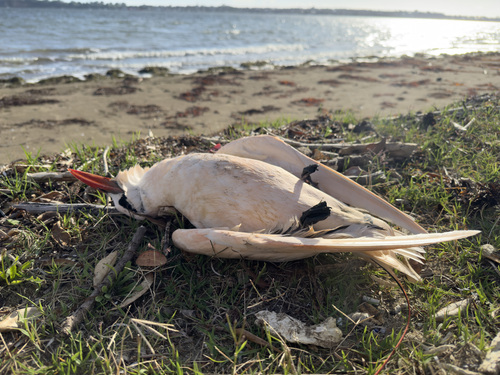
- Adult Red-tailed Tropicbird: Almost entirely white, sometimes with a pink tinge, with a black mask through the eye and a long, red tail streamer. The bill is bright red. The wings are white with dark chevrons on the tertials and dark shafts on the primaries. No rusty or brown coloration anywhere.
- Andaman Cuckoo-Dove (all ages): Uniform rusty or rufous-brown throughout, with no white, black mask, or red bill/tail. The plumage is plain, lacking any barring or scaling. The tail is long and graduated but never has streamers or contrasting colors.
- In flight: Tropicbird shows white upperwings with dark chevrons and long streamers; dove shows uniform rusty-brown wings and tail, with no contrasting marks.
Behaviour
Red-tailed Tropicbird is a strong, agile flier, often seen gliding or soaring over open ocean, rarely perching except at breeding sites. Its flight is buoyant and tern-like, with long, pointed wings and trailing streamers. Andaman Cuckoo-Dove is a terrestrial, forest-dwelling pigeon, usually seen perched quietly in trees or flying short distances with a direct, low flight. It never glides or soars like a tropicbird and is not seen over open water.
Habitat
Andaman Cuckoo-Dove is endemic to the Andaman and Nicobar Islands and is strictly terrestrial, found in forested habitats. It is never seen at sea or along the coast. Red-tailed Tropicbird is a pelagic seabird of the Indian and Pacific Oceans, coming to land only to breed, usually on remote islands or cliffs. It is never found in forest or inland habitats. If seen at sea or along rocky coasts, it is almost certainly the tropicbird; if deep in forest, it is the dove.
Voice
Andaman Cuckoo-Dove gives a repeated, double-noted 'whoo-whup', with the first note slurred and the second shorter and higher-pitched. Red-tailed Tropicbird is generally silent in flight, only giving short squawks at the nest or a low growling call in defense. Their calls are not similar and are unlikely to be confused.
Andaman Cuckoo-Dove · Red-tailed Tropicbird · My Tricky Birds