
Amethyst Brown-Dove vs Pink-necked Green-Pigeon
Phapitreron amethystinus versus Treron vernans
Play a quiz with Amethyst Brown-Dove and Pink-necked Green-Pigeon
 Amethyst Brown-Dove
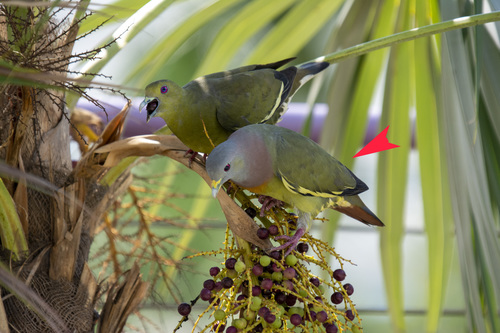 Pink-necked Green-Pigeon
In short
The most reliable field mark between Amethyst Brown-Dove and Pink-necked Green-Pigeon is overall color and structure: the brown-dove is a dark, deep-woods bird with rich brown and purple tones and a long, heavy bill, while the green-pigeon is bright green overall (especially females and immatures), with males showing a distinctive pinkish neck and orange breast. In flight, the green-pigeon shows a yellow bar across the wing (from yellow-edged tertials), absent in brown-dove. The brown-dove is scarce and shy in dense forest, while the green-pigeon is common and often seen in more open or urban habitats. Juvenile green-pigeons resemble females but are still much greener than any brown-dove.
Identification tips
- Overall color: Brown-dove is always brown with purplish and greyish tinges; green-pigeon is green overall (female/immature) or has pink/orange/green (male).
- Wing pattern in flight: Green-pigeon (all ages) shows a yellow bar across the wing from yellow-edged tertials; brown-dove never shows yellow in the wing.
- Bill structure: Brown-dove has a noticeably long, heavy bill (longer than its tarsus); green-pigeon has a shorter, more slender bill.
- Eye region: Brown-dove has pinkish bare skin around the eye and white subocular lines; green-pigeon lacks these but may have a pale bill.
- Male green-pigeon: Only species with a pink neck and orange breast—never matched by brown-dove.
- Female/immature green-pigeon: Green above, yellowish below, greenish crown—no brown-dove is ever this green.
- Underparts: Brown-dove is purplish-brown below with rich tan undertail-coverts; green-pigeon is yellowish below (female/immature) or orange (male).
- Tail: Green-pigeon has a grey tail with a black terminal band and chestnut uppertail coverts; brown-dove's tail is not described as distinctive.
- Habitat: Brown-dove is only in dense, mature forest; green-pigeon is common in open, edge, and urban habitats.
- Behavior: Brown-dove is shy, rarely seen in the open; green-pigeon is gregarious, often perches in the open.
- Flight style: Green-pigeon is swift and direct, often in flocks; brown-dove flushes low and quickly hides.
- Abundance: Green-pigeon is common and widespread; brown-dove is rare and local.
- Sexual dimorphism: Only green-pigeon shows strong male/female differences; brown-dove sexes are similar.
- Juvenile confusion: Juvenile green-pigeons can be confused with brown-doves at a distance, but are always greener and show the yellow wing bar in flight.
- Voice: Green-pigeon may give a whistling or rasping call in groups; brown-dove's voice is not described, so do not rely on this for separation.
Size
Amethyst Brown-Dove is slightly heavier (body mass about 145 g [wikidata]) and appears bulkier, with a noticeably longer and heavier bill relative to its tarsus. Pink-necked Green-Pigeon is similar in length (25–30 cm), but mass varies (105–160 g), with females being smaller. In the field, the brown-dove often looks more robust and less streamlined than the green-pigeon, which has a more slender, compact appearance with a shorter bill.
Plumage
- Juvenile/immature: Juvenile Pink-necked Green-Pigeons resemble adult females—green overall, with a yellowish belly and greenish crown, and greyer above. They lack the pink neck and orange breast of adult males, but still show the yellow wing bar in flight, which is never present in brown-dove. Amethyst Brown-Dove immatures are not described in detail, but all ages are generally dark brown with purplish and greyish tinges, lacking any green or yellow.
- Adult male Pink-necked Green-Pigeon: Striking pinkish neck and upper breast, orange lower breast, olive green back, yellow belly, and a yellow bar across the wing in flight. Grey head and tail with a black terminal band.
- Adult female Pink-necked Green-Pigeon: Green overall, yellowish below, greenish crown and nape, yellow wing bar in flight.
- Amethyst Brown-Dove (all ages/sexes): Darker, richer brown overall with purplish-brown underparts, extensive blue-purple patch on mantle, reddish-brown chin and throat with darker streaking, grey tinge, pinkish bare skin around the eye, and amethyst or purple iridescence on the nape. Subocular white lines below the eye are present but can be subtle. No green or yellow tones anywhere.
Behaviour
Amethyst Brown-Dove is a shy, rare species of deep, dense forests, often remaining hidden and difficult to observe. It tends to perch quietly and is rarely seen in the open. Pink-necked Green-Pigeon is gregarious, often seen in small flocks, and is much more approachable, frequently perching in the open on wires, fruiting trees, or in gardens. In flight, green-pigeons are swift and direct, often revealing the yellow wing bar; brown-doves are more likely to flush low and quickly disappear into cover.
Habitat
Amethyst Brown-Dove is restricted to dense, mature forests on several Philippine islands and is generally rare and local. It avoids open or disturbed areas. Pink-necked Green-Pigeon is widespread and common across Southeast Asia and the Philippines, thriving in a variety of habitats: forest edge, secondary growth, mangroves, gardens, plantations, and even urban parks. If the bird is seen in a city, plantation, or open area, it is almost certainly a green-pigeon.
Voice
Pink-necked Green-Pigeon is not very vocal, but males sometimes give a tri-syllabic whistling call ending in a coo, and occasionally a rasping 'krrak krrak...' sound, especially in communal roosts or when finding food. Amethyst Brown-Dove's vocalizations are not described in the provided notes, so voice is not a reliable separation in the field based on current information.
Amethyst Brown-Dove · Pink-necked Green-Pigeon · My Tricky Birds