

American Dipper vs Black Catbird
Cinclus mexicanus versus Melanoptila glabrirostris
Play a quiz with American Dipper and Black Catbird
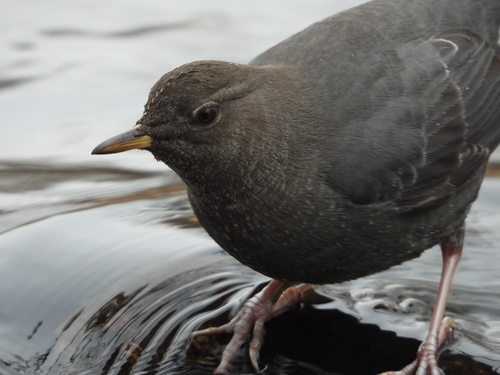 American Dipper
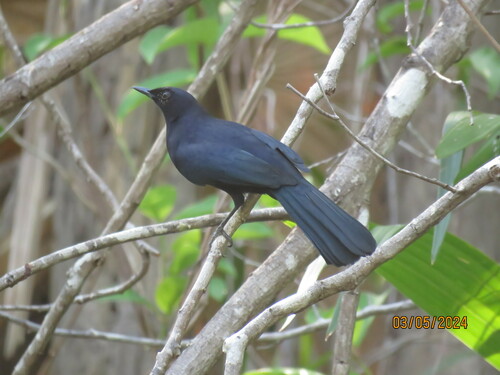 Black Catbird
In short
The most reliable field mark between American Dipper and Black Catbird is overall color: American Dipper is a uniform slate-gray with a flashing white eyelid, while Black Catbird is glossy black with a purplish or greenish sheen. Juvenile Black Catbirds are brownish-gray and mottled below, which can cause confusion with the dipper, but the dipper’s white eyelid and aquatic behavior are distinctive. Structurally, dippers are stocky and short-tailed, while Black Catbird is longer-tailed and more slender. Habitat is a strong clue: dippers are always near fast-flowing streams, while Black Catbird is a songbird of dense lowland thickets in the Yucatán region.
Identification tips
- Overall color: Adult American Dipper is uniform slate-gray, never black or glossy; Black Catbird is glossy black with purplish/greenish sheen (adults), or brownish-gray and mottled (juveniles).
- White eyelid: Watch for the dipper’s white eyelid flashing as it blinks—unique and diagnostic at any age.
- Gloss and sheen: Black Catbird adults show a purplish or greenish gloss, especially in good light; dippers are always matte gray.
- Juvenile confusion: Juvenile Black Catbirds are brownish-gray with mottling below, possibly resembling a pale dipper, but lack the dipper’s white eyelid and aquatic behavior.
- Bill shape: Dipper has a short, stubby bill; catbird’s bill is black, straight with a decurved tip, and proportionally longer.
- Tail length: Dipper’s tail is short and square; catbird’s tail is longer and more prominent, often cocked or flicked.
- Body shape: Dipper is stocky and barrel-chested; catbird is slimmer and more elongated.
- Legs: Both have black legs, but the dipper’s are stronger and adapted for gripping rocks.
- Eye color: Black Catbird adults have a dark reddish iris (hard to see in the field); dippers have dark eyes but not reddish.
- Habitat: Dipper is always near fast-flowing streams; catbird is in dense thickets, rarely near water.
- Behavior: Dipper bobs/dips constantly and may dive underwater; catbird skulks in brush and sings from perches.
- Flight: Both species have short, rounded wings, but dipper’s flight is low and direct over water; catbird’s flight is more typical of mimids, fluttery and through vegetation.
- Song: Black Catbird’s song is complex, with harsh, flute-like, and metallic notes; dipper’s song is simpler and warbling.
- Geography: Dipper is found in western North America and Central America; Black Catbird is restricted to the Yucatán Peninsula and nearby islands.
- Sex differences: Both species are sexually similar; only subtle differences in gloss for catbird females, not usually useful in the field.
Size
American Dipper is slightly shorter (16.5 cm) but heavier (46 g) and stockier than Black Catbird (19–20.5 cm, 35 g). Dipper has a compact, chunky build with a short tail and wings, while Black Catbird is slimmer, with a longer tail and short, rounded wings. In the field, the catbird may look longer and sleeker, but the dipper appears more robust and barrel-chested.
Plumage
- Juvenile/immature: Juvenile Black Catbirds are brownish-gray with mottling below, lacking the adult’s gloss. American Dipper juveniles closely resemble adults but may be slightly paler and lack the brownish tinge on the head; they never show the catbird’s mottling.
- Adult: Adult American Dipper is uniform slate-gray, sometimes with a brownish head, and always shows white eyelid feathers that flash when blinking. Black Catbird adults are glossy black with a purplish or greenish sheen, especially on the tail and wing coverts; remiges are duller blackish-brown. The catbird’s iris is dark reddish, while the dipper’s eye is dark but not reddish. Female Black Catbird is less glossy, but still black overall. Both species have black legs and bills, but the dipper’s bill is stubbier.
- Flight: No distinctive upperwing pattern is noted for either species, but the dipper’s uniform gray and the catbird’s glossy black (or brownish-gray in juveniles) are contrasting.
Behaviour
American Dipper is almost always seen in or beside fast-flowing streams, often bobbing or dipping its body, and may plunge underwater to feed. It perches on rocks or low branches over water. Black Catbird is a skulker in dense thickets, rarely near water, and often sings from an exposed perch. Dipper’s behavior is unique among songbirds in North America: aquatic, with constant dipping movements. Catbird is more typical of mimids, foraging in vegetation and perching upright.
Habitat
American Dipper is strictly associated with clear, fast-flowing streams in mountainous or hilly terrain of western North America and parts of Central America. It is never found away from running water. Black Catbird is endemic to the Yucatán Peninsula and adjacent areas, inhabiting dense lowland thickets, brush, and sometimes small trees, but not aquatic habitats. If seen near water, it is incidental, not a habitat preference.
Voice
American Dipper’s song is a high, warbling series of notes, often given near streams, but it is not described here in detail. Black Catbird’s song is a mix of repeated phrases, ranging from harsh and scratchy to flute-like, with metallic clicking buzzes; it does not mimic other species. Its calls can resemble Gray Catbird, with harsh, nasal, or grating notes. Dipper’s vocalizations are less varied and not cat-like. In the field, the catbird’s song is more complex and varied than the dipper’s.