

Acadian Flycatcher vs Varzea Thrush
Empidonax virescens versus Turdus sanchezorum
Play a quiz with Acadian Flycatcher and Varzea Thrush
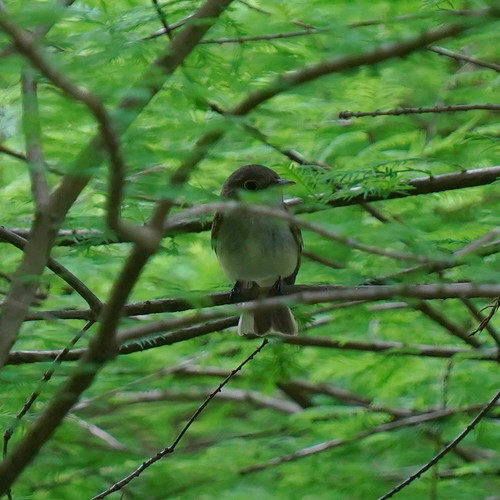 Acadian Flycatcher
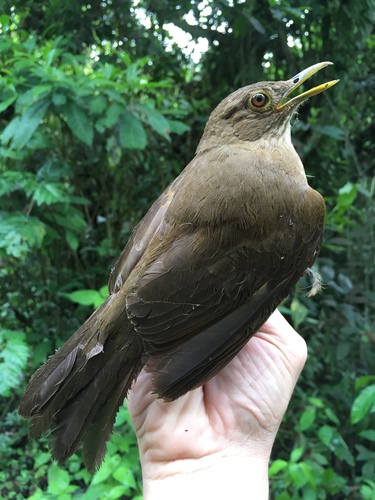 Varzea Thrush
In short
The most reliable way to separate Acadian Flycatcher from Varzea Thrush is by overall structure and plumage: Acadian Flycatcher is a small, slim, olive Empidonax with a short bill and bold wingbars, while Varzea Thrush is a much larger, chunky, brown thrush with a richer, streaked underpart pattern and a contrasting orange eye-ring. The thrush’s size and shape are unmistakable in direct comparison, but in poor views, note the Acadian’s white eye-ring and wingbars versus the thrush’s orange eye-ring and lack of wingbars. Voice and behavior also differ sharply, with Acadian giving explosive peet-sa calls and Varzea Thrush singing slow, mellow carols. Even in flight or with immature birds, the thrush’s bulk and warm brown tones contrast with the flycatcher’s compact, olive-and-white look.
Identification tips
- Size is a major clue: Varzea Thrush is nearly twice as long and several times heavier than Acadian Flycatcher. If the bird looks large and robust, it’s the thrush.
- Wingbars vs. no wingbars: Acadian Flycatcher always shows two crisp white wingbars on dark wings; Varzea Thrush lacks wingbars entirely. This is reliable at all ages and in all seasons.
- Eye-ring color: Acadian Flycatcher’s eye-ring is white and stands out on its olive face; Varzea Thrush’s is dull orange, matching the warm brown tones of its head.
- Bill structure and color: The flycatcher has a short, wide bill with a dark upper and yellowish lower mandible; the thrush’s bill is longer, dull yellow with a blackish base, and more typical of a Turdus thrush.
- Upperpart color: Acadian Flycatcher is olive-green above, while Varzea Thrush is a rich sepia-brown. The thrush’s color is warmer and more uniform.
- Underpart pattern: The flycatcher’s underparts are clean whitish with an olive wash on the breast; the thrush has a streaked buffy throat, caramel-brown upper breast/flanks, and a paler belly with streaked undertail coverts.
- Underwing color: Varzea Thrush has bright orange-rufous underwing coverts, visible in flight or when preening; Acadian Flycatcher’s underwing is not described as contrasting.
- Tail: The thrush’s tail is longer and grayish brown with warm edges; the flycatcher’s is shorter and darker, matching the wings.
- Leg color: Acadian Flycatcher has pale legs; Varzea Thrush’s legs are olive-gray, but this is subtle and rarely diagnostic at a distance.
- Posture and behavior: Flycatchers perch upright and sally for insects; thrushes are more likely to be seen hopping on the ground or moving through low vegetation.
- Flight style: Acadian Flycatcher is agile and buoyant in flight, often flicking wings and tail; Varzea Thrush is heavier and more direct.
- Voice: Acadian Flycatcher’s explosive peet-sa is unlike any thrush; Varzea Thrush’s mellow, slurred carol is typical of Turdus thrushes and never as abrupt as the flycatcher’s calls.
- Habitat context: If seen in seasonally flooded Amazonian forest, it’s likely Varzea Thrush; if in mature woodland in eastern North America, it’s Acadian Flycatcher. However, do not rely solely on habitat if the location is uncertain.
- Sex and age: Both species have similar plumage in both sexes and all ages, so sex is not helpful for separation.
- Pitfalls: In poor light, the thrush’s orange eye-ring may look pale, and the flycatcher’s white wingbars may be less obvious. Always check multiple features—size, structure, and overall color are most reliable.
Size
Varzea Thrush is much larger and heavier than Acadian Flycatcher. The thrush measures about 22–24 cm (8.7–9.4 in) in length and weighs around 58 g (2.0 oz), while the flycatcher is only 14–15 cm (5.5–5.9 in) long and weighs 11–14 g (0.4–0.5 oz). The thrush appears robust and full-bodied, with a broad chest and longer tail, while the flycatcher is slim, small-headed, and delicate. Even at a distance, the size gap is striking if both species are familiar.
Plumage
Acadian Flycatcher (all ages) shows olive-green upperparts, a bold white eye-ring, and two bright white wingbars set off against darker wings. The underparts are whitish with an olive wash on the breast, and the bill is wide with a dark upper mandible and yellowish lower mandible. In contrast, Varzea Thrush (adults, sexes alike) is rich sepia-brown above, with a dull orange eye-ring and no wingbars. Its flight feathers are dark brown edged with warm sepia, and the tail is grayish brown with similar warm edges. The underparts are more complex: chin and throat are buffy white with brown streaks, upper breast and flanks are caramel-brown, lower breast is paler, and belly/vent are whitish. The underwing coverts are bright orange-rufous, a feature not present in the flycatcher. The thrush’s bill is dull yellow with a blackish base, and the legs are olive-gray. No age-specific upperwing pattern is noted for either species, so these contrasts apply to adults and immatures alike.
Behaviour
Acadian Flycatcher typically perches upright on slender branches, often sallying out to catch insects in short, acrobatic flights. Its movements are quick and restless, and it often flicks its tail or wings. Varzea Thrush, in contrast, behaves like a typical thrush: it spends more time on or near the ground, hopping or walking, and forages for insects and fruit. Its movements are slower and more deliberate, and it is less likely to sally out from a perch. In flight, the thrush appears heavier and more direct, while the flycatcher is agile and buoyant.
Habitat
Acadian Flycatcher is not found in the same range as Varzea Thrush, but if encountered in the field, the flycatcher would be in wooded habitats, often in mature forests with dense understory. Varzea Thrush is found in varzea (seasonally flooded) forests in the Amazon basin of Brazil, Colombia, and Peru. The thrush’s habitat is more likely to be lowland, seasonally inundated forest, while the flycatcher prefers drier, mature woodland. However, habitat alone is not diagnostic if the observer is unsure of location.
Voice
Acadian Flycatcher’s song is a sharp, explosive two-note peet-sa, and its call is a soft peet, sometimes resembling a flicker’s call. This is very different from Varzea Thrush, which sings a slow, mellow, slurred carol with short phrases separated by pauses. The thrush also gives a rising, mewing call and series of cuk notes. The flycatcher’s vocalizations are abrupt and piercing, while the thrush’s are musical and drawn-out.