

Motmot

Common Reed Warbler vs Great Reed Warbler

Acrocephalus scirpaceus versus Acrocephalus arundinaceus

Play a quiz with Common Reed Warbler and Great Reed Warbler
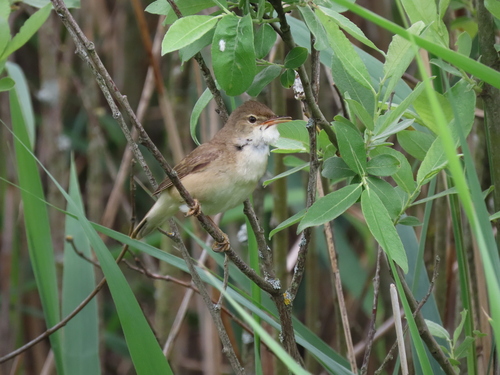
Common Reed Warbler (Acrocephalus scirpaceus) Common Reed Warbler
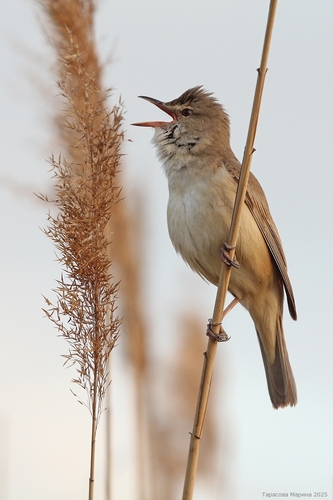
Great Reed Warbler (Acrocephalus arundinaceus) Great Reed Warbler

Media

Loading…

In short

The most reliable way to separate Common Reed Warbler from Great Reed Warbler is by size: Great Reed Warbler is much larger, with a noticeably bulkier build and longer wings and tail, often described as 'thrush-sized' compared to the much smaller, slimmer Common Reed Warbler. Both species have similar unstreaked brown upperparts and buff underparts, but Great Reed Warbler shows a stronger, more obvious pale supercilium (eyebrow), especially in adults. Juveniles of both are richer buff below, so age alone is not a safe separator. In the field, Great Reed Warbler’s song is much louder and more far-carrying. If only brief or distant views are available, focus first on overall size and the strength of the supercilium.

Identification tips

  1. Size is the most reliable field mark: Great Reed Warbler is much larger and heavier than Common Reed Warbler. If you get a good look at the bird’s proportions, especially if you can compare it to other reedbed birds, this is often diagnostic.
  2. Supercilium (eyebrow): Great Reed Warbler has a strong, broad, pale supercilium that is obvious in the field, especially in front of the eye. Common Reed Warbler’s supercilium is faint or nearly absent. This is a key mark for adults and older juveniles.
  3. Bill size: Great Reed Warbler’s bill is noticeably larger and heavier, matching its overall robust structure. Common Reed Warbler’s bill is finer and more delicate.
  4. Underparts color in juveniles: Both species’ juveniles are richer buff below, so this is not a reliable separator.
  5. Upperparts: Both species are unstreaked brown above, so this is not helpful for separation.
  6. Wing and tail length: Great Reed Warbler has longer wings and a longer tail, giving it a more elongated appearance when perched or in flight.
  7. Posture and behavior: Great Reed Warbler often perches more upright and in the open, especially when singing, while Common Reed Warbler is more skulking and agile, moving quickly through reeds.
  8. Song: If you hear a loud, harsh, far-carrying song, it is Great Reed Warbler. Common Reed Warbler’s song is much softer and less forceful.
  9. Habitat context: In very small reedbeds or isolated patches, Common Reed Warbler is more likely. Great Reed Warbler prefers large, dense reedbeds.
  10. Flight jizz: Great Reed Warbler looks heavy and powerful in flight, while Common Reed Warbler is slimmer and more fluttery.
  11. No distinctive wing or flight marks: Neither species has age-specific upperwing or flight marks that are useful for separation.
  12. Sexes similar: Both species show little or no sexual dimorphism in plumage, so do not rely on sex for identification.
  13. If in doubt, focus on size and supercilium: These two features together will separate almost all individuals seen well.
  14. Beware of distant or backlit birds: At a distance or in poor light, size and supercilium may be hard to judge, so use a combination of marks and, if possible, song.
  15. Do not rely on underpart color alone: Both can appear buffy below, especially juveniles.

Size

Great Reed Warbler is dramatically larger than Common Reed Warbler in every dimension. Great Reed Warbler measures 16–21 cm in length with a wingspan of 25–30 cm and a mass of 22–38 g, while Common Reed Warbler is only 13 cm long with a wingspan of 17–21 cm and a mass of about 12 g [wikidata, wikipedia]. In the field, Great Reed Warbler appears almost twice as heavy and much more robust, with a longer tail and a larger, thicker bill. This size difference is often obvious even at a distance or when seen alongside other reedbed birds.

Plumage

Both species have unstreaked brown upperparts and buff to whitish underparts. Adults of both sexes are similar. The most consistent plumage difference is the supercilium: Great Reed Warbler has a much stronger and broader pale eyebrow, especially in front of the eye, while Common Reed Warbler’s supercilium is faint or almost absent. Juveniles of both are richer buff below, so this is not a safe separator. There are no notes of distinctive upperwing or flight marks in either species for any age. Bill structure is similar, but Great Reed Warbler’s is proportionally larger and heavier. In poor light or at a distance, the two can look very similar except for size and supercilium.

Behaviour

Both species are typically seen clambering through reedbeds. Great Reed Warbler, due to its size, often appears more sluggish and deliberate in its movements, sometimes perching more upright and in the open, especially when singing. Common Reed Warbler is more agile and tends to move quickly and unobtrusively through reeds, often keeping lower in the vegetation. In flight, Great Reed Warbler looks heavier and longer-winged, while Common Reed Warbler appears slimmer and more delicate.

Habitat

Both species breed in reedbeds, but Great Reed Warbler prefers larger, denser reedbeds and is more likely to be found in extensive marshes. Common Reed Warbler is more adaptable and can be found in smaller reed patches, ditches, and even scattered clumps of reeds. Outside the breeding season, both migrate to sub-Saharan Africa and can be found in a range of wetland habitats, but Great Reed Warbler may also use bush thickets and rice fields.

Voice

Great Reed Warbler’s song is extremely loud, harsh, and far-carrying, with a chattering and croaking quality ("carr-carr-cree-cree-cree-jet-jet"), often delivered from an exposed perch. Males use both short, simple territorial songs and longer, more complex songs to attract females. Common Reed Warbler’s song is much softer, more rhythmic and chattering ("jit-jit-jit"), with typical Acrocephalus whistles and some mimicry, but lacks the volume and harshness of Great Reed Warbler. If you hear a warbler singing at a distance and it is extremely loud, it is almost certainly Great Reed Warbler.

Submit a better description

Use the same sections as the comparison. Your text is published immediately.

The most reliable way to separate Common Reed Warbler from Great Reed Warbler is by size: Great Reed Warbler is much larger, with a noticeably bulkier build and longer wings and tail, often described as 'thrush-sized' compared to the much smaller, slimmer Common Reed Warbler. Both species have similar unstreaked brown upperparts and buff underparts, but Great Reed Warbler shows a stronger, more obvious pale supercilium (eyebrow), especially in adults. Juveniles of both are richer buff below, so age alone is not a safe separator. In the field, Great Reed Warbler’s song is much louder and more far-carrying. If only brief or distant views are available, focus first on overall size and the strength of the supercilium.

  1. Size is the most reliable field mark: Great Reed Warbler is much larger and heavier than Common Reed Warbler. If you get a good look at the bird’s proportions, especially if you can compare it to other reedbed birds, this is often diagnostic.
  2. Supercilium (eyebrow): Great Reed Warbler has a strong, broad, pale supercilium that is obvious in the field, especially in front of the eye. Common Reed Warbler’s supercilium is faint or nearly absent. This is a key mark for adults and older juveniles.
  3. Bill size: Great Reed Warbler’s bill is noticeably larger and heavier, matching its overall robust structure. Common Reed Warbler’s bill is finer and more delicate.
  4. Underparts color in juveniles: Both species’ juveniles are richer buff below, so this is not a reliable separator.
  5. Upperparts: Both species are unstreaked brown above, so this is not helpful for separation.
  6. Wing and tail length: Great Reed Warbler has longer wings and a longer tail, giving it a more elongated appearance when perched or in flight.
  7. Posture and behavior: Great Reed Warbler often perches more upright and in the open, especially when singing, while Common Reed Warbler is more skulking and agile, moving quickly through reeds.
  8. Song: If you hear a loud, harsh, far-carrying song, it is Great Reed Warbler. Common Reed Warbler’s song is much softer and less forceful.
  9. Habitat context: In very small reedbeds or isolated patches, Common Reed Warbler is more likely. Great Reed Warbler prefers large, dense reedbeds.
  10. Flight jizz: Great Reed Warbler looks heavy and powerful in flight, while Common Reed Warbler is slimmer and more fluttery.
  11. No distinctive wing or flight marks: Neither species has age-specific upperwing or flight marks that are useful for separation.
  12. Sexes similar: Both species show little or no sexual dimorphism in plumage, so do not rely on sex for identification.
  13. If in doubt, focus on size and supercilium: These two features together will separate almost all individuals seen well.
  14. Beware of distant or backlit birds: At a distance or in poor light, size and supercilium may be hard to judge, so use a combination of marks and, if possible, song.
  15. Do not rely on underpart color alone: Both can appear buffy below, especially juveniles.

Great Reed Warbler is dramatically larger than Common Reed Warbler in every dimension. Great Reed Warbler measures 16–21 cm in length with a wingspan of 25–30 cm and a mass of 22–38 g, while Common Reed Warbler is only 13 cm long with a wingspan of 17–21 cm and a mass of about 12 g [wikidata, wikipedia]. In the field, Great Reed Warbler appears almost twice as heavy and much more robust, with a longer tail and a larger, thicker bill. This size difference is often obvious even at a distance or when seen alongside other reedbed birds.

Both species have unstreaked brown upperparts and buff to whitish underparts. Adults of both sexes are similar. The most consistent plumage difference is the supercilium: Great Reed Warbler has a much stronger and broader pale eyebrow, especially in front of the eye, while Common Reed Warbler’s supercilium is faint or almost absent. Juveniles of both are richer buff below, so this is not a safe separator. There are no notes of distinctive upperwing or flight marks in either species for any age. Bill structure is similar, but Great Reed Warbler’s is proportionally larger and heavier. In poor light or at a distance, the two can look very similar except for size and supercilium.

Both species are typically seen clambering through reedbeds. Great Reed Warbler, due to its size, often appears more sluggish and deliberate in its movements, sometimes perching more upright and in the open, especially when singing. Common Reed Warbler is more agile and tends to move quickly and unobtrusively through reeds, often keeping lower in the vegetation. In flight, Great Reed Warbler looks heavier and longer-winged, while Common Reed Warbler appears slimmer and more delicate.

Both species breed in reedbeds, but Great Reed Warbler prefers larger, denser reedbeds and is more likely to be found in extensive marshes. Common Reed Warbler is more adaptable and can be found in smaller reed patches, ditches, and even scattered clumps of reeds. Outside the breeding season, both migrate to sub-Saharan Africa and can be found in a range of wetland habitats, but Great Reed Warbler may also use bush thickets and rice fields.

Great Reed Warbler’s song is extremely loud, harsh, and far-carrying, with a chattering and croaking quality ("carr-carr-cree-cree-cree-jet-jet"), often delivered from an exposed perch. Males use both short, simple territorial songs and longer, more complex songs to attract females. Common Reed Warbler’s song is much softer, more rhythmic and chattering ("jit-jit-jit"), with typical Acrocephalus whistles and some mimicry, but lacks the volume and harshness of Great Reed Warbler. If you hear a warbler singing at a distance and it is extremely loud, it is almost certainly Great Reed Warbler.

Discard your changes?

You have unsaved edits. If you leave now, those changes will be lost.

Common Reed Warbler · Great Reed Warbler · My Tricky Birds