
Sedge Warbler vs Common Reed Warbler
Acrocephalus schoenobaenus versus Acrocephalus scirpaceus
Play a quiz with Sedge Warbler and Common Reed Warbler
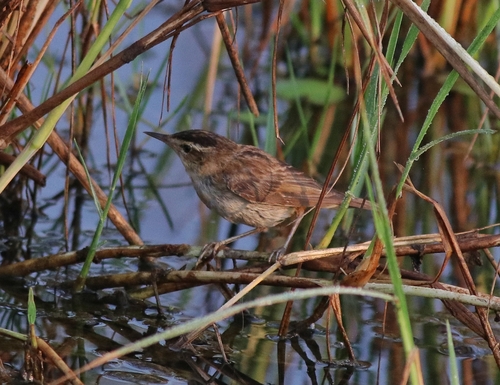 Sedge Warbler
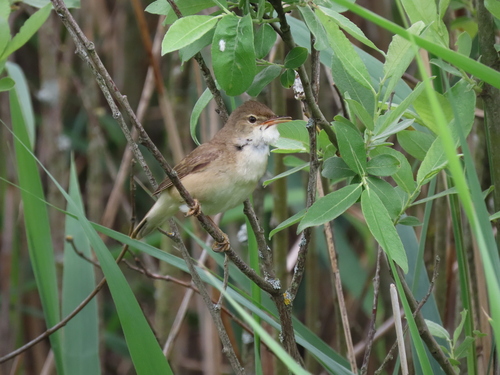 Common Reed Warbler
In short
The most reliable field mark to separate Sedge Warbler from Common Reed Warbler is the presence of bold dark streaking on the back and crown of Sedge Warbler, along with a prominent pale supercilium, versus the plainer, unstreaked upperparts and less distinct supercilium of Common Reed Warbler. Juvenile Sedge Warblers also show dark spots on the breast, which are absent in Common Reed Warbler. Both species are similar in size and shape, but Sedge Warbler often appears more contrasting and 'busy' above, especially in fresh plumage or among juveniles. In flight or at rest, focus on the pattern of the upperparts and the strength of the supercilium for the quickest separation.
Identification tips
- Back and crown streaking (all ages): Sedge Warbler always shows bold, dark streaks on the back and crown, while Common Reed Warbler is plain brown above with no streaking. This is the single most reliable field mark.
- Supercilium (all ages): Sedge Warbler has a prominent, whitish supercilium that stands out against the face, especially in fresh plumage. Common Reed Warbler's supercilium is weaker and less contrasting.
- Juvenile breast spots: Juvenile Sedge Warblers have dark spots on the breast, which are never present in Common Reed Warbler of any age. If you see these spots, it's a Sedge Warbler.
- Crown pattern: Sedge Warbler can show a pale central crown stripe, especially in juveniles, bordered by darker edges. Common Reed Warbler's crown is plain and lacks this contrast.
- Rump color: Sedge Warbler has a warm brown, unstreaked rump that can contrast with the duller wings. Reed Warbler's rump is not notably different from its back.
- Facial contrast: The Sedge Warbler's face looks more 'masked' and patterned due to the strong supercilium and streaked crown; Reed Warbler's face is plainer and less defined.
- Underparts: Both are pale below, but juvenile Reed Warblers can be a richer buff, while Sedge Warbler juveniles may appear paler with spots.
- Song-flights: If you see a warbler rising and parachuting down with wings in a 'V' while singing, it's likely a Sedge Warbler. Reed Warbler rarely does this.
- Song: Listen for a rapid, chattering, and unpredictable song with mimicry for Sedge Warbler; a slower, rhythmic, and less varied chattering for Reed Warbler.
- Alarm calls: Sedge Warbler gives a rattling 'chirr' or 'kerr' call; Reed Warbler's calls are less distinctive but not as rattling.
- Habitat preference: Sedge Warbler may be found in bushier or more varied wetland edges, while Reed Warbler prefers dense, pure reedbeds. However, overlap is common.
- Bill and leg color: Both have strong, pointed bills and greyish legs; these are not useful for separation.
- Size and structure: Both are very similar in size and shape; do not rely on this in the field.
- Seasonal context: Both are migratory in Europe and winter in Africa. Timing and location alone do not reliably separate them.
- Sex and age: Both sexes look alike in both species; only age-related marks (like juvenile breast spots in Sedge Warbler) are useful. Sex cannot be determined in the field except by breeding condition.
Size
Both species are medium-sized Acrocephalus warblers and are very close in size, with Common Reed Warbler at about 13 cm in length and 12 g in mass [wikidata], and Sedge Warbler at 11.5–13 cm and around 12 g [wikipedia]. In the field, size is not a reliable separator. Structure—such as bill shape and wing length—are similar and not diagnostic between these two.
Plumage
- Juveniles: Sedge Warbler juveniles have dark spots on the breast and a pale central crown stripe, which can make them look even more streaked and contrasty above. Common Reed Warbler juveniles are richer buff below but lack the breast spots and crown streaking, appearing plainer overall.
- Adults: Sedge Warbler adults have a streaked brown back and crown, a warm brown unstreaked rump, and a strong pale supercilium. Common Reed Warbler adults have an unstreaked brown back and crown, buff underparts, and a less prominent supercilium. Both have flattened foreheads and strong, pointed bills, but the Sedge Warbler's facial pattern is more striking.
- Wings in flight: No distinctive upperwing or flight pattern is described for either species in these notes, so separation in flight relies on overall upperpart contrast and head pattern rather than wing panels or edges.
Behaviour
Both species are often seen clambering in reeds and low vegetation. Sedge Warbler males are notable for their song-flights, where they rise above the reeds and parachute down with wings held in a 'V', often singing. This behavior is less typical of Common Reed Warbler, which tends to sing from cover or a low perch. Both species forage for insects and occasionally berries, but their foraging style is broadly similar.
Habitat
Both species breed in wetland habitats with reeds and tall vegetation. Sedge Warbler is often found in slightly more varied and bushy wetland edges, while Common Reed Warbler is more strictly associated with extensive reedbeds. However, there is significant overlap, and habitat alone is not a reliable separator where both occur.
Voice
Sedge Warbler's song is a fast, varied, and chattering mix of phrases, often including mimicry and delivered both from perches and in flight. Its contact and alarm calls are rattling 'chirr' or 'kerr' notes. Common Reed Warbler's song is slower, more rhythmic, and less varied, described as a chattering 'jit-jit-jit' with some whistles and mimicry. In the field, Sedge Warbler's song is more frenetic and unpredictable, while Common Reed Warbler is steadier and less showy.