

Black-legged Kittiwake vs Black-headed Gull
Rissa tridactyla versus Chroicocephalus ridibundus
Play a quiz with Black-legged Kittiwake and Black-headed Gull
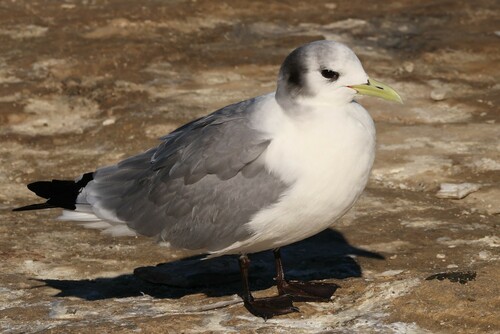 Black-legged Kittiwake
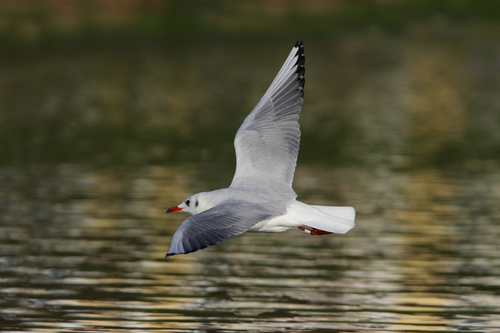 Black-headed Gull
In short
The most reliable field mark to separate Black-legged Kittiwake from Black-headed Gull, especially in juvenile and first-winter birds, is the upperwing pattern in flight: juvenile kittiwakes show a bold black 'W' across the wings, while juvenile black-headed gulls have a brown carpal bar and lack the 'W'. Adults are best separated by leg and bill color—kittiwakes have black legs and yellow bills, while black-headed gulls have red legs and bills in breeding plumage. In winter, kittiwakes show a dusky smudge behind the eye and a pale bill, while black-headed gulls lose their dark hood, retaining only two small dark spots on the head. Kittiwakes are strictly pelagic and rarely seen inland, while black-headed gulls are common in freshwater and urban habitats. Size is not a strong field mark due to overlap, but kittiwakes are slightly heavier and more robust.
Identification tips
- Juvenile/first-winter upperwing pattern: Juvenile kittiwakes show a bold black 'W' across the upperwing in flight, with white panels behind it—this is the single best separator from black-headed gull at this age. Juvenile black-headed gulls have a brown carpal bar and lack the 'W'.
- Tail pattern in juveniles: Both species have a black tail band as juveniles, but kittiwake's is combined with the 'W' and a black hind-neck collar, while black-headed gulls have a more mottled brown body and no collar.
- Bill color by age: Juvenile kittiwakes have a solid black bill, turning greenish in the second year, then yellow by adulthood. Black-headed gulls have a dark bill as juveniles, but it becomes red by adulthood.
- Leg color: Adult kittiwakes have black legs (rarely pinkish), while black-headed gulls have red legs in all adult plumages. Juvenile black-headed gulls have duller legs, but never truly black.
- Adult head pattern (breeding): Kittiwakes always have a white head; black-headed gulls have a chocolate-brown (not truly black) hood in summer.
- Adult head pattern (non-breeding): Kittiwakes show a grey smudge behind the eye and a faint hind-neck collar; black-headed gulls lose the hood and show two small dark spots on the head.
- Wingtip pattern (adult): Kittiwakes have solid black wingtips with no white mirrors; black-headed gulls have black tips but with a white leading edge on the outer wing, visible in flight.
- Bill color (adult): Kittiwake's bill is yellow (dull olive in winter); black-headed gull's is red in adults, dark in juveniles.
- Leg color (adult): Kittiwake's legs are black; black-headed gull's are red (never black).
- Habitat: Kittiwakes are marine and rarely seen inland; black-headed gulls are common inland and in urban areas.
- Flight style: Kittiwakes have a more buoyant, tern-like flight; black-headed gulls are more agile and often seen wheeling over fields and water.
- Voice: Kittiwake gives a shrill 'kittee-wa-aaake' call; black-headed gull gives harsh 'kree-ar' calls.
- Moult sequence: Kittiwake's moult is protracted, with partial head/body moult in spring; black-headed gulls have a more typical gull moult, with hood developing in spring.
- Structure: Kittiwakes have a shorter bill and smaller head compared to black-headed gulls, but this is subtle and best used in combination with other marks.
- Sexes: Both species are similar between sexes; do not use sex as a separator.
Size
Black-legged Kittiwake is somewhat heavier (average body mass 418 g) than Black-headed Gull (average 280.5 g), but their lengths and wingspans overlap considerably. In the field, this difference is subtle and not always apparent, especially at a distance or in flight. Kittiwakes may appear slightly chunkier and more compact, while black-headed gulls can look slimmer and longer-winged. Use size only as a supporting clue, not a primary separator.
Plumage
Juvenile/first-winter: Juvenile kittiwakes (up to 2nd year) show a distinctive, bold black 'W' pattern across the upperwings in flight, with white secondaries and primaries behind the 'W', a black hind-neck collar, and a black terminal tail band. Their bills are solid black in the first year, turning greenish in the second year. Juvenile black-headed gulls have a brown mottled pattern on the body, a brown carpal bar on the inner wing, blackish secondaries, and a black tail band, but lack the 'W'—their upperwing is more muted and patchy. First-winter black-headed gulls retain the brown carpal bar and black tail band, with a grey back developing.
Adults: Adult kittiwakes have a clean white head and body, pale grey back, solid black wingtips (no white mirrors), black legs, and a yellow bill. In winter, they show a grey smudge behind the eye and a faint grey hind-neck collar, with the bill turning dusky-olive. Adult black-headed gulls in summer have a chocolate-brown hood (appearing black at a distance), red bill and legs, pale grey wings with black tips, and a white leading edge to the outer wing. In winter, the hood is lost, leaving two small dark spots on the head, and the bill/legs remain reddish. Second-winter black-headed gulls are like adults but may retain some brown on the wings/tail. Kittiwakes never show a hood or red on the bill/legs.
Behaviour
Kittiwakes are strictly pelagic, rarely coming inland except to breed on sea cliffs. They are almost never seen loafing on freshwater or in urban areas. In flight, kittiwakes have a more buoyant, tern-like flight with less head-bobbing and more direct gliding. Black-headed gulls are highly gregarious, often found in large flocks on lakes, rivers, fields, and even city parks. They show both head-bobbing and non-bobbing walking, and are much more likely to be seen scavenging or foraging inland. Their flight is more agile and often includes quick changes of direction.
Habitat
Black-legged Kittiwake is a marine specialist, almost always found at sea or on coastal cliffs during breeding. Away from breeding colonies, it is rarely seen inland or on freshwater. Black-headed Gull is common in a wide variety of habitats, including lakes, rivers, marshes, farmland, and urban parks, as well as coastal areas. If you see a small gull inland or in a city, it is almost certainly a black-headed gull, not a kittiwake.
Voice
Kittiwake has a shrill, repeated 'kittee-wa-aaake' call, which is distinctive and gives the species its name. Black-headed Gull has a more varied repertoire, including harsh 'kree-ar' and 'kreee' calls, but does not give the kittiwake's namesake call. In mixed flocks, the kittiwake's call stands out as higher-pitched and more piercing.
Black-legged Kittiwake · Black-headed Gull · My Tricky Birds