

crowned hornbill vs southern red-billed hornbill
Lophoceros alboterminatus versus Tockus rufirostris
Jogue um quiz com crowned hornbill e southern red-billed hornbill
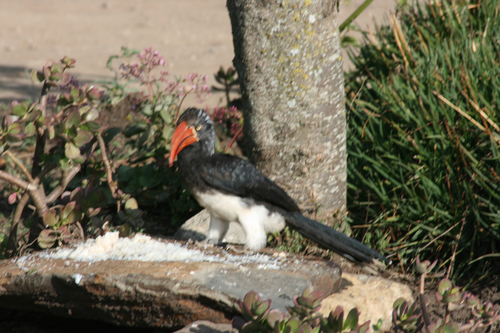 crowned hornbill
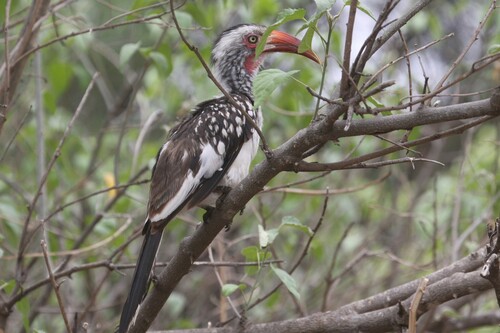 southern red-billed hornbill
Em resumo
A marca de campo mais confiável para separar o crowned hornbill do southern red-billed hornbill é a combinação de plumagem geral e estrutura do bico: o crowned hornbill é maior, com um bico vermelho robusto coberto por um casque proeminente (menor nas fêmeas), uma barriga branca, costas e asas pretas, e uma cauda longa com pontas brancas. O southern red-billed hornbill é menor, com um bico vermelho mais fino (mandíbula inferior parcialmente preta nos machos), olhos amarelos, pele orbital pálida e listras negras distintas a partir das coberturas auriculares descendo pelo pescoço, além de coberturas de asas manchadas. Padrões de asas específicos para juvenis ou imaturos não são descritos para nenhuma das espécies, então concentre-se nessas características de adultos. O habitat também pode ajudar: o crowned hornbill prefere áreas florestais, enquanto o southern red-billed hornbill é um pássaro de savanas abertas e matas.
Dicas de identificação
- Estrutura e cor do bico: O crowned hornbill tem um bico grosso e vermelho com um casque proeminente na mandíbula superior (menor nas fêmeas), dando-lhe uma aparência pesada e arqueada. O bico do southern red-billed hornbill é mais fino, não possui um casque proeminente e, nos machos, a mandíbula inferior é parcialmente preta.
- Padrão da cauda: A longa cauda do crowned hornbill tem pontas brancas óbvias, visíveis tanto empoleirado quanto em voo. A cauda do southern red-billed hornbill não possui essas pontas brancas e parece mais simples.
- Contraste da plumagem: O crowned hornbill apresenta um contraste acentuado entre suas costas/asas pretas e a barriga branca. O southern red-billed hornbill é mais pálido no geral, com uma garganta branca e partes inferiores pálidas, mas com listras negras descendo pelo pescoço e coberturas de asas manchadas.
- Padrão do pescoço e rosto: O southern red-billed hornbill tem listras negras a partir das coberturas auriculares descendo pelo lado do pescoço, e um anel orbital pálido (rosa a acinzentado) ao redor do olho amarelo. O crowned hornbill não possui essas listras e tem um padrão de cabeça mais uniforme.
- Cor dos olhos: Ambas as espécies têm olhos amarelos, mas a pele orbital pálida do southern red-billed hornbill é distintiva em close.
- Coberturas de asas: O southern red-billed hornbill tem coberturas de asas claramente manchadas, uma característica não presente no crowned hornbill.
- Tamanho e volume: O crowned hornbill é maior e mais pesado, com uma construção mais robusta e cauda mais longa. O southern red-billed hornbill é noticeably menor e mais esguio.
- Habitat: O crowned hornbill é encontrado em florestas (especialmente costeiras e ribeirinhas), enquanto o southern red-billed hornbill prefere savanas abertas e matas. O habitat sozinho pode ser uma pista forte.
- Comportamento: O crowned hornbill é mais arbóreo, frequentemente forrageando alto nas árvores e às vezes em bandos. O southern red-billed hornbill é mais terrestre, frequentemente visto caminhando no chão ou se movendo através da vegetação baixa.
- Dimorfismo sexual: No crowned hornbill, as fêmeas têm um casque menor, mas de outra forma os sexos são semelhantes. No southern red-billed hornbill, os machos são maiores com um bico mais longo e mais preto na mandíbula inferior.
- Vocalizações: Se você ouvir um 'kuk kuk kuk...' acelerado terminando em 'kuk-we kuk-we,' é o southern red-billed hornbill. O chamado do crowned hornbill não é descrito aqui.
- Exibição: O southern red-billed hornbill não levanta suas asas na exibição, ao contrário de alguns outros hornbills de bico vermelho. Isso não é uma separação do crowned, mas pode ajudar a evitar confusão com outras espécies.
- Tamanho do bando: O crowned hornbill pode ser visto em bandos maiores, especialmente na estação seca, enquanto o southern red-billed hornbill é mais frequentemente encontrado em pares ou pequenos grupos.
- Sobreposição geográfica: Ambas as espécies podem ocorrer em partes do sul da África, mas o crowned hornbill é mais restrito às florestas costeiras e ribeirinhas do leste, enquanto o southern red-billed é amplamente distribuído em habitats abertos e mais secos.
- Confusão juvenil/imatura: Nenhum padrão de asa juvenil ou imaturo distinto é descrito para nenhuma das espécies, então confie nas características estruturais e de plumagem acima em todas as idades.
Tamanho
O crowned hornbill é significativamente mais pesado, com uma massa corporal média de 224,5g [wikidata], e é descrito como de tamanho médio (50–54 cm de comprimento) [wikipedia]. O southern red-billed hornbill é menor e mais leve; enquanto nenhuma massa precisa é dada, é consistentemente notado como menor e mais esguio que o crowned hornbill. No campo, o crowned hornbill parecerá mais volumoso e com cauda mais longa, com uma presença mais imponente, especialmente quando empoleirado.
Plumagem
-
Padrões de asas juvenis/imaturos: Nenhum padrão de asa ou marca de voo específico para idade é descrito para nenhuma das espécies nas notas fornecidas. Concentre-se na plumagem adulta para separação.
-
Crowned Hornbill (adulto): Costas e asas pretas, barriga branca, cauda longa com pontas brancas. O bico é vermelho com um casque proeminente na mandíbula superior (menor nas fêmeas). Os olhos são amarelos. No geral, o pássaro parece escuro acima e pálido abaixo, com um forte contraste de cor entre as partes superiores pretas e as partes inferiores brancas.
-
Southern Red-billed Hornbill (adulto): Garganta branca, partes inferiores pálidas, mas com listras negras abundantes descendo a partir das coberturas auriculares pelo lado do pescoço. As coberturas de asas são claramente manchadas. O bico é vermelho (mandíbula inferior parcialmente preta nos machos), e a íris é amarela com um anel orbital pálido (rosa a acinzentado). As costas não são descritas como solidamente pretas, e a cauda não possui as pontas brancas proeminentes do crowned hornbill. A impressão geral é mais pálida e mais padronizada, especialmente no pescoço e nas asas.
Comportamento
O crowned hornbill forrageia principalmente em árvores, frequentemente em bandos durante a estação seca, e é mais arbóreo em seus hábitos. O southern red-billed hornbill é tipicamente visto em áreas abertas, frequentemente caminhando no chão ou se movendo através de arbustos e árvores baixas. Ele não exibe levantando suas asas, ao contrário de alguns outros hornbills de bico vermelho. Ambas as espécies podem ser vistas em pares ou pequenos grupos, mas o crowned hornbill é mais provável de ser observado no dossel, enquanto o southern red-billed hornbill é mais terrestre e conspícuo em habitats abertos.
Habitat
O crowned hornbill é residente de florestas costeiras e ribeirinhas no sul a nordeste da África, favorecendo ambientes densos e arborizados. Em contraste, o southern red-billed hornbill é nativo de savanas e matas secas em toda a África do Sul, e geralmente está ausente de florestas densas e das baixadas orientais de Moçambique. Se você encontrar um hornbill em uma floresta densa, é muito mais provável que seja o crowned; em matas abertas ou savanas, espera-se o southern red-billed.
Voz
O southern red-billed hornbill tem um chamado distinto: uma série acelerada de notas 'kuk kuk kuk...' terminando em um crescendo de notas duplas, 'kuk-we kuk-we.' As vocalizações do crowned hornbill não são descritas nas notas fornecidas, então a voz é apenas diagnóstica se você ouvir o chamado descrito do southern red-billed.
crowned hornbill · southern red-billed hornbill · Minhas aves difíceis