

カンムリコサイチョウ 対 ミナミアカハシコサイチョウ
Lophoceros alboterminatus 対 Tockus rufirostris
カンムリコサイチョウとミナミアカハシコサイチョウのクイズ
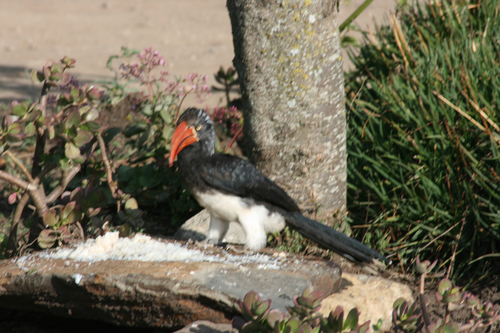 カンムリコサイチョウ
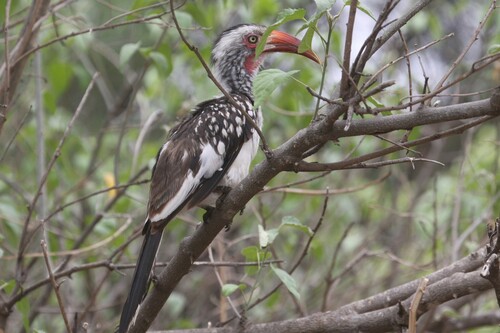 ミナミアカハシコサイチョウ
要点
The most reliable field mark to separate Crowned Hornbill from Southern Red-billed Hornbill is the combination of overall plumage and bill structure: Crowned Hornbill is larger, with a robust red bill topped by a prominent casque (smaller in females), a white belly, black back and wings, and a long tail with white tips. Southern Red-billed Hornbill is smaller, with a slimmer red bill (lower mandible partly black in males), yellow eyes, pale orbital skin, and distinctive blackish streaking from the ear coverts down the neck, plus spotted wing coverts. Juvenile or immature-specific upperwing patterns are not described for either species, so focus on these adult features. Habitat can also help: Crowned Hornbill prefers forested areas, while Southern Red-billed Hornbill is a bird of open savanna and bushland.
識別のコツ
- Bill structure and color: Crowned Hornbill has a thick, red bill with a prominent casque on the upper mandible (smaller in females), giving it a heavy, arched look. Southern Red-billed Hornbill's bill is slimmer, lacks a prominent casque, and in males, the lower mandible is partly black.
- Tail pattern: Crowned Hornbill's long tail has obvious white tips, visible both perched and in flight. Southern Red-billed Hornbill's tail lacks these white tips and appears plainer.
- Plumage contrast: Crowned Hornbill shows a sharp contrast between its black back/wings and white belly. Southern Red-billed Hornbill is paler overall, with a white throat and underparts, but with blackish streaking down the neck and spotted wing coverts.
- Neck and face pattern: Southern Red-billed Hornbill has blackish streaking from the ear coverts down the side of the neck, and a pale (pink to greyish) orbital ring around the yellow eye. Crowned Hornbill lacks these streaks and has a more uniform head pattern.
- Eye color: Both species have yellow eyes, but Southern Red-billed Hornbill's pale orbital skin is distinctive at close range.
- Wing coverts: Southern Red-billed Hornbill has clearly spotted wing coverts, a feature not present in Crowned Hornbill.
- Size and bulk: Crowned Hornbill is larger and heavier, with a more robust build and longer tail. Southern Red-billed Hornbill is noticeably smaller and more slender.
- Habitat: Crowned Hornbill is found in forests (especially coastal and riverine), while Southern Red-billed Hornbill prefers open savanna and bushland. Habitat alone can be a strong clue.
- Behavior: Crowned Hornbill is more arboreal, often foraging high in trees and sometimes in flocks. Southern Red-billed Hornbill is more terrestrial, often seen walking on the ground or moving through low vegetation.
- Sexual dimorphism: In Crowned Hornbill, females have a smaller casque, but otherwise sexes are similar. In Southern Red-billed Hornbill, males are larger with a longer bill and more black on the lower mandible.
- Vocalizations: If you hear an accelerating 'kuk kuk kuk...' ending in 'kuk-we kuk-we,' it's Southern Red-billed Hornbill. Crowned Hornbill's call is not described here.
- Display: Southern Red-billed Hornbill does not raise its wings in display, unlike some other red-billed hornbills. This is not a separation from Crowned, but can help avoid confusion with other species.
- Flock size: Crowned Hornbill may be seen in larger flocks, especially in the dry season, whereas Southern Red-billed Hornbill is more often in pairs or small groups.
- Geographic overlap: Both species can occur in parts of southern Africa, but Crowned Hornbill is more restricted to the eastern coastal and riverine forests, while Southern Red-billed is widespread in drier, open habitats.
- Juvenile/immature confusion: No distinctive juvenile or immature wing patterns are described for either species, so rely on the above structural and plumage features at all ages.
大きさ
Crowned Hornbill is significantly heavier, with an average body mass of 224.5g [wikidata], and is described as medium-sized (50–54 cm in length) [wikipedia]. Southern Red-billed Hornbill is smaller and lighter; while no precise mass is given, it is consistently noted as smaller and more slender than Crowned Hornbill. In the field, Crowned Hornbill will look bulkier and longer-tailed, with a more imposing presence, especially when perched.
羽色
-
Juvenile/immature wing patterns: No distinctive age-specific upperwing or flight marks are described for either species in the provided notes. Focus on adult plumage for separation.
-
Crowned Hornbill (adult): Black back and wings, white belly, long tail with white tips. The bill is red with a prominent casque on the upper mandible (smaller in females). Eyes are yellow. Overall, the bird looks dark above and pale below, with a strong color contrast between the black upperparts and white underparts.
-
Southern Red-billed Hornbill (adult): White throat, pale underparts, but with ample blackish streaking running from the ear coverts down the side of the neck. The wing coverts are clearly spotted. The bill is red (lower mandible partly black in males), and the iris is yellow with a pale (pink to greyish) orbital ring. The back is not described as solidly black, and the tail lacks the prominent white tips of Crowned Hornbill. The overall impression is paler and more patterned, especially on the neck and wings.
行動
Crowned Hornbill forages mainly in trees, often in flocks during the dry season, and is more arboreal in its habits. Southern Red-billed Hornbill is typically seen in open country, often walking on the ground or moving through bushes and low trees. It does not display by raising its wings, unlike some other red-billed hornbills. Both species may be seen in pairs or small groups, but Crowned Hornbill is more likely to be observed in the canopy, while Southern Red-billed Hornbill is more terrestrial and conspicuous in open habitats.
生息環境
Crowned Hornbill is a resident of coastal and riverine forests in southern to northeastern Africa, favoring dense, wooded environments. In contrast, Southern Red-billed Hornbill is native to savannas and dry bushlands across southern Africa, and is generally absent from dense forests and the eastern lowlands of Mozambique. If you encounter a hornbill in thick forest, it is much more likely to be Crowned; in open bush or savanna, Southern Red-billed is expected.
声
Southern Red-billed Hornbill has a distinctive call: an accelerating series of 'kuk kuk kuk...' notes ending in a crescendo of double notes, 'kuk-we kuk-we.' Crowned Hornbill's vocalizations are not described in the provided notes, so voice is only diagnostic if you hear the Southern Red-billed's described call.