

band-tailed barbthroat vs long-billed hermit
Threnetes ruckeri versus Phaethornis longirostris
Jogue um quiz com band-tailed barbthroat e long-billed hermit
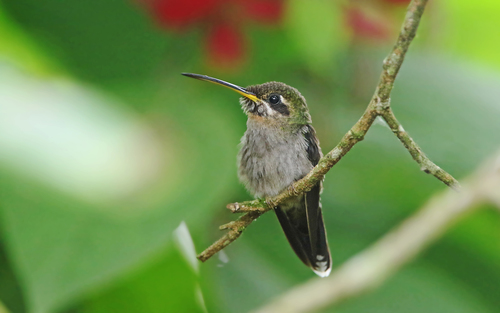 band-tailed barbthroat
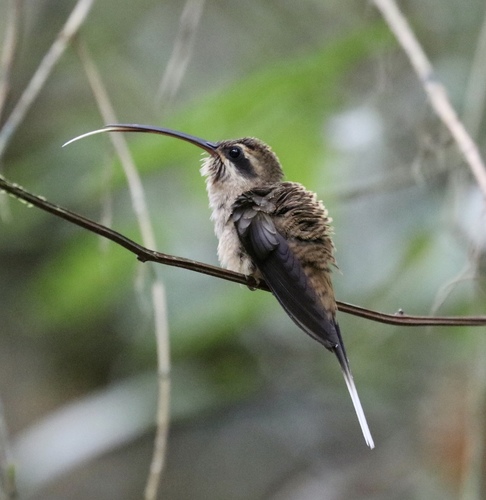 long-billed hermit
Em resumo
A marca de campo mais confiável para separar o band-tailed barbthroat do long-billed hermit é a cauda: o band-tailed barbthroat apresenta uma cauda escura com bases e pontas brancas ousadas formando uma distinta 'banda' preta perto da extremidade, enquanto o long-billed hermit tem penas centrais da cauda longas com pontas brancas proeminentes, mas não possui o efeito de bandas. A forma do bico também é fundamental: o band-tailed barbthroat tem um bico quase reto (ligeiramente curvado para baixo nas fêmeas), enquanto o long-billed hermit possui um bico muito mais longo e fortemente curvado para baixo. Em vistas empoleiradas ou em voo, note a mancha de garganta ocrácea do barbthroat e a aparência mais compacta e de bico reto em comparação com a longa cauda pendente do hermit e a aparência geral mais esguia. Ambas as espécies se alimentam em linhas de armadilha em habitats semelhantes, mas sua estrutura e padrões de cauda são as pistas de campo mais consistentes.
Dicas de identificação
- Padrão da cauda (todas as idades): O band-tailed barbthroat sempre mostra uma cauda escura com bases e pontas brancas ousadas, formando uma nítida 'banda' preta perto da extremidade—procure por isso em vistas empoleiradas e em voo com cauda aberta. O long-billed hermit não possui essa banda; em vez disso, tem penas centrais da cauda longas com grandes pontas brancas e menos contraste no restante da cauda.
- Forma e comprimento da cauda: O long-billed hermit tem penas centrais da cauda muito longas e pendentes que se estendem bem além do restante da cauda, dando uma aparência de 'remador' ou 'bandeira', especialmente óbvio quando empoleirado ou exibindo. A cauda do band-tailed barbthroat é mais curta, mais quadrada e não possui penas centrais alongadas.
- Forma do bico: O band-tailed barbthroat tem um bico quase reto (ligeiramente mais curvado para baixo nas fêmeas), enquanto o bico do long-billed hermit é muito mais longo e fortemente curvado para baixo, frequentemente parecendo desproporcionalmente grande para a cabeça. Esta é uma das diferenças estruturais mais confiáveis em campo.
- Mancha de garganta: O band-tailed barbthroat apresenta uma mancha de garganta ocrácea a laranja (varia por subespécie), que se destaca contra as partes inferiores cinzentas. O long-billed hermit não possui uma mancha de garganta discreta; suas partes inferiores são marrons a cinzentas, às vezes com um tom ocráceo, mas nunca uma mancha bem definida.
- Mancha da orelha e faixa malar: O band-tailed barbthroat tem uma mancha de orelha escura e uma faixa malar escura, adicionando contraste facial. O long-billed hermit não possui essas características, apresentando um rosto mais uniforme.
- Partes superiores: Ambas são esverdeadas, mas o barbthroat é mais verde bronzeado, enquanto o hermit pode parecer mais opaco ou verde metálico, dependendo da subespécie.
- Marcas juvenis: Os jovens barbthroats têm bordas de penas ocráceas, mas mantêm o padrão de cauda bandada; os juvenis do hermit não apresentam marcas únicas que ajudem na separação.
- Tamanho e aparência: O long-billed hermit é mais longo e esguio, com uma aparência esticada devido ao seu bico e cauda. O barbthroat é mais compacto e proporcional.
- Postura empoleirada: O hermit frequentemente se empoleira com sua longa cauda pendente conspicuamente abaixo do poleiro; a cauda do barbthroat é mais curta e menos óbvia.
- Estilo de voo: Ambas são ágeis, mas a longa cauda e o bico do hermit fazem seu voo parecer mais desajeitado e 'arrastado' em comparação com o voo mais limpo e direto do barbthroat.
- Vocalizações: Ouça as frases rápidas e complexas do barbthroat com trilos (especialmente na Costa Rica do Pacífico) em comparação com a série monótona e ascendente de notas 'sweeup' ou 'tchee' do hermit. Os chamados também são distintos: o agudo 'week!' ou o fino 'seep' do hermit é diferente da canção do barbthroat.
- Comportamento de lek: Se você vir machos exibindo em grupo com movimentos de cauda e uso agressivo do bico, é o hermit; o barbthroat não faz lek.
- Sobreposição de habitat: Ambas podem ocorrer nos mesmos habitats e elevações, então não confie apenas no contexto.
- Diferenças sexuais: Ambos os sexos são semelhantes em plumagem, mas a fêmea do barbthroat tem um bico ligeiramente mais curvado para baixo; a fêmea do hermit tem um bico mais curto e mais curvado do que o macho do hermit, mas ambos os sexos apresentam a forma longa e curvada para baixo.
- Variação entre subespécies: A mancha de garganta do barbthroat é a maior e mais brilhante laranja em T. r. ventosus; as subespécies do hermit variam na cor das partes inferiores e no comprimento da cauda, mas nenhuma desenvolve a cauda bandada do barbthroat.
Tamanho
O long-billed hermit é notavelmente maior e mais longo em geral (13–16 cm) em comparação com o band-tailed barbthroat (10–11 cm). Apesar disso, suas massas se sobrepõem (barbthroat: 5–7 g; hermit: 4–7,5 g), mas o maior comprimento do hermit se deve principalmente ao seu bico alongado e especialmente às suas longas penas centrais da cauda. Em campo, o hermit parece mais esguio e esticado, enquanto o barbthroat é mais compacto e proporcional.
Plumagem
Os juvenis e adultos do band-tailed barbthroat de todas as subespécies mostram uma cauda escura com bases e pontas brancas largas, criando uma nítida banda preta perto da extremidade—isso é visível em vistas empoleiradas e em voo com cauda aberta. Os jovens têm bordas de penas ocráceas, mas mantêm o padrão de cauda bandada. A mancha de garganta varia por subespécie, mas é sempre ocrácea a laranja e contrasta com as partes inferiores cinzentas. Em contraste, o long-billed hermit (todas as idades) tem longas penas centrais da cauda com grandes pontas brancas, mas não possui um efeito de bandas; o restante da cauda é menos contrastante, e as coberturas da cauda superior têm bandas escuras e ocráceas. As partes inferiores do hermit são marrons a cinzentas, às vezes ocráceas em aves do sul, mas nunca tão marcadas quanto a mancha de garganta do barbthroat. Ambas as espécies têm partes superiores esverdeadas, mas apenas o barbthroat apresenta uma distinta mancha de orelha escura e faixa malar.
Comportamento
Ambas as espécies são alimentadoras clássicas de 'linha de armadilha', movendo-se por circuitos de flores em busca de néctar e pequenos artrópodes. No entanto, os machos do long-billed hermit se reúnem em leks durante a temporada de reprodução, onde cantam e exibem suas longas caudas, um comportamento não descrito para o band-tailed barbthroat. Ambas constroem ninhos sob folhas pendentes, mas apenas o hermit é notado por fazer lek comunitário e uso agressivo do bico entre os machos.
Habitat
Ambas as espécies habitam o sub-bosque e as bordas de florestas úmidas, crescimento secundário antigo e áreas semi-abertas, frequentemente em elevações semelhantes (nível do mar até ~1.200 m para o barbthroat, até 1.500 m ou mais para o hermit, dependendo da região). Seus intervalos se sobrepõem na América Central e na Colômbia/Ecuador ocidental, então o habitat sozinho não é diagnóstico. O hermit pode ser encontrado em uma gama ligeiramente mais ampla de tipos de floresta, incluindo florestas de nuvens e florestas de galeria.
Voz
O band-tailed barbthroat emite uma frase rápida e aguda de 5–10 notas, repetida com pausas (por exemplo, 'tzi-tzi-tsee-ee-tsi-tzi-tzi'), com aves da encosta do Pacífico na Costa Rica adicionando trilos. O long-billed hermit canta uma série contínua de notas únicas, penetrantes e ascendentes 'sweeup', ou, em algumas regiões, um 'tchee..tchee..tchee..' semelhante a um pardal. Os chamados do hermit são agudos e explosivos ('week!' ou fino 'seep'), frequentemente emitidos em voo. A canção do barbthroat é mais complexa e variável, enquanto a do hermit é mais monótona e penetrante.
band-tailed barbthroat · long-billed hermit · Minhas aves difíceis