

Steppehoen vs Roodbuikzandhoen
Syrrhaptes paradoxus versus Pterocles exustus
Speel een quiz met Steppehoen en Roodbuikzandhoen
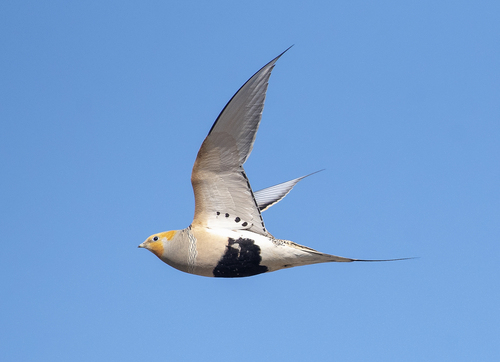 Steppehoen
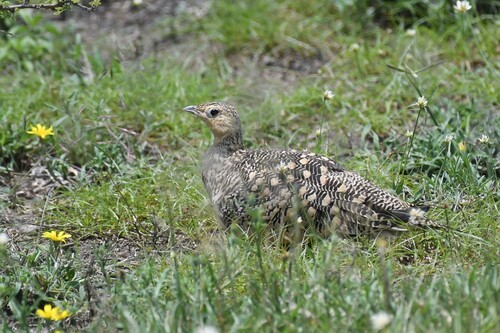 Roodbuikzandhoen
Kort gezegd
The most reliable separation between Pallas's Sandgrouse and Chestnut-bellied Sandgrouse is the combination of underwing and belly pattern in flight: Pallas's shows a strikingly pale underwing and a solid black belly patch, while Chestnut-bellied has a darker, chocolate or chestnut belly but less contrasty underwings. On the ground, Pallas's is bulkier with a compact, pigeon-like build and feathered legs and toes, whereas Chestnut-bellied appears more slender, with a longer neck and tail. Sex and age differences are subtle but can help: male Pallas's has a grey head and orange face, while male Chestnut-bellied shows a yellow-ochre face and a narrow black breast band. Females of both are duller and more barred, but Pallas's female lacks the breast band entirely. Both species can be seen in large flocks, but their preferred habitats and range rarely overlap.
Herkenningstips
- In flight, look for the underwing: Pallas's Sandgrouse always shows a pale underwing and a solid black belly patch, regardless of age or sex. Chestnut-bellied lacks this contrast and has a darker, less sharply defined underwing.
- Belly color in flight: Pallas's has a black belly patch; Chestnut-bellied shows a chocolate or chestnut belly, with males having a black center to the abdomen but not a clean patch.
- Overall shape: Pallas's is bulkier and more compact, with a pigeon-like head and neck, and a sturdy body. Chestnut-bellied is more slender, with a longer neck and tail, and appears more upright when alert.
- Legs and feet: Pallas's has feathered legs and toes, giving a paw-like appearance; Chestnut-bellied's legs are short and less feathered, not forming a paw-like structure.
- Tail: Both have pointed tails, but Chestnut-bellied's is more elongated and accentuates its slender look, especially in flight.
- Male head and breast: Male Pallas's has a grey head and breast with an orange face and a grey breast band. Male Chestnut-bellied has a yellow-ochre face and throat, a vinous-buff upper breast, and a narrow black breast band bordered with white.
- Female plumage: Female Pallas's is duller, lacks the breast band, and is more heavily barred above. Female Chestnut-bellied is buffy and streaked/barred, especially on the underparts and back of the neck, with a vinous breast and black spots.
- Ground jizz: Pallas's looks compact and pigeon-like, often with a hunched posture. Chestnut-bellied appears more upright, with a stretched neck when wary.
- Flock behavior: Both species may form large flocks, but Pallas's is especially known for huge, fast-flying groups covering long distances to water.
- Habitat context: If seen in Eurasian steppe or during an irruption in Europe, Pallas's is more likely. In African or Indian arid zones, Chestnut-bellied is the default.
- Subspecies variation (Chestnut-bellied): Some subspecies are greyer or paler, but none show the pale underwing and black belly patch of Pallas's.
- Breast band (sexing): Only male Pallas's has a grey breast band; male Chestnut-bellied has a narrow black breast band bordered with white, and females of both lack a clear breast band.
- Face color: Orange face in male Pallas's vs yellow-ochre face in male Chestnut-bellied.
- Upperpart barring: Female Pallas's is more barred above; Chestnut-bellied females have streaked or barred backs and necks, but pattern is less bold than Pallas's.
- When in doubt, rely on flight views: The underwing and belly pattern are the most consistent and reliable marks for all ages and sexes.
Grootte
Direct size comparison is limited by available data, but Pallas's Sandgrouse is generally the larger and more robust species, with a body length of 30–41 cm and a notably sturdy, compact build. Chestnut-bellied Sandgrouse is smaller and lighter (adult mass ~210 g [wikidata]), with a more elongated and slender appearance, especially noticeable in the longer tail and neck. In the field, Pallas's often looks chunkier and more pigeon-like, while Chestnut-bellied is sleeker and more upright when alert.
Verenkleed
- In flight (all ages): Pallas's Sandgrouse shows a pale underwing and a bold black belly patch, which is the single most diagnostic mark. Chestnut-bellied Sandgrouse has a chocolate or chestnut belly (with a black center in males), but the underwing is less contrasting and lacks the clean pale look of Pallas's.
- Adult males: Pallas's has a grey head and breast, orange face, and a grey breast band. Chestnut-bellied males have a yellow-ochre face and throat, vinous-buff upper breast, and a narrow black breast band bordered with white; their lower breast grades into chocolate, with a black center to the abdomen.
- Adult females: Pallas's female is duller overall, lacks the breast band, and is more heavily barred above. Chestnut-bellied females are buffy and streaked or barred, especially on the underparts and back of the neck; their breast is vinous with black spots, and the belly is pale ochre-buff, closely barred dark brown.
- Feet and legs: Pallas's has feathered legs and toes (giving a paw-like look), while Chestnut-bellied's legs are short and less feathered.
- Tail: Both have pointed tails, but Chestnut-bellied's is more elongated and accentuates its slender look.
Gedrag
Both species gather in large flocks and fly to water at dawn and dusk, but Pallas's Sandgrouse is especially known for massive, fast-flying flocks covering long distances (up to 121 km per day) [wikipedia]. Males of Pallas's soak their breast feathers to carry water for chicks, a behavior not specifically noted for Chestnut-bellied. On the ground, Pallas's appears more compact and pigeon-like, while Chestnut-bellied often stretches its neck and looks more upright and slender. Both can be wary, but Chestnut-bellied is described as stretching its neck when alert.
Habitat
Pallas's Sandgrouse breeds across the dry steppes of central Asia and is partial migrant, sometimes irrupting far west into Europe. Chestnut-bellied Sandgrouse is more widespread, ranging from North and Central Africa to western and southern Asia, and is generally sedentary or nomadic. Their habitats may overlap in arid zones, but Pallas's prefers open, treeless steppe, while Chestnut-bellied is more often found in semi-desert, scrub, and sandy plains.