

Grijskopduif vs Sclaterkwartelduif
Leptotila plumbeiceps versus Zentrygon albifacies
Speel een quiz met Grijskopduif en Sclaterkwartelduif
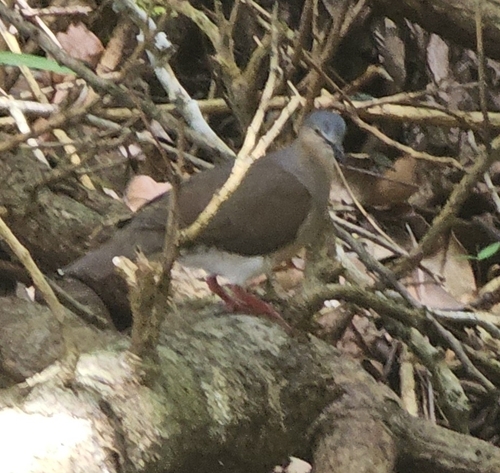 Grijskopduif
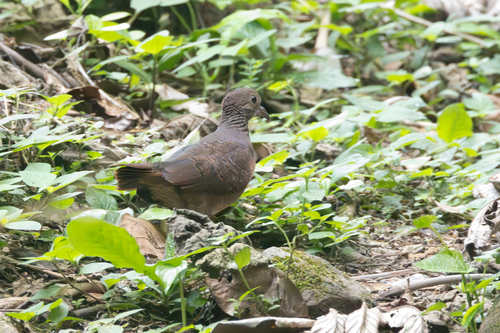 Sclaterkwartelduif
Kort gezegd
The most reliable field mark is the head and face pattern: adult White-faced Quail-Dove shows a distinctly pale grayish-buff face and chin, with a gray crown and cinnamon hindneck, while Grey-headed Dove has a more uniform pale bluish-gray head and pinkish-buff face, lacking the sharp pale face contrast. Juvenile birds are best separated by upperpart color and barring: juvenile Grey-headed Dove is more intensely olive above with a barred breast, while juvenile White-faced Quail-Dove is brown above with dusky bars and a tawny, barred breast. Size is also a useful clue: White-faced Quail-Dove is noticeably larger and heavier. Both species prefer forested habitats, but White-faced Quail-Dove is more strictly montane and often found at higher elevations. Voice is similar and not reliably diagnostic in the field.
Herkenningstips
- Head and face pattern (adults): White-faced Quail-Dove shows a distinctly pale grayish-buff face and chin, sharply contrasting with a gray crown and cinnamon hindneck. Grey-headed Dove has a more uniform pale bluish-gray forehead and crown, with a pinkish-buff face but no sharp pale facial patch.
- Neck and nape color: Cinnamon hindneck and sides with furrowed texture are unique to White-faced Quail-Dove; Grey-headed Dove's nape is just a slightly darker gray.
- Upperparts (adults): White-faced Quail-Dove has chestnut upperparts with a bluish-violet gloss on the back, while Grey-headed Dove is olive-brown with a rufous wash—less rich and glossy.
- Breast and belly: Grey-headed Dove males have a pale pink breast, females grayish fawn; both have a white belly. White-faced Quail-Dove has a buffy gray breast, paling and becoming cinnamon at the belly.
- Juvenile upperparts: Juvenile Grey-headed Dove is more intensely olive above, with a barred breast; juvenile White-faced Quail-Dove is brown above with dusky bars and a tawny, barred breast and sides.
- Tail pattern: Grey-headed Dove has central tail feathers dark olive-brown and outer three black with white tips. White-faced Quail-Dove's tail is less described but not noted as contrasting.
- Eye and facial skin: White-faced Quail-Dove has orange to red eyes surrounded by bare blue-gray skin, a potential close-range mark. Grey-headed Dove's eye color is not specified.
- Leg color: Grey-headed Dove has pink legs and feet, while White-faced Quail-Dove has red legs and feet.
- Size and structure: White-faced Quail-Dove is larger (28–31.5 cm, 158–339 g) and bulkier, with a longer tail and more robust appearance. Grey-headed Dove is smaller (23.5–26 cm, 139–205 g) and less heavy-bodied.
- Behavior: White-faced Quail-Dove is more strictly terrestrial, foraging on the ground in dense cover and often roosting above ground in small groups. Grey-headed Dove's behavior is less well known but is generally a typical forest dove.
- Habitat and elevation: White-faced Quail-Dove is found in humid montane forest (1,000–2,700 m), while Grey-headed Dove is more widespread in lowland to mid-elevation humid and sometimes drier forests (sea level to 1,500 m, up to 2,600 m in Colombia).
- Voice: Both species have similar, low, mournful single-note songs that are not reliably separated by ear.
- Sex differences: Female Grey-headed Dove has a grayish fawn wash on the breast, but otherwise sexes are similar in both species.
- Pitfalls: Immature birds can be confused due to barred breasts, but note the overall olive (Grey-headed) vs brown (White-faced) upperparts and the more intense barring in White-faced Quail-Dove juveniles.
- Context: In high-elevation cloud forest, especially above 1,500 m, White-faced Quail-Dove is much more likely; in lowland or foothill forest, expect Grey-headed Dove.
Grootte
White-faced Quail-Dove is the larger and bulkier of the two, measuring 28–31.5 cm in length and weighing 158–339 g, with some individuals nearly twice the mass of the largest Grey-headed Doves. Grey-headed Dove is smaller at 23.5–26 cm and 139–205 g. In the field, White-faced Quail-Dove often appears more robust and long-tailed, while Grey-headed Dove is more medium-sized and less heavy-bodied. This size difference can be subtle at a distance but is noticeable with direct comparison or good views.
Verenkleed
Juvenile birds are best separated by upperpart color and barring: juvenile Grey-headed Dove is a more intense olive above than adults, with a barred breast, while juvenile White-faced Quail-Dove is brown above with dusky bars and a tawny brown, barred breast and sides. Adults differ most in the head and neck: White-faced Quail-Dove has a pale grayish-buff face and chin, a gray crown (lighter in front, darker at the nape), and a cinnamon hindneck with loose, furrowed feathers, plus a chestnut back with bluish-violet gloss. Grey-headed Dove adults have a pale bluish-gray forehead and crown, pinkish-buff face, white throat and belly, and olive-brown upperparts with a rufous wash. The breast of Grey-headed Dove is pale pink (male) or grayish fawn (female), while White-faced Quail-Dove's breast is buffy gray, paling and becoming cinnamon towards the belly. Tail pattern is not strongly diagnostic, but Grey-headed Dove has central tail feathers dark olive-brown and outer three black with white tips, while White-faced Quail-Dove's tail is less described but not noted as contrasting. Eye color is orange to red with bare blue-gray skin in White-faced Quail-Dove; Grey-headed Dove's eye color is not specified. Legs and feet are pink in Grey-headed Dove, red in White-faced Quail-Dove.
Gedrag
White-faced Quail-Dove is more likely to be seen walking on the ground in dense cover, foraging singly or in pairs, and roosting above ground, sometimes in small groups. It often walks along branches or hops to its roost rather than flying directly. Grey-headed Dove's behavior is less well documented, but it is generally considered a typical ground-dwelling dove of forest interior and edge. Both species are shy and secretive, but White-faced Quail-Dove may be more strictly terrestrial and less likely to flush into open view.
Habitat
Grey-headed Dove occurs from lowland to mid-elevation humid forests (sea level to 1,500 m in Central America, up to 2,600 m in Colombia), favoring both primary and secondary forest, and sometimes drier forests in Colombia. White-faced Quail-Dove is much more restricted to humid montane forests, including evergreen and pine-evergreen types, and shade coffee plantations, at elevations of 1,000–2,700 m. Thus, in lowland or foothill forest, Grey-headed Dove is far more likely, while in higher elevation cloud forest, especially above 1,500 m, White-faced Quail-Dove becomes the expected species.
Geluid
Both species give a low, mournful, single-note song: Grey-headed Dove's is described as a single monotonous 'wooOOOoo' that fades in and out, while White-faced Quail-Dove gives a low, hollow 'whoooo' or 'whoo'oo.' These are very similar in tone and rhythm, and are not reliably separated by ear in the field.