

Motmot

ハイガシラシャコバト 対 カオジロウズラバト

Leptotila plumbeiceps 対 Zentrygon albifacies

ハイガシラシャコバトとカオジロウズラバトのクイズ
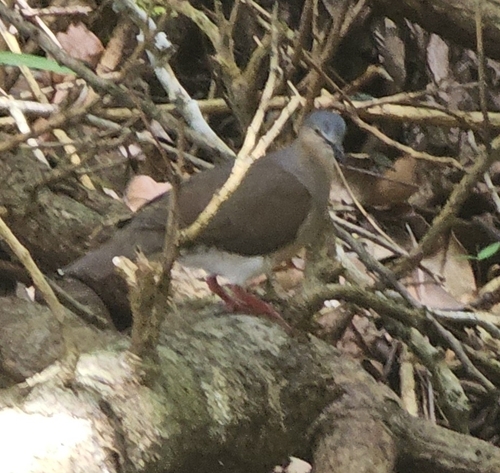
ハイガシラシャコバト (Leptotila plumbeiceps) ハイガシラシャコバト
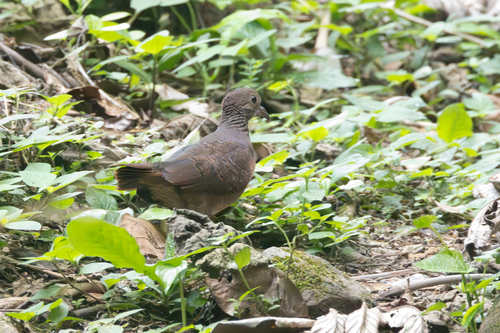
カオジロウズラバト (Zentrygon albifacies) カオジロウズラバト

メディア

読み込み中…

要点

最も信頼できるフィールドマークは頭部と顔のパターンです:成鳥のカオジロウズラバトは明らかに淡い灰色がかったバフの顔と顎を示し、灰色の冠とシナモン色の後頸を持っています。一方、ハイガシラシャコバトはより均一な淡い青灰色の頭とピンクがかったバフの顔を持ち、鮮明な淡い顔のコントラストが欠けています。幼鳥は上面の色と横縞で最も区別されます:幼鳥のハイガシラシャコバトは上面がより強いオリーブ色で、横縞のある胸を持ち、幼鳥のカオジロウズラバトは上面が茶色で、暗い横縞とタウニー色の横縞のある胸を持っています。サイズも有用な手がかりです:カオジロウズラバトは明らかに大きくて重いです。両種は森林の生息地を好みますが、カオジロウズラバトはより厳密に山地に生息し、しばしば高い標高で見られます。声は似ており、フィールドで信頼できる診断にはなりません。

識別のコツ

  1. Head and face pattern (adults): カオジロウズラバトは明らかに淡い灰色がかったバフの顔と顎を示し、灰色の冠とシナモン色の後頸と鮮明に対比しています。ハイガシラシャコバトはより均一な淡い青灰色の額と冠を持ち、ピンクがかったバフの顔を持っていますが、鮮明な淡い顔のパッチはありません。
  2. Neck and nape color: シナモン色の後頸と側面のひだ状の質感はカオジロウズラバトに特有です;ハイガシラシャコバトの後頸はわずかに暗い灰色です。
  3. Upperparts (adults): カオジロウズラバトは胸栗色の上面を持ち、背中には青紫色の光沢がありますが、ハイガシラシャコバトはオリーブ色の茶色で、ルフス色の洗いがかかっています—より豊かで光沢がありません。
  4. Breast and belly: ハイガシラシャコバトのオスは淡いピンクの胸を持ち、メスは灰色がかったバフの胸を持っています;両方とも白い腹を持っています。カオジロウズラバトはバフ色の灰色の胸を持ち、腹部ではシナモン色に薄くなります。
  5. Juvenile upperparts: 幼鳥のハイガシラシャコバトは上面がより強いオリーブ色で、横縞のある胸を持ちます;幼鳥のカオジロウズラバトは上面が茶色で、暗い横縞とタウニー色の横縞のある胸と側面を持っています。
  6. Tail pattern: ハイガシラシャコバトは中央の尾羽が暗いオリーブ色で、外側の3本は黒で白い先端を持っています。カオジロウズラバトの尾はあまり記載されていませんが、対比があるとは記載されていません。
  7. Eye and facial skin: カオジロウズラバトはオレンジから赤の目を持ち、裸の青灰色の皮膚に囲まれています。これは近距離でのマークの可能性があります。ハイガシラシャコバトの目の色は指定されていません。
  8. Leg color: ハイガシラシャコバトはピンクの足と足を持ち、カオジロウズラバトは赤の足と足を持っています。
  9. Size and structure: カオジロウズラバトはより大きく(28–31.5 cm、158–339 g)で、よりがっしりしており、尾が長く、より頑丈な外観を持っています。ハイガシラシャコバトはより小さく(23.5–26 cm、139–205 g)で、体が重くありません。
  10. Behavior: カオジロウズラバトはより厳密に地上性で、密なカバーの中で地面を探し回り、しばしば小グループで地上に止まります。ハイガシラシャコバトの行動はあまり知られていませんが、一般的には典型的な森林の鳩です。
  11. Habitat and elevation: カオジロウズラバトは湿った山地の森林(1,000–2,700 m)に見られますが、ハイガシラシャコバトは低地から中標高の湿った森林や時には乾燥した森林に広く分布しています(海面から1,500 m、コロンビアでは最大2,600 m)。
  12. Voice: 両種は似たような低く、悲しげな単音の歌を持ち、耳で信頼できる区別はできません。
  13. Sex differences: メスのハイガシラシャコバトは胸に灰色がかったバフの洗いがありますが、その他の性別は両種で似ています。
  14. Pitfalls: 幼鳥は横縞のある胸のために混同されることがありますが、全体的なオリーブ(ハイガシラ)対茶色(カオジロウズラバト)の上面と、カオジロウズラバトの幼鳥のより強い横縞に注意してください。
  15. Context: 高標高の雲霧林、特に1,500 m以上では、カオジロウズラバトがはるかに可能性が高いです;低地または丘の森林では、ハイガシラシャコバトを期待してください。

大きさ

カオジロウズラバトは2種の中でより大きく、がっしりしており、長さ28–31.5 cm、重さ158–339 gで、最大のハイガシラシャコバトのほぼ2倍の質量を持つ個体もいます。ハイガシラシャコバトは23.5–26 cm、139–205 gと小さいです。フィールドでは、カオジロウズラバトはしばしばより頑丈で長い尾を持っているように見え、ハイガシラシャコバトはより中型で体が重くありません。このサイズの違いは遠くからは微妙ですが、直接比較や良い視界で目立ちます。

羽色

幼鳥は上面の色と横縞で最も区別されます:幼鳥のハイガシラシャコバトは成鳥よりも上面がより強いオリーブ色で、横縞のある胸を持ち、幼鳥のカオジロウズラバトは上面が茶色で、暗い横縞とタウニー色の横縞のある胸と側面を持っています。成鳥は頭部と首で最も異なります:カオジロウズラバトは淡い灰色がかったバフの顔と顎、灰色の冠(前が明るく、後頸が暗い)、ひだ状の羽毛を持つシナモン色の後頸、青紫色の光沢のある胸栗色の背中を持っています。ハイガシラシャコバトの成鳥は淡い青灰色の額と冠、ピンクがかったバフの顔、白い喉と腹、オリーブ色の茶色の上面を持ち、ルフス色の洗いがあります。ハイガシラシャコバトの胸は淡いピンク(オス)または灰色がかったバフ(メス)ですが、カオジロウズラバトの胸はバフ色の灰色で、腹部に向かって薄くなり、シナモン色になります。尾のパターンは強く診断的ではありませんが、ハイガシラシャコバトは中央の尾羽が暗いオリーブ色で、外側の3本は黒で白い先端を持ち、カオジロウズラバトの尾はあまり記載されていませんが、対比があるとは記載されていません。目の色はカオジロウズラバトではオレンジから赤で、裸の青灰色の皮膚があります;ハイガシラシャコバトの目の色は指定されていません。ハイガシラシャコバトの足と足はピンクで、カオジロウズラバトは赤です。

行動

カオジロウズラバトは密なカバーの中で地面を歩いているのが見られる可能性が高く、単独またはペアで食べ物を探し、時には小グループで地上に止まります。しばしば枝に沿って歩いたり、直接飛ぶのではなく止まり木に跳ねたりします。ハイガシラシャコバトの行動はあまり文書化されていませんが、一般的には森林の内部や端に生息する典型的な地上性の鳩と見なされています。両種は内気で秘密主義ですが、カオジロウズラバトはより厳密に地上性で、開けた視界に飛び出す可能性が低いかもしれません。

生息環境

ハイガシラシャコバトは低地から中標高の湿った森林(中央アメリカでは海面から1,500 m、コロンビアでは最大2,600 m)に生息し、原生林と二次林の両方を好み、時にはコロンビアの乾燥した森林にも見られます。カオジロウズラバトは湿った山地の森林に非常に制限されており、常緑樹や松の常緑樹のタイプ、日陰のコーヒー農園に生息し、標高1,000–2,700 mで見られます。したがって、低地または丘の森林では、ハイガシラシャコバトがはるかに可能性が高く、高標高の雲霧林、特に1,500 m以上では、カオジロウズラバトが期待される種になります。

声

両種は低く、悲しげな単音の歌を発します:ハイガシラシャコバトの歌は単調な「wooOOOoo」として記載され、フェードイン・フェードアウトしますが、カオジロウズラバトは低く、空洞の「whoooo」または「whoo'oo」を発します。これらは音色とリズムが非常に似ており、フィールドで耳で信頼できる区別はできません。

より良い説明を送る

比較と同じ項目を使ってください。文章はすぐに公開されます。

The most reliable field mark is the head and face pattern: adult White-faced Quail-Dove shows a distinctly pale grayish-buff face and chin, with a gray crown and cinnamon hindneck, while Grey-headed Dove has a more uniform pale bluish-gray head and pinkish-buff face, lacking the sharp pale face contrast. Juvenile birds are best separated by upperpart color and barring: juvenile Grey-headed Dove is more intensely olive above with a barred breast, while juvenile White-faced Quail-Dove is brown above with dusky bars and a tawny, barred breast. Size is also a useful clue: White-faced Quail-Dove is noticeably larger and heavier. Both species prefer forested habitats, but White-faced Quail-Dove is more strictly montane and often found at higher elevations. Voice is similar and not reliably diagnostic in the field.

  1. Head and face pattern (adults): White-faced Quail-Dove shows a distinctly pale grayish-buff face and chin, sharply contrasting with a gray crown and cinnamon hindneck. Grey-headed Dove has a more uniform pale bluish-gray forehead and crown, with a pinkish-buff face but no sharp pale facial patch.
  2. Neck and nape color: Cinnamon hindneck and sides with furrowed texture are unique to White-faced Quail-Dove; Grey-headed Dove's nape is just a slightly darker gray.
  3. Upperparts (adults): White-faced Quail-Dove has chestnut upperparts with a bluish-violet gloss on the back, while Grey-headed Dove is olive-brown with a rufous wash—less rich and glossy.
  4. Breast and belly: Grey-headed Dove males have a pale pink breast, females grayish fawn; both have a white belly. White-faced Quail-Dove has a buffy gray breast, paling and becoming cinnamon at the belly.
  5. Juvenile upperparts: Juvenile Grey-headed Dove is more intensely olive above, with a barred breast; juvenile White-faced Quail-Dove is brown above with dusky bars and a tawny, barred breast and sides.
  6. Tail pattern: Grey-headed Dove has central tail feathers dark olive-brown and outer three black with white tips. White-faced Quail-Dove's tail is less described but not noted as contrasting.
  7. Eye and facial skin: White-faced Quail-Dove has orange to red eyes surrounded by bare blue-gray skin, a potential close-range mark. Grey-headed Dove's eye color is not specified.
  8. Leg color: Grey-headed Dove has pink legs and feet, while White-faced Quail-Dove has red legs and feet.
  9. Size and structure: White-faced Quail-Dove is larger (28–31.5 cm, 158–339 g) and bulkier, with a longer tail and more robust appearance. Grey-headed Dove is smaller (23.5–26 cm, 139–205 g) and less heavy-bodied.
  10. Behavior: White-faced Quail-Dove is more strictly terrestrial, foraging on the ground in dense cover and often roosting above ground in small groups. Grey-headed Dove's behavior is less well known but is generally a typical forest dove.
  11. Habitat and elevation: White-faced Quail-Dove is found in humid montane forest (1,000–2,700 m), while Grey-headed Dove is more widespread in lowland to mid-elevation humid and sometimes drier forests (sea level to 1,500 m, up to 2,600 m in Colombia).
  12. Voice: Both species have similar, low, mournful single-note songs that are not reliably separated by ear.
  13. Sex differences: Female Grey-headed Dove has a grayish fawn wash on the breast, but otherwise sexes are similar in both species.
  14. Pitfalls: Immature birds can be confused due to barred breasts, but note the overall olive (Grey-headed) vs brown (White-faced) upperparts and the more intense barring in White-faced Quail-Dove juveniles.
  15. Context: In high-elevation cloud forest, especially above 1,500 m, White-faced Quail-Dove is much more likely; in lowland or foothill forest, expect Grey-headed Dove.

White-faced Quail-Dove is the larger and bulkier of the two, measuring 28–31.5 cm in length and weighing 158–339 g, with some individuals nearly twice the mass of the largest Grey-headed Doves. Grey-headed Dove is smaller at 23.5–26 cm and 139–205 g. In the field, White-faced Quail-Dove often appears more robust and long-tailed, while Grey-headed Dove is more medium-sized and less heavy-bodied. This size difference can be subtle at a distance but is noticeable with direct comparison or good views.

Juvenile birds are best separated by upperpart color and barring: juvenile Grey-headed Dove is a more intense olive above than adults, with a barred breast, while juvenile White-faced Quail-Dove is brown above with dusky bars and a tawny brown, barred breast and sides. Adults differ most in the head and neck: White-faced Quail-Dove has a pale grayish-buff face and chin, a gray crown (lighter in front, darker at the nape), and a cinnamon hindneck with loose, furrowed feathers, plus a chestnut back with bluish-violet gloss. Grey-headed Dove adults have a pale bluish-gray forehead and crown, pinkish-buff face, white throat and belly, and olive-brown upperparts with a rufous wash. The breast of Grey-headed Dove is pale pink (male) or grayish fawn (female), while White-faced Quail-Dove's breast is buffy gray, paling and becoming cinnamon towards the belly. Tail pattern is not strongly diagnostic, but Grey-headed Dove has central tail feathers dark olive-brown and outer three black with white tips, while White-faced Quail-Dove's tail is less described but not noted as contrasting. Eye color is orange to red with bare blue-gray skin in White-faced Quail-Dove; Grey-headed Dove's eye color is not specified. Legs and feet are pink in Grey-headed Dove, red in White-faced Quail-Dove.

White-faced Quail-Dove is more likely to be seen walking on the ground in dense cover, foraging singly or in pairs, and roosting above ground, sometimes in small groups. It often walks along branches or hops to its roost rather than flying directly. Grey-headed Dove's behavior is less well documented, but it is generally considered a typical ground-dwelling dove of forest interior and edge. Both species are shy and secretive, but White-faced Quail-Dove may be more strictly terrestrial and less likely to flush into open view.

Grey-headed Dove occurs from lowland to mid-elevation humid forests (sea level to 1,500 m in Central America, up to 2,600 m in Colombia), favoring both primary and secondary forest, and sometimes drier forests in Colombia. White-faced Quail-Dove is much more restricted to humid montane forests, including evergreen and pine-evergreen types, and shade coffee plantations, at elevations of 1,000–2,700 m. Thus, in lowland or foothill forest, Grey-headed Dove is far more likely, while in higher elevation cloud forest, especially above 1,500 m, White-faced Quail-Dove becomes the expected species.

Both species give a low, mournful, single-note song: Grey-headed Dove's is described as a single monotonous 'wooOOOoo' that fades in and out, while White-faced Quail-Dove gives a low, hollow 'whoooo' or 'whoo'oo.' These are very similar in tone and rhythm, and are not reliably separated by ear in the field.

変更を破棄しますか?

保存していない編集があります。今離れると失われます。

ハイガシラシャコバト · カオジロウズラバト · 苦手な鳥