

Motmot

Zwartkopschoffelsnavel vs Groenkapbreedbektiran

Todirostrum nigriceps versus Tolmomyias sulphurescens

Speel een quiz met Zwartkopschoffelsnavel en Groenkapbreedbektiran
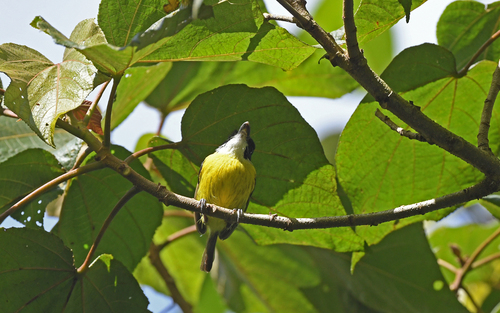
Zwartkopschoffelsnavel (Todirostrum nigriceps) Zwartkopschoffelsnavel
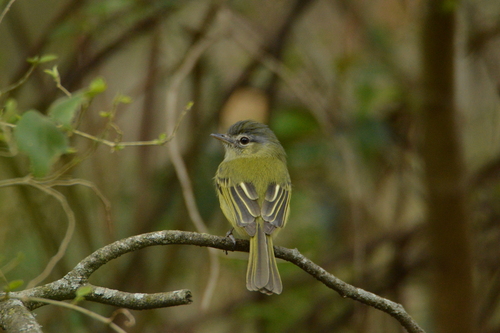
Groenkapbreedbektiran (Tolmomyias sulphurescens) Groenkapbreedbektiran

Media

Laden…

Kort gezegd

The most reliable field mark to separate Black-headed Tody-Flycatcher from Yellow-olive Flatbill is the former's striking glossy black head and white throat, contrasting sharply with its bright yellow underparts—features never shown by any Yellow-olive Flatbill. In contrast, Yellow-olive Flatbill always has an olive or grayish crown, a thin white eye-ring, and a pale greenish or gray throat, lacking the bold black-and-white head pattern. Juvenile plumages are subtly different but still diagnostic: young Tody-Flycatchers are duller but retain the blackish head and lack any eye-ring, while juvenile Flatbills show a broken eye-ring and a paler, less contrasting face. Structure is also helpful: Tody-Flycatcher is much smaller, with a short tail and a proportionally large, straight bill, while Flatbill is larger and has a broad, flat bill. Both species can show yellow underparts and wingbars, so focus on head pattern and size for reliable separation.

Herkenningstips

  1. Head pattern is diagnostic: Black-headed Tody-Flycatcher always shows a glossy black (or dull black in juveniles) head and nape with a white throat; Yellow-olive Flatbill never has a black head or white throat—its crown is olive or grayish, and its throat is pale greenish or gray.
  2. Eye-ring presence: Yellow-olive Flatbill has a thin white eye-ring (broken in juveniles); Tody-Flycatcher lacks any eye-ring at all ages.
  3. Bill shape and size: Tody-Flycatcher has a short, straight, proportionally large black bill; Flatbill has a much broader, flatter bill with a pale lower mandible—look for the wide, flat shape in profile.
  4. Body size: Tody-Flycatcher is tiny (6.2 g, 8–10 cm), Flatbill is much larger (14–15 g, 12.5–14 cm)—if you get a sense of scale, this is a strong clue.
  5. Tail length and shape: Tody-Flycatcher has a very short, black tail; Flatbill's tail is longer, brownish to dusky, and never as short or as dark as the Tody-Flycatcher's.
  6. Underpart color: Both can show yellow underparts, but Tody-Flycatcher's are bright yellow and sharply set off from the white throat; Flatbill's yellow is on the belly and undertail, with the breast and throat more olive or grayish.
  7. Wingbars: Both species have two yellowish wingbars, but Tody-Flycatcher's are brighter and more sharply defined, especially in adults; Flatbill's are yellowish-olive and less contrasting.
  8. Juvenile differences: Young Tody-Flycatchers are duller but still have a dark head and lack any eye-ring; juvenile Flatbills have a broken eye-ring and paler underparts, but never a dark head.
  9. Iris color: Tody-Flycatcher has dark irises at all ages; Flatbill's iris is variable but often pale brown to gray in adults, dark in juveniles—use with caution.
  10. Leg color: Tody-Flycatcher has blueish-gray legs; Flatbill's legs are gray—subtle, but may help in good light.
  11. Behavior: Tody-Flycatcher is hyperactive, flicking its short tail and moving quickly; Flatbill is more deliberate and perches for longer.
  12. Vocalizations: Tody-Flycatcher's high, repetitive 'peep' and 'jyip' series are distinctive; Flatbill's voice is not described here, so use Tody-Flycatcher's calls as a positive clue.
  13. Habitat context: If in drier or edge habitats, Flatbill is more likely; Tody-Flycatcher prefers humid lowland forest interiors.
  14. Geographic range: If outside Colombia, Costa Rica, Ecuador, Panama, or Venezuela, Tody-Flycatcher is unlikely; Flatbill is widespread across the Neotropics.
  15. Sex differences: Both species are sexually monomorphic—plumage differences are not sex-based, so do not use sex as a clue.

Grootte

Black-headed Tody-Flycatcher is significantly smaller, at 8–10.2 cm in length and about 6.2 g in mass [wikidata], compared to the Yellow-olive Flatbill's 12.5–14 cm length and 14.5–15.2 g mass [wikipedia]. In the field, Tody-Flycatcher appears tiny and compact, with a short tail and a large-headed look. Flatbill is noticeably bulkier, with a longer body and a heavier, broader bill. If seen side by side, the Flatbill is more than twice as heavy and substantially longer.

Verenkleed

Juvenile and adult Black-headed Tody-Flycatchers always show a black (or dull black in juveniles) head and nape, with a white throat and bright yellow underparts. Juveniles are duller overall, with a vaguely yellow throat and more olive-tinged wingbars, but still lack any eye-ring. In contrast, all ages of Yellow-olive Flatbill have an olive or grayish crown, a thin white eye-ring (broken in juveniles), and a pale greenish or gray throat. Their upperparts are olive-green, and their underparts are yellow but less sharply demarcated from the breast. The Flatbill's wingbars are yellowish-olive and less sharply defined than the Tody-Flycatcher's bright yellow bars. Subspecific variation in Flatbill affects crown and underpart tones but never produces a black head or white throat. The Flatbill's tail is brownish to dusky, not black. Eye color is also useful: Tody-Flycatcher has dark irises, while Flatbill's iris is variable but often pale brown to gray in adults, dark in juveniles.

Gedrag

Black-headed Tody-Flycatcher is typically seen as a very active, restless bird, often flicking its short tail and making quick, darting movements through low to mid-level foliage. Its small size and energetic behavior give it a 'hyperactive' impression. Yellow-olive Flatbill, being larger, moves more deliberately, often perching quietly for longer periods and sallying out to catch insects. Its broader bill is used to glean prey from leaves and branches. Tody-Flycatcher often forages in pairs or small groups, while Flatbill is more often solitary or in mixed flocks.

Habitat

Both species occur in lowland and foothill forests, but Black-headed Tody-Flycatcher is more restricted to humid, subtropical or tropical moist lowland forests in Central and northern South America (Colombia, Costa Rica, Ecuador, Panama, Venezuela) [wikipedia]. Yellow-olive Flatbill has a much broader range, found from Mexico through all of Central America, Trinidad, and nearly all of South America except Chile. Flatbill is more likely in drier or edge habitats, secondary growth, and a wider range of forest types. If you are outside the Tody-Flycatcher's range, the confusion is less likely, but both can overlap in Central America and northern South America.

Geluid

Black-headed Tody-Flycatcher's call is a single high-pitched 'peep,' and its song is a rapid series of 5–8 high-pitched 'jyip' notes, accelerating and rising slightly at the end—often insect-like and repeated frequently. Yellow-olive Flatbill's voice is not described in the notes, so cannot be contrasted here. In the field, Tody-Flycatcher's high, quick, repetitive calls can help confirm its presence, especially if the bird is hidden.

Stuur een betere beschrijving

Gebruik dezelfde onderdelen als de vergelijking. Je tekst staat meteen live.

The most reliable field mark to separate Black-headed Tody-Flycatcher from Yellow-olive Flatbill is the former's striking glossy black head and white throat, contrasting sharply with its bright yellow underparts—features never shown by any Yellow-olive Flatbill. In contrast, Yellow-olive Flatbill always has an olive or grayish crown, a thin white eye-ring, and a pale greenish or gray throat, lacking the bold black-and-white head pattern. Juvenile plumages are subtly different but still diagnostic: young Tody-Flycatchers are duller but retain the blackish head and lack any eye-ring, while juvenile Flatbills show a broken eye-ring and a paler, less contrasting face. Structure is also helpful: Tody-Flycatcher is much smaller, with a short tail and a proportionally large, straight bill, while Flatbill is larger and has a broad, flat bill. Both species can show yellow underparts and wingbars, so focus on head pattern and size for reliable separation.

  1. Head pattern is diagnostic: Black-headed Tody-Flycatcher always shows a glossy black (or dull black in juveniles) head and nape with a white throat; Yellow-olive Flatbill never has a black head or white throat—its crown is olive or grayish, and its throat is pale greenish or gray.
  2. Eye-ring presence: Yellow-olive Flatbill has a thin white eye-ring (broken in juveniles); Tody-Flycatcher lacks any eye-ring at all ages.
  3. Bill shape and size: Tody-Flycatcher has a short, straight, proportionally large black bill; Flatbill has a much broader, flatter bill with a pale lower mandible—look for the wide, flat shape in profile.
  4. Body size: Tody-Flycatcher is tiny (6.2 g, 8–10 cm), Flatbill is much larger (14–15 g, 12.5–14 cm)—if you get a sense of scale, this is a strong clue.
  5. Tail length and shape: Tody-Flycatcher has a very short, black tail; Flatbill's tail is longer, brownish to dusky, and never as short or as dark as the Tody-Flycatcher's.
  6. Underpart color: Both can show yellow underparts, but Tody-Flycatcher's are bright yellow and sharply set off from the white throat; Flatbill's yellow is on the belly and undertail, with the breast and throat more olive or grayish.
  7. Wingbars: Both species have two yellowish wingbars, but Tody-Flycatcher's are brighter and more sharply defined, especially in adults; Flatbill's are yellowish-olive and less contrasting.
  8. Juvenile differences: Young Tody-Flycatchers are duller but still have a dark head and lack any eye-ring; juvenile Flatbills have a broken eye-ring and paler underparts, but never a dark head.
  9. Iris color: Tody-Flycatcher has dark irises at all ages; Flatbill's iris is variable but often pale brown to gray in adults, dark in juveniles—use with caution.
  10. Leg color: Tody-Flycatcher has blueish-gray legs; Flatbill's legs are gray—subtle, but may help in good light.
  11. Behavior: Tody-Flycatcher is hyperactive, flicking its short tail and moving quickly; Flatbill is more deliberate and perches for longer.
  12. Vocalizations: Tody-Flycatcher's high, repetitive 'peep' and 'jyip' series are distinctive; Flatbill's voice is not described here, so use Tody-Flycatcher's calls as a positive clue.
  13. Habitat context: If in drier or edge habitats, Flatbill is more likely; Tody-Flycatcher prefers humid lowland forest interiors.
  14. Geographic range: If outside Colombia, Costa Rica, Ecuador, Panama, or Venezuela, Tody-Flycatcher is unlikely; Flatbill is widespread across the Neotropics.
  15. Sex differences: Both species are sexually monomorphic—plumage differences are not sex-based, so do not use sex as a clue.

Black-headed Tody-Flycatcher is significantly smaller, at 8–10.2 cm in length and about 6.2 g in mass [wikidata], compared to the Yellow-olive Flatbill's 12.5–14 cm length and 14.5–15.2 g mass [wikipedia]. In the field, Tody-Flycatcher appears tiny and compact, with a short tail and a large-headed look. Flatbill is noticeably bulkier, with a longer body and a heavier, broader bill. If seen side by side, the Flatbill is more than twice as heavy and substantially longer.

Juvenile and adult Black-headed Tody-Flycatchers always show a black (or dull black in juveniles) head and nape, with a white throat and bright yellow underparts. Juveniles are duller overall, with a vaguely yellow throat and more olive-tinged wingbars, but still lack any eye-ring. In contrast, all ages of Yellow-olive Flatbill have an olive or grayish crown, a thin white eye-ring (broken in juveniles), and a pale greenish or gray throat. Their upperparts are olive-green, and their underparts are yellow but less sharply demarcated from the breast. The Flatbill's wingbars are yellowish-olive and less sharply defined than the Tody-Flycatcher's bright yellow bars. Subspecific variation in Flatbill affects crown and underpart tones but never produces a black head or white throat. The Flatbill's tail is brownish to dusky, not black. Eye color is also useful: Tody-Flycatcher has dark irises, while Flatbill's iris is variable but often pale brown to gray in adults, dark in juveniles.

Black-headed Tody-Flycatcher is typically seen as a very active, restless bird, often flicking its short tail and making quick, darting movements through low to mid-level foliage. Its small size and energetic behavior give it a 'hyperactive' impression. Yellow-olive Flatbill, being larger, moves more deliberately, often perching quietly for longer periods and sallying out to catch insects. Its broader bill is used to glean prey from leaves and branches. Tody-Flycatcher often forages in pairs or small groups, while Flatbill is more often solitary or in mixed flocks.

Both species occur in lowland and foothill forests, but Black-headed Tody-Flycatcher is more restricted to humid, subtropical or tropical moist lowland forests in Central and northern South America (Colombia, Costa Rica, Ecuador, Panama, Venezuela) [wikipedia]. Yellow-olive Flatbill has a much broader range, found from Mexico through all of Central America, Trinidad, and nearly all of South America except Chile. Flatbill is more likely in drier or edge habitats, secondary growth, and a wider range of forest types. If you are outside the Tody-Flycatcher's range, the confusion is less likely, but both can overlap in Central America and northern South America.

Black-headed Tody-Flycatcher's call is a single high-pitched 'peep,' and its song is a rapid series of 5–8 high-pitched 'jyip' notes, accelerating and rising slightly at the end—often insect-like and repeated frequently. Yellow-olive Flatbill's voice is not described in the notes, so cannot be contrasted here. In the field, Tody-Flycatcher's high, quick, repetitive calls can help confirm its presence, especially if the bird is hidden.

Wijzigingen weggooien?

Je hebt niet-opgeslagen wijzigingen. Als je nu weggaat, gaan die verloren.

Zwartkopschoffelsnavel · Groenkapbreedbektiran · Mijn lastige vogels