

ハイガシラアゴカンムリヒヨドリ 対 Gray-cheeked Bulbul
Alophoixus phaeocephalus 対 Alophoixus tephrogenys
ハイガシラアゴカンムリヒヨドリとGray-cheeked Bulbulのクイズ
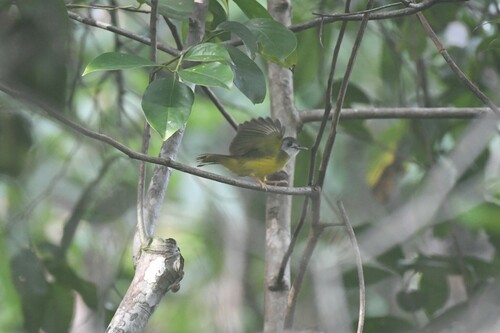 ハイガシラアゴカンムリヒヨドリ
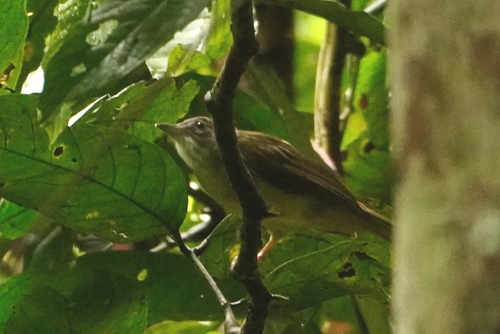 Gray-cheeked Bulbul
要点
Yellow-bellied Bulbul and Grey-cheeked Bulbul are both medium-sized Alophoixus bulbuls of the Malay Peninsula and Greater Sunda Islands, often sharing lowland forest habitat. The most reliable field mark, when visible, is the underpart coloration: Yellow-bellied Bulbul shows a distinctly yellow belly, while Grey-cheeked Bulbul lacks this bright yellow and instead has more muted, greyish underparts. Both species are similar in overall structure and can be confused in poor light or at a distance, especially when perched. Age-specific wing or flight patterns are not described in available sources, so separation relies primarily on plumage and subtle structural differences.
識別のコツ
- Yellow belly (all ages): Look for a distinctly yellow belly and vent on Yellow-bellied Bulbul; Grey-cheeked Bulbul never shows this bright yellow, instead appearing greyish or olive below.
- Underpart contrast: The yellow on Yellow-bellied Bulbul is usually clear even in shaded forest, while Grey-cheeked Bulbul's underparts are dull and blend with the rest of the body.
- Cheek and throat color: Grey-cheeked Bulbul has greyish cheeks and throat that merge smoothly into the underparts, lacking the crisp contrast of yellow seen on Yellow-bellied Bulbul.
- Head coloration: Both species can show greyish heads, but this is not a reliable separator due to overlap and variation.
- No crest: Both are 'crestless' compared to some other bulbuls; do not use crest shape as a separator.
- Flight and wing pattern: No documented differences in wing or flight pattern for any age; do not rely on upperwing or tail pattern in flight.
- Habitat context: If seen in montane forest, especially above lowland elevations, Grey-cheeked Bulbul is more likely. In lowland forest, both may occur, so use plumage.
- Range: On Borneo, Sumatra, and the Malay Peninsula, both occur, but Grey-cheeked Bulbul extends to the Greater Sunda Islands and higher elevations.
- Behavior: Both forage in the mid to upper canopy and may join mixed flocks; behavior is not a separator.
- Voice: No distinctive vocal differences are documented in available sources; do not rely on song or call for separation.
- Juvenile/immature birds: No age-specific marks are described; use underpart color for all plumages.
- Lighting pitfalls: In deep shade, the yellow belly of Yellow-bellied Bulbul may appear duller, but should still contrast with the rest of the underparts. Always check for any trace of yellow.
- Sex differences: No sexual dimorphism is noted; both sexes should be separated by the same marks.
- Alternate names confusion: Be aware that both species have been called by similar alternate names (e.g., 'grey-headed bulbul'), but only underpart color is reliable in the field.
- Checklist approach: If you see a bulbul with a yellow belly in the lowland forests of the Malay Peninsula, Sumatra, or Borneo, it is Yellow-bellied Bulbul. If the underparts are uniformly greyish or olive, consider Grey-cheeked Bulbul, especially in montane or broader Sundaic locations.
大きさ
Both species are similar in size and structure, typical of the Alophoixus genus. No diagnostic difference in length or mass is noted in available sources. Expect both to be medium-sized, robust bulbuls with similar proportions when seen side by side.
羽色
For all ages, the key difference is the belly and underpart coloration: Yellow-bellied Bulbul has a noticeably yellow belly and vent, which stands out even in shaded forest light. Grey-cheeked Bulbul, in contrast, lacks this yellow and appears more uniformly greyish or olive below, with the cheeks and throat blending into the rest of the underparts. No age-specific upperwing or flight pattern differences are documented for either species, so these are not reliable for separation. Both have similar head and back coloration, but the presence or absence of yellow on the belly is the most consistent field mark across all plumages.
行動
Both species behave like typical forest bulbuls: they are often seen in the mid to upper canopy, sometimes joining mixed-species flocks. There is no documented behavioral difference that reliably separates them in the field.
生息環境
Yellow-bellied Bulbul is restricted to the Malay Peninsula, Sumatra, and Borneo, favoring subtropical or tropical moist lowland forests. Grey-cheeked Bulbul has a slightly broader range, occurring from the Malay Peninsula to the Greater Sunda Islands, and is found in both lowland and montane moist forests. In strictly lowland forest on Sumatra or Borneo, both may occur together, but Grey-cheeked Bulbul is more likely at higher elevations or in montane forest. Habitat alone is not diagnostic where ranges overlap, but can help in montane areas.