

セグロムクドリモドキ 対 キホオアメリカムシクイ
Icterus parisorum 対 Setophaga chrysoparia
セグロムクドリモドキとキホオアメリカムシクイのクイズ
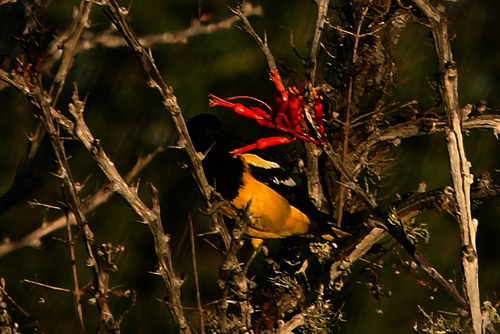 セグロムクドリモドキ
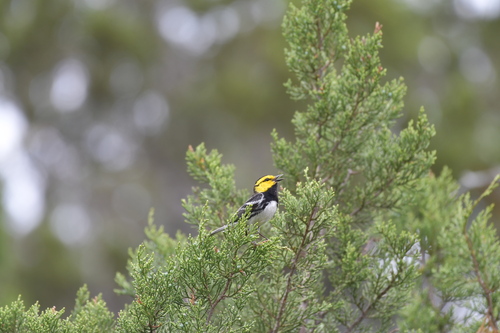 キホオアメリカムシクイ
要点
The most reliable field mark to separate Scott's Oriole from Golden-cheeked Warbler is overall size and structure: Scott's Oriole is much larger, with a long, pointed bill and a bold black-and-yellow color pattern, while Golden-cheeked Warbler is a small, compact warbler with a delicate bill and a striking yellow face with black markings. In flight or perched, the oriole's size, wing bars, and tail pattern are distinctive, especially in males. Females and immatures of both species can be confusing, but the oriole always shows a much larger, bulkier profile and different wing pattern. Habitat and range also help: Scott's Oriole is found in arid Southwest and Mexico, while Golden-cheeked Warbler is restricted to central Texas oak-juniper woodlands.
識別のコツ
- Size and Structure: Scott's Oriole is much larger and bulkier than Golden-cheeked Warbler. If the bird looks robin-sized or larger, it's not a warbler. Warblers are small, quick, and delicate.
- Bill Shape: Scott's Oriole has a long, pointed, and thick bill, suited for probing and eating fruit/nectar. Golden-cheeked Warbler has a short, fine, insect-eating bill. Bill size is obvious at close range.
- Wing Bars: Adult Scott's Orioles (both sexes) show two bold white wing bars on blackish wings, plus a yellow epaulet (lesser/median coverts) in males. Golden-cheeked Warbler lacks any wing bars—its wings are plain grayish or dark.
- Tail Pattern: Scott's Oriole has a long tail with yellow bases and white tips, especially obvious on the outer feathers. Golden-cheeked Warbler has a short, plain tail with no yellow or white pattern.
- Adult Male Plumage: Male Scott's Oriole is black above with a bright yellow belly and rump; male Golden-cheeked Warbler is never black above, but has a yellow face, black throat, and gray back.
- Female/Immature Plumage: Female Scott's Oriole is olive above with streaks, pale yellow below, and still shows wing bars and a long tail. Female/immature Golden-cheeked Warbler is gray above, white below, yellow-faced, and lacks wing bars or tail pattern.
- Face Pattern: Golden-cheeked Warbler always has a bright yellow face with a black eyeline and black throat, unique among Texas warblers. Scott's Oriole never shows this face pattern.
- Jizz in Flight: Scott's Oriole flies with slow, strong wingbeats and a long tail trailing; Golden-cheeked Warbler is rapid, fluttery, and short-tailed.
- Perched Posture: Orioles often perch upright and exposed, while warblers are more likely to be hidden in foliage, moving quickly.
- Habitat: If you are in central Texas oak-juniper woodland, consider Golden-cheeked Warbler. If in arid Southwest, open desert, or among yuccas, Scott's Oriole is more likely.
- Range: Golden-cheeked Warbler is endemic to central Texas; Scott's Oriole ranges from the southwestern US into Mexico.
- Underparts Color: Scott's Oriole (male) has a lemon yellow belly and rump; Golden-cheeked Warbler has white underparts with yellow only on the face.
- Back Color: Scott's Oriole (male) is black-backed; Golden-cheeked Warbler is gray-backed.
- Voice: Not described in the notes, but oriole songs are typically rich and whistled, while warbler songs are high, buzzy, and rapid. Use with caution.
- Seasonality: Golden-cheeked Warbler is present only during the breeding season in Texas (spring/summer); Scott's Oriole is present in the Southwest and Mexico depending on season.
大きさ
Scott's Oriole is significantly larger: about 23 cm (9.1 in) long with a 32 cm (13 in) wingspan and weighing 32–41 g. In contrast, Golden-cheeked Warbler is a typical small warbler, much shorter and lighter (exact measurements not given here, but warblers are generally 11–13 cm long and weigh under 10 g). The oriole's size is evident even at a distance, with a long tail and robust body, while the warbler is compact and quick-moving.
羽色
- Juvenile/Immature/First-year (where relevant):
- No detailed juvenile/immature wing pattern is provided for either species, but Scott's Oriole females and immatures have olive and yellowish tones with streaking, while Golden-cheeked Warbler immatures are not described here, but typically resemble adults with less crisp contrast.
- Adult Male Scott's Oriole: Striking black head, back, throat, and breast, with lemon yellow rump and underparts. Wings are black with pale yellow lesser/median coverts (forming an epaulet) and two white wing bars; tail is mostly black with yellow bases and white tips, especially on outer feathers.
- Adult Female Scott's Oriole: Olive-gray above with streaks, pale olive-yellow below, blackish chin/throat/upper breast, two white wing bars, and olive tail with yellowish bases.
- Golden-cheeked Warbler (adult): Not fully described here, but always shows a bright yellow face with a black eyeline and black throat, contrasting with a gray back and white underparts. Lacks the oriole's wing bars and tail pattern. No yellow on the rump or tail. Bill is small and pointed, not heavy like the oriole's.
- Key contrast: Scott's Oriole always shows bold wing bars and a long tail with yellow bases, while Golden-cheeked Warbler has a plain wing and a much shorter tail.
行動
Scott's Oriole often perches conspicuously on yuccas or open branches, sometimes singing from high vantage points. Its flight is strong and direct, befitting its larger size. Golden-cheeked Warbler is much more active and restless, flitting through foliage, gleaning insects, and rarely sitting still for long. Warblers are generally harder to spot in the open and move quickly between branches.
生息環境
Scott's Oriole is found in arid or semi-arid habitats in the southwestern US and Mexico, often associated with yucca, open woodlands, or desert foothills. Golden-cheeked Warbler is restricted to central Texas, breeding only in mature oak-juniper woodlands with Ashe juniper and various oaks, often in hilly terrain. If you are outside central Texas oak-juniper habitat, Golden-cheeked Warbler is extremely unlikely.