

アカハラコシアカツバメ 対 ナンアサンショクツバメ
Cecropis semirufa 対 Petrochelidon spilodera
アカハラコシアカツバメとナンアサンショクツバメのクイズ
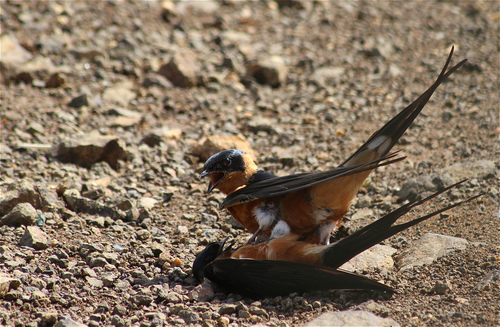 アカハラコシアカツバメ
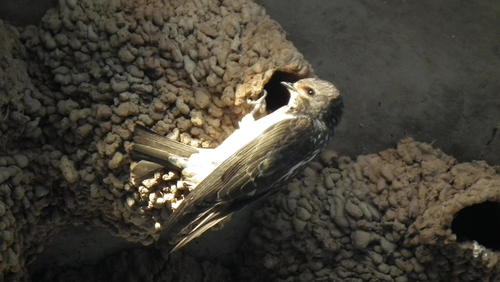 ナンアサンショクツバメ
要点
The most reliable field mark to separate Rufous-chested Swallow from South African Swallow is the absence of white on the underwing in all ages of Rufous-chested Swallow, versus the South African Swallow, which typically shows white underwing coverts. Rufous-chested Swallow also has a blue crown that extends below the eye and a rufous rump and underparts, while South African Swallow is generally paler below and lacks the deep rufous tones. Juvenile Rufous-chested Swallows show blue on the side of the head (not dull red), which is a key point if you suspect a young bird. Both species are similar in size and structure, but tail streamer length and underwing color are the quickest field clues. Habitat overlap is possible under bridges and human structures, but Rufous-chested Swallow is more solitary and prefers open country, while South African Swallow is more colonial and often found in larger groups.
識別のコツ
- Underwing color in flight: Rufous-chested Swallow always lacks white on the underwing, while South African Swallow shows white underwing coverts. This is the quickest way to separate them in flight or when the bird is stretching/preening.
- Tail streamer length: Rufous-chested Swallow has longer tail streamers, giving a more deeply forked tail look. South African Swallow's tail is shorter and less deeply forked. This mark is most reliable on perched adults but can be seen in flight.
- Crown and head pattern: Rufous-chested Swallow's blue crown extends below the eye, creating a darker-headed look. South African Swallow does not show this extension; its crown is less extensive and does not reach below the eye.
- Rump and underparts color: Rufous-chested Swallow has a rufous rump and rufous underparts, while South African Swallow is paler below and lacks the deep rufous tones. This is especially obvious in good light.
- Juvenile head color: Juvenile Rufous-chested Swallow shows blue on the side of the head (not dull red), which is a subtle but important mark if you suspect a young bird. South African Swallow juveniles are not described in detail in the notes, but do not show this blue.
- Perching behavior: Rufous-chested Swallow is more likely to perch alone or in pairs on wires or twigs, while South African Swallow is often seen in groups, especially near nesting sites.
- Nesting habits: Rufous-chested Swallow builds closed mud nests with tubular entrances, often singly or in loose pairs under bridges or in cavities. South African Swallow nests colonially, with many mud nests clustered under bridges or eaves.
- Flight style: Rufous-chested Swallow has a slow, buoyant flight, which can help distinguish it from the more erratic, fast-flying South African Swallow, especially in mixed swallow flocks.
- Habitat context: If you find a solitary or paired swallow in open country or on a wire away from large colonies, Rufous-chested Swallow is more likely. If you see many swallows nesting or flying together under a bridge or building, South African Swallow is more probable.
- Seasonal presence: Rufous-chested Swallow is migratory in southern Africa (present July–March), while South African Swallow is more resident or locally migratory. Time of year can help, but there is overlap.
- Confusion with other swallows: Rufous-chested Swallow is similar to Mosque Swallow but is smaller with longer tail streamers. South African Swallow is less likely to be confused with Mosque Swallow due to paler underparts and shorter tail.
- No known vocal differences: The notes do not provide vocalization differences, so do not rely on calls or songs for separation.
- Sex differences: No sexual dimorphism is described for either species, so all marks apply to both sexes.
- Pitfalls: Beware of lighting conditions that can obscure underwing color or tail streamer length. Immature birds may be especially tricky; focus on underwing and head color for best results.
- When in doubt: Prioritize underwing color in flight and tail streamer length when perched. If you cannot see these, use habitat and group size as secondary clues.
大きさ
Both species are similar in overall size and structure, being medium-sized swallows of the region. Rufous-chested Swallow is slightly smaller than the similar Mosque Swallow, but there is no direct size comparison to South African Swallow in the notes. Both have streamlined bodies and long wings, but Rufous-chested Swallow has longer tail streamers, which can be a subtle but useful mark when seen well. No significant difference in mass or length is documented between these two.
羽色
- Juvenile/immature birds: Juvenile Rufous-chested Swallow shows blue on the side of the head (not dull red), which distinguishes it from similar swallows but is not directly compared to South African Swallow juveniles. The key diagnostic for all ages is the underwing: Rufous-chested Swallow lacks any white on the underwing, while South African Swallow shows white underwing coverts, especially visible in flight or when preening.
- Adults: Rufous-chested Swallow has a blue crown and mantle, rufous rump and underparts, and the blue crown extends below the eye. South African Swallow is paler below, lacks the deep rufous underparts, and does not show the blue crown extending below the eye. Tail streamers are longer in Rufous-chested Swallow, giving a more deeply forked tail impression when perched or in flight. Both species have some blue on the upperparts, but the contrast with the rufous rump is stronger in Rufous-chested Swallow.
行動
Rufous-chested Swallow is generally solitary or found in pairs, rarely breeding in groups, and is more likely to perch on wires or twigs. Its flight is described as slow and buoyant. South African Swallow is more colonial, often nesting in groups under bridges or eaves, and is more likely to be seen in flocks. Both species feed almost exclusively on aerial insects and rarely land on the ground. Rufous-chested Swallow is more migratory, especially in southern Africa, while South African Swallow is more resident or locally migratory.
生息環境
Rufous-chested Swallow is a bird of dry open country, although it may enter tropical rainforest during the wet season. It uses artificial structures for nesting but is less likely to be found in wooded areas, where Mosque Swallow replaces it. South African Swallow is strongly associated with human structures, especially bridges and huts, and is more likely to be found nesting in large groups under these. Both can be found near water or open areas but Rufous-chested Swallow is more solitary and less tied to dense colonies or large aggregations.