

Northern House Wren 対 Chestnut-breasted Wren
Troglodytes aedon 対 Cyphorhinus thoracicus
Northern House WrenとChestnut-breasted Wrenのクイズ
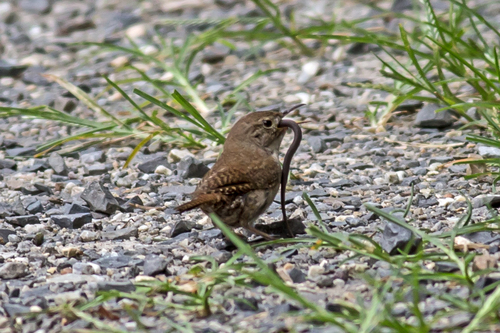 Northern House Wren
 Chestnut-breasted Wren
要点
The most reliable field mark to separate Northern House Wren from Chestnut-breasted Wren is plumage: Chestnut-breasted Wren shows a striking deep orange-brown face, throat, and upper belly, contrasting with its sooty black crown and rich brown back, while Northern House Wren is much plainer and lacks any orange or chestnut tones. Juvenile Chestnut-breasted Wrens have a paler lower belly but still show the distinctive chestnut on the upperparts, unlike any House Wren age. Structurally, Chestnut-breasted Wren is much heavier-bodied and bulkier, with a darker, richer overall look. Habitat is also a strong clue: House Wren is a common suburban and open-country bird in North America, while Chestnut-breasted Wren is a forest species of southern Peru and northwest Bolivia.
識別のコツ
- Face and throat color: Chestnut-breasted Wren always shows a deep orange-brown (chestnut) face, throat, and upper belly—this is never present in Northern House Wren of any age or sex.
- Crown color: Chestnut-breasted Wren has a sooty black crown, contrasting with the brown back. House Wren's crown is always similar in tone to its back, never black.
- Underparts: House Wren is plain below, varying from brown to buff or pale grey, sometimes with faint barring on the flanks. Chestnut-breasted Wren has a dark brown lower belly and flanks, with a sharp transition from the orange-brown upper belly.
- Juvenile marks: Even juvenile Chestnut-breasted Wrens show the chestnut face and throat, with only the lower belly being paler. House Wren juveniles are plain brownish and lack any chestnut.
- Overall contrast: Chestnut-breasted Wren is boldly patterned and strongly colored; House Wren is much duller and more uniform.
- Size and bulk: Chestnut-breasted Wren is much heavier and bulkier than House Wren—if you see a large, chunky wren, it's not a House Wren.
- Tail: Both species have dark brown tails with barring, but House Wren's tail is shorter and often cocked; Chestnut-breasted Wren's tail is proportionally longer and less likely to be held upright.
- Bill: House Wren has a long, thin bill with a blackish upper mandible and pale lower mandible with a black tip. Chestnut-breasted Wren's bill is not described in detail in the sources, but is not a primary separator.
- Eye-ring and eyebrow: House Wren may show a faint eye-ring and eyebrow; Chestnut-breasted Wren does not have these pale facial features, instead showing strong orange-brown coloration.
- Habitat: House Wren is found in open, suburban, or edge habitats in North America; Chestnut-breasted Wren is restricted to humid forests in southern Peru and northwest Bolivia. Location is a strong clue.
- Behavior: House Wren is active, perky, and often visible; Chestnut-breasted Wren is shy, secretive, and usually hidden in dense forest undergrowth.
- Song: House Wren's song is bubbly and variable, often heard in the breeding season; Chestnut-breasted Wren's song is more musical and less frenetic, but this is not a primary field mark.
- Season and context: House Wren is present in its range during the breeding season and is often heard singing; Chestnut-breasted Wren is resident in humid forests year-round.
- Pitfalls: Do not rely on barring on the wings and tail, as both species show this to some extent. Focus on face and underpart color, size, and habitat.
- Sex differences: No sex-specific plumage differences are described for either species; all field marks apply to both males and females.
大きさ
Northern House Wren is a very small wren, averaging about 11.5 g in mass and 11–13 cm in length [wikidata, wikipedia]. Chestnut-breasted Wren is much larger and heavier, ranging from 11.5 to 15 cm in length and weighing 26.5–41 g [wikipedia]. In the field, Chestnut-breasted Wren will appear noticeably bulkier and more robust, while House Wren is petite and compact. The difference in mass is especially striking—Chestnut-breasted Wren is more than twice as heavy as House Wren.
羽色
- Juvenile/immature: Juvenile Chestnut-breasted Wrens have a paler lower belly but retain the deep orange-brown face, throat, and upper belly, and the dark brown flanks and lower belly. Northern House Wren juveniles are similar to adults: plain brownish above, paler below, with only faint barring and no orange or chestnut tones.
- Adult: Chestnut-breasted Wren adults are boldly marked with a sooty black crown, rich dark brown back and rump, dark brown tail, and a deep orange-brown face, throat, and upper belly. The flanks and lower belly are dark brown. Northern House Wren adults are much plainer, with upperparts ranging from dull greyish-brown to rich rufescent-brown, underparts from brown to buff or pale grey, and always lacking any strong orange or chestnut coloration. Both species have some barring on the wings and tail, but only House Wren may show faint eye-ring and eyebrow. Chestnut-breasted Wren's overall contrast and color are much stronger.
行動
Northern House Wren is often active, perky, and conspicuous, frequently seen hopping through shrubs, gardens, and open woodlands, often with its short tail cocked upward. Chestnut-breasted Wren, by contrast, is a skulking forest bird, more likely to be heard than seen, and typically remains hidden in dense undergrowth. House Wrens are more likely to be seen in the open or near human habitation, while Chestnut-breasted Wrens tend to stay in shadowy forest interiors.
生息環境
Habitat is a strong separator. Northern House Wren is found in a wide range of open and suburban habitats across southern Canada, the USA, and Mexico, and is common in gardens, parks, and edge habitats [wikipedia]. Chestnut-breasted Wren is restricted to humid forests in southern Peru and extreme northwest Bolivia, and is not found in open or suburban settings. If you are in a city park or backyard in North America, you are almost certainly seeing a House Wren; if you are in dense South American forest, Chestnut-breasted Wren is possible.
声
Northern House Wren has a rich, bubbly, and variable song, commonly heard during the nesting season but rarely afterwards [wikipedia]. Chestnut-breasted Wren is noted for significant vocal differences from its close relatives, but no direct comparison to House Wren is described in the sources. In general, Chestnut-breasted Wren's song is more musical and less frenetic than House Wren's, but this is not a primary field mark for separation between these two species.