

ミドリオオツリスドリ 対 チャバラオオツリスドリ
Psarocolius viridis 対 Psarocolius bifasciatus
ミドリオオツリスドリとチャバラオオツリスドリのクイズ
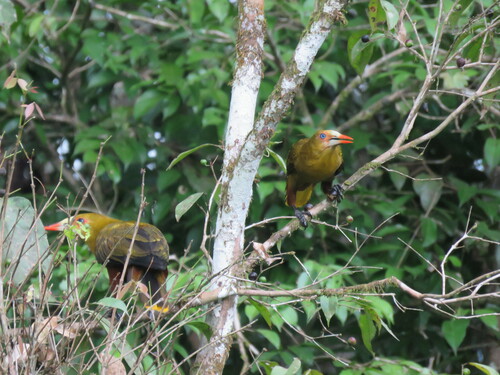 ミドリオオツリスドリ
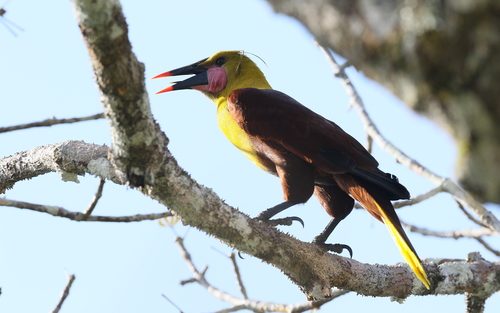 チャバラオオツリスドリ
要点
The most reliable field mark between Green and Olive Oropendolas is the head and upper breast coloration in adults: Green Oropendola has a mostly yellowish-olive head and body, while the nominate Olive Oropendola (P. b. bifasciatus) shows a striking blackish-brown 'hood' on the head, neck, and upper breast, sharply set off from the chestnut body. Subspecies of Olive Oropendola (especially P. b. yuracares and P. b. neivae) can look more olive-headed, but even then, the transition between head and chestnut underparts is sharper and the face patch and bill color differ. Both species are large, long-tailed icterids with similar structure and both sexes have a nape crest in males, but subtle differences in facial skin color, bill pattern, and iris color help. Juveniles are duller in both, but the head color and contrast with the body remain key. Size is not reliably separable in the field, as both are very large and overlap in mass and length.
識別のコツ
- Head and Upper Breast Color (Adult nominate Olive Oropendola): Look for the blackish-brown hood on the head, neck, and upper breast of Olive Oropendola (P. b. bifasciatus). Green Oropendola lacks this hood, being yellowish-olive throughout the head and body. This is the most reliable mark in adults.
- Head/Body Contrast (All subspecies): In Green Oropendola, the head and body are similar in color, blending smoothly. In Olive Oropendola (especially P. b. yuracares and P. b. neivae), the yellow-olive or olive-green head and upperparts are sharply demarcated from the chestnut underparts.
- Facial Skin Patch: Olive Oropendola has a bare pinkish skin patch on the face (all subspecies), while Green Oropendola shows pink to dull orange skin around the eye and lores, but not as a distinct patch.
- Bill Color: Green Oropendola has a bill with a pea-green base and orange-red tip. Olive Oropendola's bill is mostly black with a vermilion (red) outer third (nominate), or yellow to reddish-orange tip (P. b. yuracares), or red (P. b. neivae). The base color is darker in Olive Oropendola.
- Iris Color: Adult Green Oropendola has a pale blue iris, while Olive Oropendola has a dark brown iris. Juveniles of both have dark brown eyes, so this mark is best for adults.
- Wing Color (Perched): Green Oropendola's wings are dusky olive, blending with the body. Olive Oropendola's wings are mostly black with chestnut edges (nominate), or mostly chestnut with black inner edges (P. b. yuracares). This can be subtle but helps when seen well.
- Tail Pattern: Both have yellow tails with central olive/brown feathers. In Olive Oropendola, the central feathers are shorter, so the tail often looks all yellow from below. In Green Oropendola, the central pair are dusky olive and may be more visible.
- Chestnut Distribution: Green Oropendola shows chestnut on the rump, uppertail coverts, belly, thighs, and crissum, but the color is less sharply defined than in Olive Oropendola, where the chestnut is extensive and sharply set off from the head/neck (especially nominate).
- Juvenile Plumage: Both are duller than adults, but Green Oropendola juveniles have a grayish wash below and less chestnut. Head color and contrast remain the best clues.
- Sexual Dimorphism: Males of both have a nape crest; females lack it but otherwise resemble males. This is not a separator between species.
- Size: Both species are very large and overlap in size and mass. Do not rely on size for separation.
- Habitat and Range: Both occur in the same Amazonian lowland forests. Green Oropendola also occurs in the Guianas, but this is not helpful within the main overlap zone.
- Behavior: Both nest colonially and display similarly. Behavior is not a reliable separator.
- Voice: No diagnostic vocal differences are described in the sources provided.
- Pitfalls: Subspecies of Olive Oropendola (especially P. b. yuracares and P. b. neivae) can look more olive-headed and thus closer to Green Oropendola. Focus on head/body contrast, facial skin color, and bill pattern in these cases.
大きさ
Both species are among the largest oropendolas, with nearly identical average body mass: Green Oropendola averages 310 g and Olive Oropendola 314 g [wikidata]. Males of both are around 48–53 cm long, females 34–38 cm, so length is not a reliable separator. Olive Oropendola is sometimes described as 'spectacularly large,' but in practice, size overlap is extensive and not a safe field mark. Both have long tails and a heavy, swollen-casqued bill.
羽色
- Adults (nominate Olive Oropendola vs Green Oropendola):
- Green Oropendola is mostly yellowish-olive overall, with pink to dull orange lores and orbital skin, a pale blue iris, dusky olive wings, and chestnut on the rump, belly, thighs, and crissum. The head and body blend smoothly in color.
- Olive Oropendola (P. b. bifasciatus) has a blackish-brown hood (head, neck, upper breast), sharply set off from the chestnut mantle, rump, and underparts. The face has a bare pinkish skin patch, the iris is dark brown, and the bill is mostly black with a vermilion tip. The wings are mostly black with chestnut edges.
- Subspecies (P. b. yuracares, P. b. neivae):
- P. b. yuracares has a yellow-olive head and upperparts with a sharp boundary to chestnut underparts, a pink face patch, and a bill with a yellow to reddish-orange tip.
- P. b. neivae is overall darker and more olive-green, with a deep olive crown and face, blackish crest, and a red bill tip.
- Juveniles:
- Both species' juveniles are duller than adults, with less extensive chestnut and a grayish wash below in Green Oropendola. Iris is dark brown in young Green Oropendola; Olive Oropendola juveniles are not described in detail, but expect similar dulling. The head color and contrast with the body remain the best clues.
- Tail:
- In both, the central tail feathers are olive or brown, the rest yellow. In Olive Oropendola, the shorter central feathers often make the tail look all yellow from below.
行動
Both species are colonial nesters, with males displaying by bowing and wing-shaking from a perch. Olive Oropendola males may also cock the tail and vibrate drooped wings. Both nest in hanging woven bags high in trees, and both forage in flocks, mainly in the canopy. No major behavioral differences are noted that are diagnostic in the field.
生息環境
Both species occur in lowland tropical forests of the Amazon basin, with extensive range overlap in Brazil, Bolivia, Colombia, Ecuador, Peru, and Venezuela. Green Oropendola also occurs in French Guiana, Guyana, and Suriname. Habitat preferences are not described as distinct enough to separate them reliably in the field.