

クーパーハイタカ 対 アメリカオオタカ
Astur cooperii 対 Astur atricapillus
クーパーハイタカとアメリカオオタカのクイズ
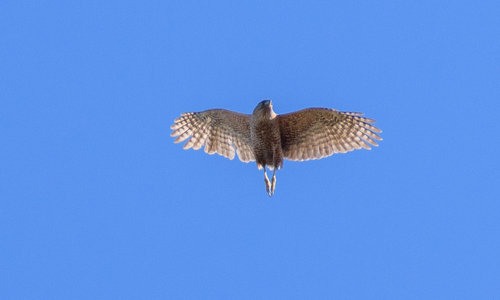 クーパーハイタカ
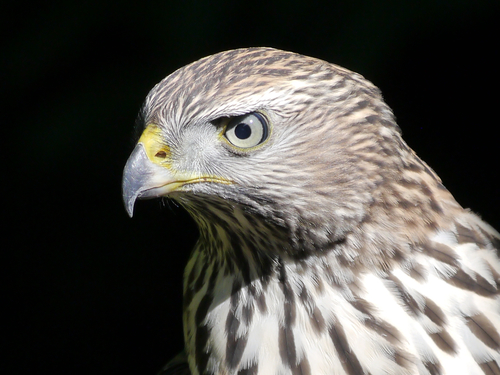 アメリカオオタカ
要点
Juvenile Cooper's Hawk and American Goshawk are most reliably separated by the pattern and shape of streaking on the underparts: Cooper's Hawk juveniles show narrow, teardrop-shaped streaks that taper at the top, while juvenile American Goshawks have heavier, more even vertical streaks. In flight, Goshawks look bulkier and broader-winged, with a shorter tail relative to body size, while Cooper's Hawks are slimmer with a proportionally longer, more graduated tail. Adult plumage is more distinct: Cooper's Hawk adults have rufous barring below and a capped appearance, while adult Goshawks have gray upperparts and never show rusty tones below. Structural differences—especially in perched birds—are subtle but can help when plumage is ambiguous.
識別のコツ
- Juvenile underpart streaking: Juvenile Cooper's Hawks show narrow, teardrop-shaped streaks that taper at the top, while juvenile American Goshawks have heavier, more even vertical streaks. This is the most reliable mark in fall and winter.
- Juvenile face pattern: Cooper's Hawk juveniles have a hooded look with tawny cheeks and a light nuchal strip; Goshawk juveniles lack this, appearing more uniform-headed.
- Adult underpart color: Adult Cooper's Hawks have rufous to cinnamon barring below; adult Goshawks never show rusty tones, only gray and white barring.
- Tail shape and pattern: Cooper's Hawk has a long, often graduated or wedge-shaped tail with three (sometimes four in juveniles) dark bands and a conspicuous white tip. Goshawk's tail is shorter relative to body, with less graduation and less contrast in the tip.
- Wing shape in flight: Goshawks are broader-winged and bulkier, with deeper, slower wingbeats. Cooper's Hawks are slimmer, with quicker, snappier flight.
- Head shape: Cooper's Hawk has a relatively large, squarish head with forward-set eyes; Goshawk's head is broader and more robust, but this can be subtle.
- Perched wing projection: On perched Cooper's Hawks, wing tips cover less than one-third of the tail, sometimes barely covering the coverts. Goshawk's wings appear relatively shorter in proportion to the tail when perched.
- Size: Goshawk is much larger and bulkier; however, beware of overlap in weight between small male Goshawks and large female Cooper's Hawks, especially at a distance.
- Adult crown: Cooper's Hawk adults have a well-defined blackish-brown crown contrasting with a paler nape, giving a capped look. Goshawks are more uniform-headed.
- Legs and toes: Both have long legs and toes, but Goshawk's are thicker and more robust, best seen at close range.
- Habitat context: Cooper's Hawks are more likely in suburban or urban areas, especially in winter. Goshawks are more strictly forest birds except during irruptions.
- Behavior: Cooper's Hawks are more likely to be seen using open perches (utility poles, isolated trees) in winter; Goshawks are more secretive and stick to deep woods.
- Sexual dimorphism: Both species have females larger than males, but this does not aid separation between species.
- Aberrant plumages: Rare pale or melanistic individuals exist in Cooper's Hawk but are exceptional and not a reliable field mark.
- Migration context: Goshawks may appear further south during irruption years, but are generally less numerous than Cooper's Hawks in most of their shared range.
大きさ
American Goshawk is distinctly larger and bulkier than Cooper's Hawk, with no overlap in wing or tail length between the species, though a small male Goshawk may approach a large female Cooper's Hawk in weight. Goshawks have a broader body, thicker legs, and a more robust overall build. Cooper's Hawk is medium-sized for a North American hawk, but small for an Astur, with a more slender, agile look.
羽色
-
Juvenile/immature: Juvenile Cooper's Hawks have brown upperparts with rufous or cinnamon edges and a hooded look due to tawny cheeks and a light nuchal strip. Their underparts show narrow, teardrop-shaped brown streaks on a whitish or cream base, often sharply defined from lower throat to breast, and their tail is brownish with 3–4 dark bands and a white tip. Juvenile American Goshawks are brown above and heavily, evenly streaked below with broad, vertical brown streaks (not teardrop-shaped), and lack any rusty or rufous tones on the underparts. Both have pale bases to the underparts, but Goshawk streaking is heavier and more uniform.
-
Adult: Adult Cooper's Hawks are blue-gray or brown-gray above with a blackish-brown crown, rufous to cinnamon barring below, and a capped appearance. Their tail is blue-gray above, pale below, with three even black bands and a conspicuous white tip. Adult American Goshawks are gray above and below, with no rusty color to the barring, and have a more uniform, less capped head. The adult Goshawk's underparts are finely barred gray and white, never rufous.
行動
Cooper's Hawks are secretive and often perch within the canopy, but may use more open perches in winter or in the western range. They are agile and quick in flight, with moderate-length wings and long tails suited for maneuvering through trees. American Goshawks are bulkier, with deeper, more deliberate wingbeats, and appear more powerful in flight. Goshawks are less likely to be seen in open areas and tend to be more elusive, especially outside of irruption years.
生息環境
Both species occur in forested habitats, but Cooper's Hawk is more adaptable and often found in suburban areas, parks, and even urban settings, especially in winter. American Goshawk favors mature forests and is less likely to be seen in open or developed areas, except during irruptions or migration. In the western and northern parts of their range, Goshawks are more strictly tied to extensive woodlands.