

ニッケイカザリドリモドキ 対 ハジロカザリドリモドキ
Pachyramphus cinnamomeus 対 Pachyramphus polychopterus
ニッケイカザリドリモドキとハジロカザリドリモドキのクイズ
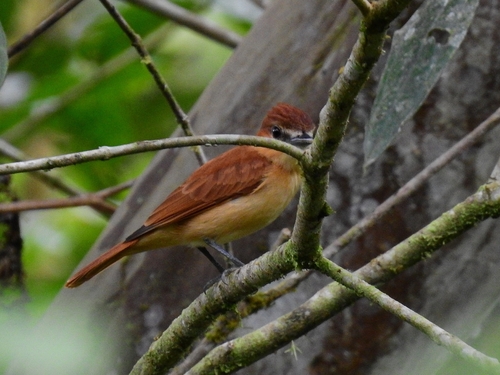 ニッケイカザリドリモドキ
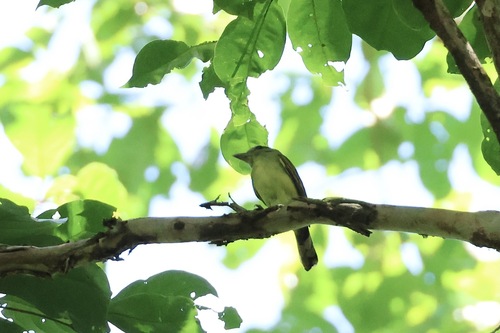 ハジロカザリドリモドキ
要点
The most reliable field mark between Cinnamon Becard and White-winged Becard is the presence of bold white wing bars and white-tipped tail feathers in adult male White-winged Becard, which are never shown by Cinnamon Becard of any age or sex. Cinnamon Becard is a uniform rufous or cinnamon bird with no contrasting wing or tail markings, while White-winged Becard (especially males) shows strong black-and-white contrast on the wings and tail. Females of both can be confusing, but Cinnamon Becard is always warm-toned and lacks any white in the wings or tail, while female White-winged Becard is olive or brownish with buffy or cinnamon wing edgings and pale underparts. Both are similar in size and overlap in much of Central America, so close attention to wing and tail pattern is essential.
識別のコツ
- White wing bars and tail tips: Adult male White-winged Becard always shows bold white wing bars and white tips to the tail feathers (except the central pair). Cinnamon Becard never shows white in the wings or tail at any age or sex.
- Overall color tone: Cinnamon Becard is warm rufous or cinnamon above and below, with ochraceous or tawny underparts. White-winged Becard males are black and gray, while females are olive or brownish above and pale yellowish below.
- Crown and face: Cinnamon Becard has a deep rufous crown and ochraceous-tawny cheeks, with a pale buff line above the lores. Female White-winged Becard has a brown-olive crown, a pale whitish supercilium, and a partial white eye-ring, with a yellowish face.
- Upperparts: Cinnamon Becard is uniform rufous or chestnut above; female White-winged Becard is brownish-olive to greenish-olive, sometimes with a slight rufescent tinge in some subspecies, but never as rich or uniform as Cinnamon Becard.
- Wing pattern in females: Female White-winged Becard shows wide buff-cinnamon edges on the scapulars, coverts, and inner flight feathers, but these are never as broad or as contrasting as the white wing bars of the male, and the overall color is olive or brownish, not rufous. Cinnamon Becard females lack any contrasting wing edgings.
- Tail pattern in females: Female White-winged Becard has blackish tail feathers with buff-cinnamon tips, while Cinnamon Becard has a uniform rufous tail.
- Underparts: Cinnamon Becard is ochraceous-tawny to cinnamon-buff below, paler on the throat and belly, with a rufous tinge across the breast. Female White-winged Becard is pale yellowish below with an olive tinge on the breast and sides, and the throat is grayish yellow.
- Sexual dimorphism: Cinnamon Becard sexes are similar. White-winged Becard shows strong sexual dimorphism: males are black and white, females are olive and yellowish.
- Bill and legs: Both have a blackish bill (sometimes with a paler mandible in Cinnamon Becard) and dark gray legs; these are not reliable for separation.
- Iris color: Both have a dark iris; not a separator.
- Subspecies variation: Cinnamon Becard subspecies vary mainly in the richness of rufous and the paleness of underparts, but always remain in the warm rufous/cinnamon range. White-winged Becard subspecies vary in the amount of white in the wings and tail and the shade of underparts, but the male always shows some black and white contrast.
- Geographic context: If in Mexico, only Cinnamon Becard is expected. In Trinidad, only White-winged Becard occurs. In most of Central America and northern South America, both can occur together.
- Habitat: Not a reliable separator where ranges overlap.
- Voice: Not described in the sources; do not rely on song or call for separation here.
- In flight: Look for white flashes in the wings and tail for male White-winged Becard; Cinnamon Becard will show uniform rufous tones with no white.
大きさ
Both species are very close in size, with Cinnamon Becard at 14–15 cm and 17–22 g, and White-winged Becard at 14–15.5 cm and 19.5–21 g [wikipedia][avonet]. In the field, neither is noticeably larger or smaller than the other, and size is not a reliable separator.
羽色
Adult male White-winged Becard is instantly separated by its glossy black upperparts, bold white wing bars, and white tips to the tail feathers (except the central pair). Cinnamon Becard of all ages and sexes is warm rufous or cinnamon above and below, with no white in the wings or tail. Female White-winged Becard has brown-olive to greenish-olive upperparts, pale yellowish underparts, and buff-cinnamon edges on wing coverts and flight feathers, plus a pale whitish supercilium and partial eye-ring; its tail is blackish with buff-cinnamon tips. Cinnamon Becard females are much warmer overall, with deep rufous crown, ochraceous-tawny cheeks, and uniform rufous or chestnut upperparts, lacking any olive or greenish tones. Juvenile and immature plumages are not described in detail for either species, but the strong white wing bars and tail tips in male White-winged Becard are diagnostic at all ages where present, and Cinnamon Becard never shows these features. Subspecific variation in both is minor compared to these main contrasts.
行動
No strong behavioral differences are described in the sources. Both species are typical becards, often seen perched quietly or moving through mid-levels of forest and edge. Behavior is not a reliable separator in the field.
生息環境
Both species overlap widely in Central America and northern South America, and both use a range of wooded habitats from forest edge to secondary growth. Cinnamon Becard is absent from El Salvador and has a more northern range limit (Mexico), while White-winged Becard is more widespread, reaching Trinidad and nearly all of South America except Chile. However, in areas of overlap, habitat is not a reliable separator.