

Atlantic Yellow-nosed Albatross 対 Indian Yellow-nosed Albatross
Thalassarche chlororhynchos 対 Thalassarche carteri
Atlantic Yellow-nosed AlbatrossとIndian Yellow-nosed Albatrossのクイズ
 Atlantic Yellow-nosed Albatross
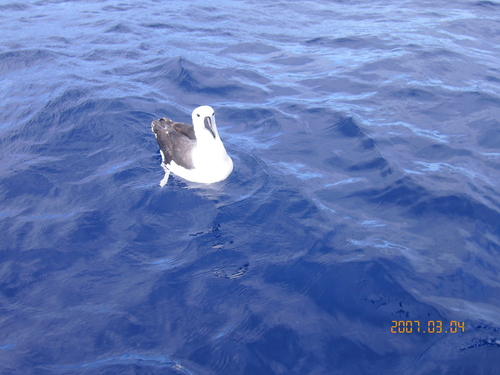 Indian Yellow-nosed Albatross
要点
The most reliable field mark between Atlantic and Indian Yellow-nosed Albatross is the color and tone of the head: Atlantic shows a distinctly darker grey head with a pronounced dark eye patch, while Indian is paler-headed, often appearing almost white or very pale grey. Juvenile birds of both species have white heads and all-black bills, making them nearly indistinguishable at that age. In flight, both show a narrow black margin to the underwing, but the Atlantic's margin is typically thinner and more sharply defined. Bill color is subtly different in adults, with Atlantic having a pink tip and Indian a red tip, but this is rarely visible at sea. Structure and size are similar, though Indian is slightly heavier on average.
識別のコツ
- Head Color in Adults: The most consistent field mark is head color. Atlantic Yellow-nosed has a noticeably darker grey head with a strong dark eye patch, while Indian Yellow-nosed is much paler-headed, often appearing nearly white. This is most visible in good light and at close range.
- Juvenile Pitfall: Juveniles of both species have white heads and all-black bills, making them almost impossible to separate visually. Do not attempt identification to species for young birds unless in a known breeding area.
- Underwing Pattern: Both species show a narrow black margin around the underwing, but Atlantic's margin is slightly thinner and more sharply defined. This is a subtle difference and not always reliable in poor light or distant views.
- Bill Color: In adults, both have a black bill with a yellow ridge, but Atlantic has a pink tip and Indian a red tip. This difference is extremely subtle and rarely visible unless the bird is very close and well-lit.
- Size and Structure: Indian Yellow-nosed is slightly heavier, but both are among the smallest mollymawks and have similarly narrow wings. Size is not a reliable field mark.
- Eye Patch: Atlantic shows a more pronounced dark eye patch due to the darker head, while Indian's pale head makes the eye patch less obvious.
- Upperwing and Saddle: Both species have a blackish-grey upperwing and saddle, with no reliable difference for field separation.
- Tail and Rump: Both have a dark tail and white rump; this is not a separating feature.
- Flight Jizz: Both species glide with stiff, narrow wings, typical of mollymawks. There is no known difference in flight style.
- Breeding Range (context only): If seen near breeding islands, range may help (Atlantic breeds in South Atlantic, Indian in southern Indian Ocean), but at sea this is rarely diagnostic due to overlap.
- Confusion with Other Mollymawks: Both can be confused with Grey-headed and Salvin's Albatross, but those species have broader wings or different bill colors. Focus on head color for separation between Atlantic and Indian.
- Sex and Season: No sexual dimorphism or seasonal plumage change is noted in either species.
- Plumage Wear: Both species may show faded or worn plumage at sea, but this does not affect the key head color difference.
- Lighting Effects: Be aware that strong sunlight or shadow can make the head appear paler or darker than it is; try to view from multiple angles.
- Do Not Rely on Voice: No useful vocal differences are noted for field separation.
大きさ
Indian Yellow-nosed Albatross is somewhat heavier (average body mass 2710g vs 2060g for Atlantic), but both are among the smallest mollymawks and are very close in length (Atlantic: 81 cm, Indian: 76 cm). In the field, this size difference is subtle and not a reliable separation point. Both have relatively narrow wings compared to other mollymawks, but Salvin's and Grey-headed Albatrosses are broader-winged and not likely to be confused here.
羽色
- Juveniles: Both species' juveniles have white heads and all-black bills, making them essentially indistinguishable at this age. The upperwing and underwing patterns are similar, with a narrow black margin to the underwing.
- Adults: The key difference is the head color: Atlantic adults have a darker grey head with a prominent dark eye patch, while Indian adults have a much paler (almost white or very pale grey) head and nape. Both have blackish-grey upperwings, saddle, and tail, and predominantly white underparts. The underwing in both is white with a narrow black margin, but the Atlantic's is thinner and more sharply defined. Bill color is black with a yellow ridge in both, but Atlantic has a pink tip and Indian a red tip. These bill tip colors are subtle and rarely diagnostic at sea.
行動
Both species are typical mollymawks in flight, gliding low over the ocean with stiff, narrow wings. There is no noted behavioral difference in flight style, posture, or foraging that would reliably separate them in the field. Both are pelagic and rarely seen close to shore except near breeding islands.
生息環境
There is no diagnostic habitat difference when seen at sea, as both are pelagic and overlap in range in the southern oceans. Breeding ranges are different (Atlantic breeds on islands in the South Atlantic, Indian on islands in the southern Indian Ocean), but this is not helpful for at-sea identification.
Atlantic Yellow-nosed Albatross · Indian Yellow-nosed Albatross · 苦手な鳥