

アマゾンアリモズ 対 ソリハシヤブアリドリ
Thamnophilus amazonicus 対 Clytoctantes alixii
アマゾンアリモズとソリハシヤブアリドリのクイズ
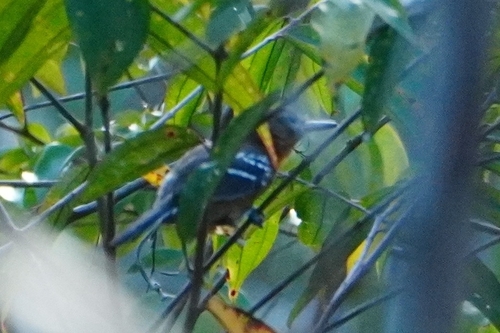 アマゾンアリモズ
 ソリハシヤブアリドリ
要点
The most reliable field mark to separate Amazonian Antshrike from Recurve-billed Bushbird is the bill: the bushbird’s bill is massive, pale, and dramatically upturned, while the antshrike’s is stout but straight and dark. Adult males of both are mostly dark gray to blackish, but the bushbird male shows a unique white shoulder patch and black throat, while the antshrike male has a black crown and more obvious white spotting on the wings and tail. Females are both rufous-crowned, but the antshrike female is brighter and more yellowish below, with olive on the back, versus the bushbird female’s overall darker, more uniform rufous-brown. In flight or perched, the bushbird’s short tail and heavy, upturned bill give it a stockier, more bull-headed look. Habitat is also a strong clue: bushbird is a local Andean specialty of dense secondary growth, while antshrike is widespread in Amazonian lowlands.
識別のコツ
- Bill shape and color: The bushbird’s bill is huge, pale horn-colored, laterally compressed, and curves sharply upward (upturned mandible)—unique among antbirds. The antshrike’s bill is stout and hooked but straight and dark. This is the single most reliable field mark at any age.
- Head and jizz: Bushbird looks bull-headed and stocky, with a short tail and massive bill; antshrike is sleeker, longer-tailed, and less heavy-headed.
- Adult male plumage: Bushbird males are dark gray with a black throat, lores, and upper breast, and a conspicuous white patch between the shoulders. Antshrike males have a black crown and forehead, gray head and underparts, black back with gray rump, and more obvious white spotting on wings and tail. The antshrike’s white scapular patch is usually hidden.
- Adult female plumage: Both have rufous crowns, but antshrike females are brighter, with yellowish red-brown underparts, deep olive back, and buff belly. Bushbird females are darker, more uniform rufous-brown above and reddish-brown below, with blackish wings and tail and pale rufous tips on the wing coverts.
- Juvenile/subadult bushbird: Subadult bushbirds are dark yellowish and blackish brown with reddish yellow-brown on the head and throat, and white dots on the wing coverts—no similar plumage is described for antshrike, so this is diagnostic for young bushbirds.
- Wing and tail pattern in flight: Antshrike (both sexes) shows more prominent white spots and tips on the wings and tail, especially visible in flight or when fanned. Bushbird’s markings are much less contrasting—males have small black spots on the coverts, females have pale rufous tips, but overall the wings and tail look darker and plainer.
- Crown color (females): Antshrike females have a bright rufous crown contrasting with olive back and buff belly; bushbird females have a dark rufous-brown crown blending into the back and rump.
- Shoulder patch (males): Bushbird males have a conspicuous white patch between the shoulders, visible when perched or in flight. Antshrike males have a hidden white scapular patch, rarely seen.
- Underpart color (females): Antshrike females are brighter and more yellowish below, while bushbird females are darker reddish-brown, especially on the flanks and undertail.
- Tail length and shape: Bushbird has a short tail, accentuating its stocky look; antshrike’s tail is longer and more typical of Thamnophilus antshrikes.
- Habitat and range: If you are in Amazonian lowland forest, it is almost certainly antshrike. Bushbird is restricted to dense secondary growth (often bamboo) in the northern Andes of Colombia and Venezuela.
- Behavior: Antshrike is often with mixed flocks and forages more openly; bushbird is secretive and rarely seen, often in dense bamboo.
- Size: Bushbird is slightly larger and bulkier (16–17 cm) than antshrike (14–15 cm), but this is subtle and less reliable than bill shape or plumage.
- Sexual dimorphism: Both species are sexually dimorphic, but the pattern differs: antshrike females are brighter and more contrasting, bushbird females are darker and more uniform.
- Voice: No diagnostic vocal differences are described in the sources; rely on visual marks.
大きさ
Recurve-billed Bushbird is slightly larger and bulkier (16–17 cm) than Amazonian Antshrike (14–15 cm) [wikipedia]. The bushbird is notably stockier with a shorter tail, while the antshrike is more slender and longer-tailed for its size. The bushbird’s bill is much larger and more prominent, accentuating its heavy-headed appearance. Weight is only given for antshrike (17–21 g), but the bushbird’s build suggests it is heavier for its length.
羽色
-
Juvenile/subadult plumage: Only the bushbird has described subadult plumage: subadult males are dark yellowish and blackish brown, with reddish yellow-brown on the forehead, sides of head, and throat, and white dots on the wing coverts. No juvenile/immature plumage is described for the antshrike, so this contrast is diagnostic for young bushbirds.
-
Adult males: Both are mostly dark gray to blackish, but the bushbird male has a black throat and lores, a white patch between the shoulders, and brownish-black flight feathers with small black spots on the coverts. The antshrike male has a black crown and forehead, gray elsewhere on the head and underparts, black back with a gray rump, and more extensive white spots and tips on the wings and tail. The antshrike’s white scapular patch is usually hidden.
-
Adult females: Both show rufous crowns, but the antshrike female is brighter and more yellowish below, with a deep olive back and buff belly, and wings/tail similar to the male but browner with pale olive edges. The bushbird female is overall dark rufous-brown above, blackish wings and tail with pale rufous tips on the coverts, and reddish-brown underparts that are darker on the flanks and undertail. The antshrike female’s underparts are brighter and more contrasting than the bushbird’s.
-
Wing and tail pattern: The antshrike (both sexes) shows more prominent white spots and tips on the wings and tail, especially in flight. The bushbird’s wing coverts have small black spots (male) or pale rufous tips (female), but the overall effect is much less contrasting.
行動
Amazonian Antshrike forages singly or in pairs, often joining mixed-species flocks and sometimes following army ant swarms. It moves through thickets and vine tangles, gleaning insects from leaves and branches, and makes short sallies. The bushbird’s behavior is less well described, but it is associated with dense secondary growth and bamboo, and has been seen at ant swarms. The bushbird is more secretive and localized, while the antshrike is more likely to be seen moving with other birds in the midstory.
生息環境
Habitat is a strong separator. Amazonian Antshrike is widespread in lowland Amazonian forests across most of tropical South America (except the southern cone), favoring thickets and vine tangles in humid forest. Recurve-billed Bushbird is highly local, found only in dense stands of secondary vegetation (often bamboo) at the northern end of the Andes in Colombia and Venezuela. If you are in the Amazon basin, you are almost certainly seeing antshrike; if in Andean foothills with dense bamboo, bushbird is possible.
アマゾンアリモズ · ソリハシヤブアリドリ · 苦手な鳥