

Spoon-billed Sandpiper vs Gray-crowned Yellowthroat
Calidris pygmaea contro Geothlypis poliocephala
Fai un quiz con Spoon-billed Sandpiper e Gray-crowned Yellowthroat
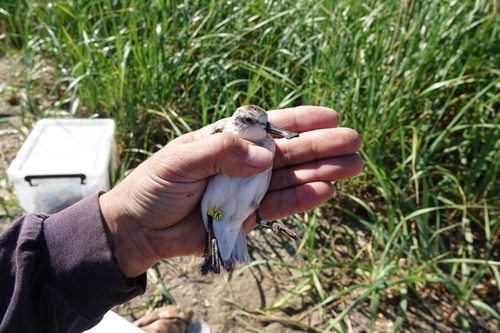 Spoon-billed Sandpiper
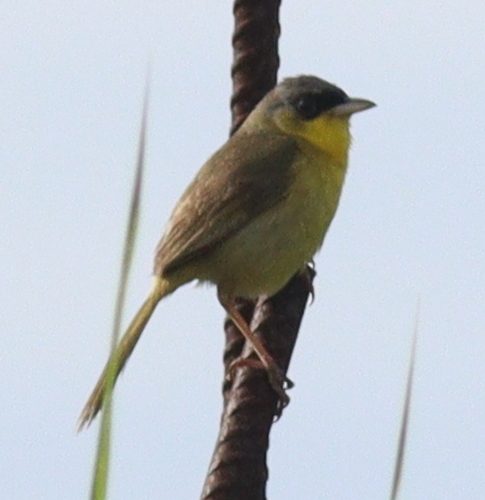 Gray-crowned Yellowthroat
In breve
The most reliable way to separate Spoon-billed Sandpiper from Grey-crowned Yellowthroat is by bill shape: the sandpiper’s bill is uniquely spatulate at the tip, while the yellowthroat has a stout, slightly curved warbler bill. In flight or at rest, Spoon-billed Sandpiper is a compact, short-legged shorebird with black legs and a white belly, whereas Grey-crowned Yellowthroat is a longer-tailed, yellow-bellied songbird with olive and gray tones. Both are similar in length, but their structure, habitat, and behavior are completely different. If you see a bird probing mudflats with a spoon-shaped bill, it is the sandpiper; if you see a bird flitting in grasslands or shrubs with a strong yellow throat and a dark-capped head, it is the yellowthroat.
Consigli di identificazione
- Bill shape is diagnostic: Spoon-billed Sandpiper has a broad, flat, spoon-shaped bill tip at all ages and seasons; Grey-crowned Yellowthroat has a stout, slightly curved, pointed warbler bill. If you see a spatulate bill, it is always the sandpiper.
- Leg color and length: Spoon-billed Sandpiper has short, black legs; Grey-crowned Yellowthroat has dark brownish legs that are proportionally longer relative to body size, but not as obvious as the sandpiper’s.
- Tail shape and length: The sandpiper has a short, straight tail; the yellowthroat has a long, graduated tail often cocked or flicked.
- Body structure: Spoon-billed Sandpiper is compact and crouched, typical of small shorebirds; Grey-crowned Yellowthroat is more elongated, upright, and perches in vegetation.
- Plumage (breeding adult): Spoon-billed Sandpiper has a red-brown head and breast with dark streaks, blackish upperparts with rufous/buff fringes, and white underparts; Grey-crowned Yellowthroat males have a gray crown, black lores, white eye crescents, olive-gray upperparts, and yellow underparts.
- Plumage (non-breeding adult): Spoon-billed Sandpiper becomes pale brownish-gray above with whitish fringing, but always has a white belly and the spatulate bill; yellowthroat remains yellow below and olive/gray above.
- Face pattern: Spoon-billed Sandpiper has a plain face with dark streaks; Grey-crowned Yellowthroat males have a contrasting gray crown, black lores, and white eye crescents, never seen in sandpipers.
- Juvenile/immature separation: No detailed upperwing pattern is described for either, but the sandpiper’s bill remains diagnostic at all ages.
- Habitat: Sandpiper is always on mudflats, estuaries, or tidal areas; yellowthroat is in grasslands, marshes, or shrubby fields, never on open mud.
- Behavior: Sandpiper probes mud with a sweeping motion; yellowthroat moves through vegetation, perching and flicking its tail.
- Flight: Sandpiper’s flight is direct and low over water or mud; yellowthroat’s flight is short, bounding, and usually between vegetation.
- Voice: Sandpiper gives simple, quiet calls and a buzzing trill in display; yellowthroat likely sings a more complex warbler song (not described here).
- Sexual dimorphism: Yellowthroat males have bold face patterns; females are duller but still show yellow underparts and olive/gray upperparts. Sandpiper shows little sexual dimorphism.
- Seasonal context: If in Southeast Asia on a tidal flat in winter, look for Spoon-billed Sandpiper; if in Central America in grassland or marsh, expect Grey-crowned Yellowthroat.
- Common pitfalls: Do not confuse the yellowthroat’s yellow underparts for a sandpiper’s white belly; do not overlook the sandpiper’s unique bill, which is never matched by any warbler.
Taglia
Both species are about 14–16 cm long ([wikipedia]), but Spoon-billed Sandpiper is a small, compact wader with a short tail and black legs, while Grey-crowned Yellowthroat is a slightly heavier-bodied, longer-tailed warbler (13–16 g) with dark brownish legs and a more upright posture. The sandpiper’s proportions are typical of a small shorebird, whereas the yellowthroat is more elongated and perches upright.
Piumaggio
No age-specific upperwing pattern is described for either species, so separation relies on body and head plumage. Spoon-billed Sandpiper (adult breeding) shows a reddish-brown head, neck, and breast with dark streaks, blackish upperparts with buff and rufous fringes, and a white belly; non-breeding adults are pale brownish-gray above with whitish fringing, always with white underparts. The most distinctive feature at all ages is the broad, flat bill tip. Grey-crowned Yellowthroat males have an olive-gray head with a gray crown, black lores, and white eye crescents, with yellow throat, breast, and undertail coverts, and grayish olive-brown upperparts. Females are duller, with grayish lores and less contrast. Both sexes have yellow underparts and olive/gray upperparts, lacking any rufous or blackish upperparts. The yellowthroat’s face pattern (gray crown, black lores, white crescents) is unique among warblers but never resembles a sandpiper’s plain face. Juvenile/immature plumages are not described in detail for either species, but the sandpiper’s spatulate bill is present at all ages.
Comportamento
Spoon-billed Sandpiper is typically seen foraging on coastal mudflats, probing with its unique bill, often in small groups or singly, and shows a crouched, rapid feeding motion. In flight, it is compact and direct. Grey-crowned Yellowthroat is a terrestrial songbird, usually found in pairs or small groups in grasslands, marsh edges, or shrubby fields, moving through vegetation with short flights and frequent perching. It does not probe mud or wade.
Habitat
Spoon-billed Sandpiper is strictly a coastal mudflat and estuary specialist, breeding in Arctic tundra near the Bering Sea and wintering on Southeast Asian tidal flats. Grey-crowned Yellowthroat is a terrestrial warbler of grasslands, marshes, and shrubby areas from Mexico to Panama, never found on open mudflats or beaches. If you are in a wetland or grassy field away from tidal flats, you are far more likely to see a yellowthroat.
Voce
Spoon-billed Sandpiper gives quiet 'preep' or shrill 'wheer' calls, and the male’s display song is a buzzing, descending trill ('preer-prr-prr'). Grey-crowned Yellowthroat’s vocalizations are not described here, but as a warbler, it is likely more musical and varied than the sandpiper’s simple calls. If you hear a buzzing trill from a bird in flight over mudflats, consider Spoon-billed Sandpiper.
Spoon-billed Sandpiper · Gray-crowned Yellowthroat · I miei uccelli difficili