

Northern Red-fronted Tinkerbird vs Southern Yellow White-eye
Pogoniulus uropygialis contro Zosterops anderssoni
Fai un quiz con Northern Red-fronted Tinkerbird e Southern Yellow White-eye
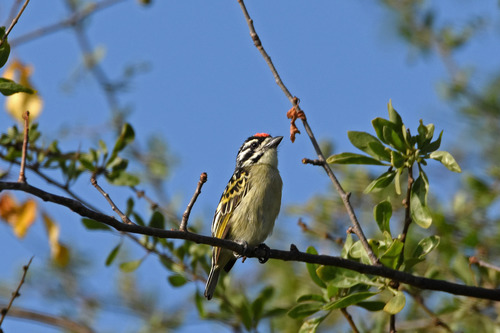 Northern Red-fronted Tinkerbird
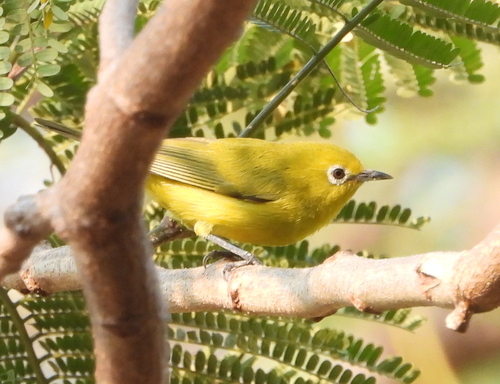 Southern Yellow White-eye
In breve
The most reliable field mark separating these two is the red frontal patch above the bill in adult male Northern Red-fronted Tinkerbird, which is never present on Southern Yellow White-eye. Immature tinkerbirds can be tricky, but they are slightly smaller and have a darker back than Yellow-fronted Tinkerbird (not directly compared here), while white-eyes lack any red on the face and instead show a prominent white eye-ring. Structurally, tinkerbirds are small, thick-billed barbets, while white-eyes are slimmer, with finer bills and a more active, flitting demeanor. Vocalizations are also distinct: tinkerbirds give a repetitive 'took' call, while white-eyes have different, less monotonous calls. Habitat and range do not overlap much, with tinkerbirds in East Africa and white-eyes in southern Africa.
Consigli di identificazione
- Red frontal patch: Only adult male Northern Red-fronted Tinkerbird shows a bright red patch above the bill. If you see this, it's diagnostic.
- White eye-ring: Southern Yellow White-eye always has a bold white eye-ring, which is never present on tinkerbirds of any age or sex.
- Bill shape: Tinkerbird has a stout, heavy, barbet-like bill; white-eye has a fine, pointed bill. This is visible even at a distance with binoculars.
- Head and body proportions: Tinkerbird looks big-headed and compact; white-eye is slim and small-headed.
- Plumage color: Tinkerbird is more patterned, with a contrasting face (especially in males), while white-eye is mostly yellow-green with no facial pattern except the eye-ring.
- Juvenile confusion: Immature tinkerbirds lack the red patch and can look plainer, but still have a darker back and more barbet-like structure than any white-eye.
- Flight style: Tinkerbird flies in short, direct bursts and perches upright; white-eye is constantly flitting, rarely still, and often in groups.
- Vocalizations: If you hear a repetitive 'took' call, it's a tinkerbird. White-eyes never make this sound.
- Habitat and range: If you are in East Africa, tinkerbird is possible; in southern Africa, white-eye is more likely. They do not overlap.
- Group behavior: White-eyes are often in small, noisy flocks; tinkerbirds are usually solitary or in pairs.
- Perched posture: Tinkerbird perches upright and still; white-eye is more horizontal and restless.
- Facial pattern: Only white-eye shows a clean, unmarked face with a white ring; tinkerbird's face is more patterned, especially in males.
- Back color in immatures: Immature tinkerbirds have a darker back compared to similar tinkerbirds, but always lack the white-eye's clean, uniform greenish back.
- Sex differences: Only male tinkerbirds show the red frontal patch; females and immatures do not, so use structure and behavior in those cases.
- Context: If you see a bird in a mixed flock with sunbirds and other small insectivores, it's likely a white-eye; tinkerbirds are less social.
Taglia
Northern Red-fronted Tinkerbird is a small barbet, but still noticeably chunkier and more robust than the Southern Yellow White-eye, which is a tiny, slim, and more delicate bird. While exact measurements are not provided, the tinkerbird's bill is stouter and head proportionally larger, giving it a more compact, big-headed look compared to the daintier, finer-billed white-eye.
Piumaggio
- Adults: Male Northern Red-fronted Tinkerbird shows a bright red patch above the bill, which is absent in all white-eyes. Both sexes of Southern Yellow White-eye have a yellow-green plumage with a conspicuous white eye-ring and no red anywhere on the face.
- Immatures/Juveniles: Immature tinkerbirds can be confused with other tinkerbirds, but not with white-eyes; they lack the red frontal patch, are slightly smaller, and have a darker back than Yellow-fronted Tinkerbird. White-eye immatures resemble adults, with the same white eye-ring and yellowish tones, and never show any red or barbet-like facial pattern.
- In flight: No distinctive upperwing pattern is described for either species in the sources, so flight separation relies on structure and jizz rather than plumage.
Comportamento
Northern Red-fronted Tinkerbird tends to perch more upright and still, often remaining motionless while calling from a prominent perch. Southern Yellow White-eye is much more active, constantly flitting through foliage, often in small groups, and rarely sitting still for long. The tinkerbird's behavior is more barbet-like, while the white-eye is reminiscent of a hyperactive warbler.
Habitat
Northern Red-fronted Tinkerbird is found in East Africa, while Southern Yellow White-eye is found in southern Africa, so their ranges do not overlap. In their respective regions, tinkerbirds are more likely in woodland or forest edge, while white-eyes frequent gardens, woodlands, and bush, often in mixed-species flocks.
Voce
Northern Red-fronted Tinkerbird gives a monotonous, repetitive 'took' call, often in long series, and also produces higher-pitched, two- or three-part calls and a rapid trill. Southern Yellow White-eye does not give such a repetitive, barbet-like call; its vocalizations are more varied and less mechanical, typically high-pitched and twittering, but not described in detail here.
Northern Red-fronted Tinkerbird · Southern Yellow White-eye · I miei uccelli difficili