

Green-and-rufous Kingfisher vs Rusty-margined Flycatcher
Chloroceryle inda contro Myiozetetes cayanensis
Fai un quiz con Green-and-rufous Kingfisher e Rusty-margined Flycatcher
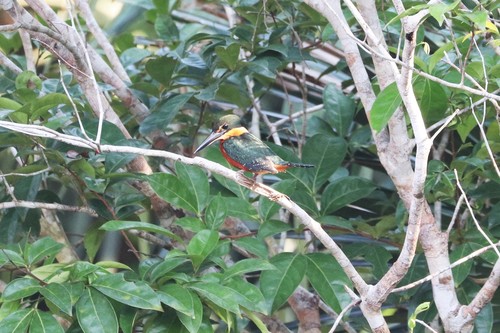 Green-and-rufous Kingfisher
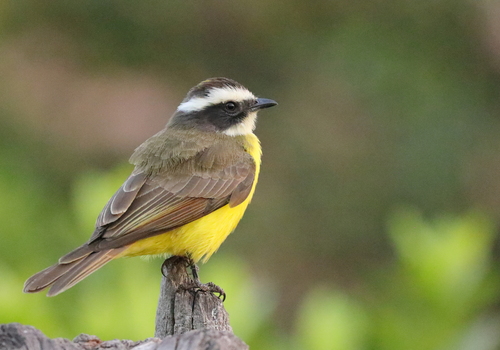 Rusty-margined Flycatcher
In breve
The most reliable field separation between Green-and-rufous Kingfisher and Rusty-margined Flycatcher is structural: the kingfisher has a long, heavy bill and a compact, big-headed, short-tailed profile, while the flycatcher shows a much shorter, stubby bill and a more typical songbird shape with a longer tail and upright posture. Juvenile kingfishers have a green breastband and heavy upperpart spotting, which can be confused with the flycatcher's wing and tail edges, but the kingfisher's rufous underparts and white-spotted green upperparts are unique. In flight or perched, look for the kingfisher’s white-spotted wings and rich rufous belly versus the flycatcher’s bright yellow underparts and rusty-edged wings. Both species occur in overlapping regions, but their behavior and structure are very different.
Consigli di identificazione
- Bill shape and size: Green-and-rufous Kingfisher has a long, heavy, dagger-like bill (black with pale yellow at the base), much larger than the stubby, black bill of Rusty-margined Flycatcher. This is the most reliable structural difference at any age.
- Head and crest: Kingfisher has a shaggy crest and a proportionally massive head, giving a top-heavy look. Flycatcher’s head is more rounded, with a dark sooty crown and a hidden yellow crown patch in adults.
- Breastband in juveniles: Juvenile and female kingfishers show a green breastband with white speckles; males have a thin green band, but all have rufous underparts. Flycatcher never shows a breastband—its underparts are always bright yellow, sharply set off from the white throat.
- Upperwing pattern: Kingfisher (all ages) has white-tipped coverts and small white spots on secondaries, tertials, and tail; flycatcher has rusty or cinnamon-rufous edges (never white spots) on the wings and tail, which are more obvious in juveniles and some subspecies.
- Underparts color: Kingfisher’s underparts (except chin/throat) are rich dark rufous; flycatcher’s are bright yellow from breast to vent, with a white chin and throat.
- Supercilium: Flycatcher has a bold white supercilium extending well past the eye; kingfisher lacks any supercilium, with a plain green head and pale collar.
- Tail: Kingfisher’s tail is short and green with white spots; flycatcher’s is longer, dusky brown with olive or rusty edges, never spotted.
- Leg color: Kingfisher’s legs and feet are pinkish to dark gray; flycatcher’s are black.
- Perching posture: Kingfisher sits horizontally, often low over water; flycatcher perches upright, often higher up and away from water.
- Habitat context: If seen away from water, rule out kingfisher. If perched over a stream or river, check for kingfisher structure and plumage.
- Flight style: Kingfisher flies fast and direct, usually low over water; flycatcher has a more bounding, undulating flight, often sallying out and returning to a perch.
- Crown patch: Adult flycatchers have a hidden yellow or golden-orange crown patch, sometimes visible when agitated; kingfisher’s crown is plain green.
- Sex differences: Only female and juvenile kingfishers show a broad green breastband; male kingfishers have a thin green band or none, but all have rufous underparts. Flycatcher sexes are alike.
- Juvenile confusion: Juvenile kingfishers have heavier white spotting above and a green breastband, but never the yellow underparts or white supercilium of the flycatcher. Juvenile flycatchers have more rusty-cinnamon on wings and tail, but no green or white spots.
- Size impression: Kingfisher is noticeably larger, bulkier, and heavier-billed than any flycatcher, even when perched at a distance.
Taglia
Green-and-rufous Kingfisher is larger and heavier (24 cm, 40–62 g) than Rusty-margined Flycatcher (16.5–18 cm, 22–29.5 g). The kingfisher appears more robust and compact, with a proportionally bigger head and bill, while the flycatcher is slimmer, with a longer tail and more delicate build. Even the largest flycatcher is notably lighter and shorter than the smallest kingfisher.
Piumaggio
- Juvenile Green-and-rufous Kingfisher: Both sexes show a green breastband and heavy white spotting on the green upperparts, which can superficially resemble the rusty and olive edges of the flycatcher’s wings, but the kingfisher always has a rich rufous belly and flanks, and white-spotted green wings and tail. The green breastband is thin in young males and broader in females and juveniles.
- Adult Green-and-rufous Kingfisher: Males have glossy green upperparts with white-tipped coverts and small white spots on the wings and tail, a pale yellowish collar, and entirely dark rufous underparts. Females are similar but with a broad green breastband with white speckles and more pale spotting above. Both sexes have a buffy rufous throat and chin.
- Rusty-margined Flycatcher (all ages): Never shows green or rufous underparts. Adults and juveniles have a dark sooty crown (with a hidden yellow crown patch in adults), a bold white supercilium, plain brown to olive-brown upperparts, and bright yellow underparts. Wings have thin rusty or cinnamon-rufous edges (bolder in some subspecies and juveniles), but never white spots. Juveniles lack the yellow crown patch and have more extensive rusty-cinnamon on wings and tail.
- Key contrast: Only the kingfisher has white-spotted green wings and tail, and rich rufous underparts; only the flycatcher has bright yellow underparts and a white supercilium.
Comportamento
Green-and-rufous Kingfisher is typically seen perched low over water, often on branches or roots near streams, scanning for fish and diving headfirst. It sits horizontally, with a large head and bill, and rarely flicks its tail. In flight, it is direct and fast, often low over water. Rusty-margined Flycatcher is usually found higher up, often in open woodland or forest edge, perching upright on exposed branches, sallying out to catch insects and returning to the same perch. It frequently flicks its tail and shifts position, and its flight is more bounding and less direct than the kingfisher’s.
Habitat
Both species occur in much of Central and South America, but Green-and-rufous Kingfisher is strictly tied to water—streams, rivers, and forested wetlands—where it hunts for aquatic prey. Rusty-margined Flycatcher is found in a wider range of habitats, including open woodland, forest edge, gardens, and even urban parks, and is not tied to water. If the bird is far from water, it is almost certainly not a Green-and-rufous Kingfisher.
Green-and-rufous Kingfisher · Rusty-margined Flycatcher · I miei uccelli difficili