

Hirondelle chalybée vs Hirondelle à gorge rousse
Progne chalybea contre Stelgidopteryx ruficollis
Faire un quiz avec Hirondelle chalybée et Hirondelle à gorge rousse
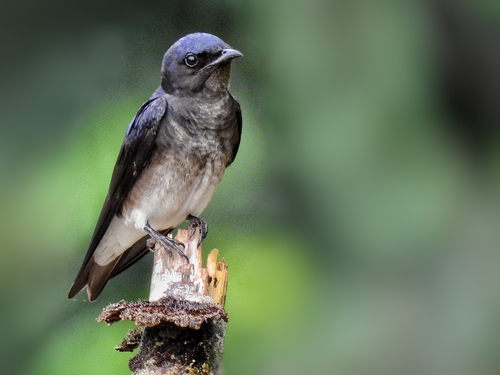 Hirondelle chalybée
 Hirondelle à gorge rousse
En bref
The most reliable field mark to separate Grey-breasted Martin from Southern Rough-winged Swallow is overall size and structure: Grey-breasted Martin is much larger and bulkier, with a broad-chested, heavy look and a distinctly forked tail, while Southern Rough-winged Swallow is noticeably smaller, slimmer, and has a square tail. In flight or perched, Grey-breasted Martin shows a strong contrast between its grey-brown breast and white belly, whereas Southern Rough-winged Swallow is more uniformly brownish below with a cinnamon or tawny throat and lacks sharp underpart contrast. Juveniles of both species are duller, but the martin’s larger size and forked tail remain clear. Be cautious with distant or backlit birds, as both species can appear brownish and similar in shape at a glance.
Conseils d’identification
- Size is the most immediate clue: Grey-breasted Martin is much larger and bulkier than Southern Rough-winged Swallow. If you see a swallow-sized bird that looks noticeably big and broad-chested, suspect martin.
- Tail shape: Grey-breasted Martin has a distinctly forked tail, visible both in flight and when perched. Southern Rough-winged Swallow has a square tail. This is reliable except in very worn or molting birds.
- Underpart contrast: Adult martins show a sharp division between the grey-brown breast and the white belly, while Southern Rough-winged Swallow is more uniformly brownish below, with only a subtle transition from breast to belly.
- Throat color: Southern Rough-winged Swallow has a cinnamon or tawny throat (especially in some subspecies), contrasting with the martin’s grey-brown throat. This is most useful at close range or in good light.
- Upperpart gloss: Adult male martins are glossy blue-black above, while Southern Rough-winged Swallow is always a plain dark gray-brown above. Females and juveniles of both are duller, but the martin is never as uniformly brown as the swallow.
- Juvenile marks: Juvenile martins are dull brown above but remain large and fork-tailed; juvenile swallows have pale feather edges on the back and a duller throat, but are always small and square-tailed.
- Flight style: Martins fly with powerful, direct wingbeats and often soar or glide; swallows have a lighter, more fluttery flight and often forage lower to the ground or water.
- Flocking: Martins may form large, conspicuous flocks, especially outside the breeding season. Swallows are more often seen in small groups or loose aggregations.
- Bill and head: The martin’s bill is stouter and the head appears larger and more robust than the swallow’s finer bill and smaller head.
- Subspecies variation: Some Southern Rough-winged Swallow subspecies have a paler rump or streaked underparts, but none show the martin’s strong underpart contrast or size.
- Habitat overlap: Both species can occur together near water or in open country, but swallows are more likely in forest clearings and higher elevations.
- Voice: If heard, the martin’s gurgly chew-chew may help, but do not rely on voice for separation unless familiar with both.
- Perched posture: Martins often perch upright on wires or exposed branches, appearing large and heavy. Swallows perch more horizontally and look slim.
- Pitfalls: Distant or backlit birds can make both species appear similar in color and shape. Use size, tail shape, and flocking behavior as primary clues in poor light.
- Seasonal context: Both species can be present year-round in much of their range, but Southern Rough-winged Swallow is a partial migrant and may be more numerous in some areas during migration or non-breeding season.
Taille
Grey-breasted Martin is significantly larger, weighing around 42 g and measuring 16–18 cm in length. Its body is robust, with broad wings and a deep chest, giving it a heavy, powerful appearance. In contrast, Southern Rough-winged Swallow is much smaller and lighter (13 cm, 14–18 g), with a slender, delicate build and proportionally shorter wings and tail. This size difference is often obvious when both species are seen together or with other swallows for scale.
Plumage
- Juveniles and immatures: Both species have duller upperparts as juveniles, but Grey-breasted Martin juveniles are overall brown above and still larger with a forked tail, while Southern Rough-winged Swallow juveniles show pale edges on the back feathers and a duller throat.
- Adults: Grey-breasted Martin adult males are glossy blue-black above with a grey-brown throat and breast sharply contrasting with white lower underparts; females are duller but still show this contrast. Southern Rough-winged Swallow adults are dark gray-brown above with a cinnamon or tawny throat, a gray-brown breast, and a yellowish or brownish belly—lacking the martin’s crisp underpart contrast. The swallow’s undertail coverts are white, but the rest of the underparts are more blended in tone. The martin’s forked tail also contrasts with the swallow’s square tail.
- Subspecies: Some Southern Rough-winged Swallow subspecies (e.g., S. r. uropygialis) have a whitish rump, but this does not approach the martin’s bold underpart contrast.
Comportement
Both species are aerial insectivores, but Grey-breasted Martin often forages in larger, higher-flying, and more conspicuous flocks, sometimes with other martins. Southern Rough-winged Swallow typically forages lower over water or open ground, often in smaller groups or loose flocks. The martin’s flight is stronger and more direct, while the swallow’s is lighter and more fluttery. Both can be gregarious, especially outside the breeding season, but the martin’s size and flocking habits make it more obvious in open areas.
Habitat
Both species occur in open habitats, often near water, but Southern Rough-winged Swallow is more likely to be found in a wider range of open landscapes, including clearings within forests and at higher elevations (up to 3,600 m in some regions). Grey-breasted Martin favors open country, towns, and areas near water, but is generally less likely to be found at the highest elevations or deep within forest clearings. Overlap is common in lowland open areas, especially near water.
Voix
Grey-breasted Martin gives a gurgly chew-chew call, similar to Caribbean Martin. Southern Rough-winged Swallow’s voice is not described in detail in the notes, so vocalizations are not a reliable separation point based on current information.
Hirondelle chalybée · Hirondelle à gorge rousse · Mes oiseaux difficiles