

Étourneau sansonnet vs Grive draine
Sturnus vulgaris contre Turdus viscivorus
Faire un quiz avec Étourneau sansonnet et Grive draine
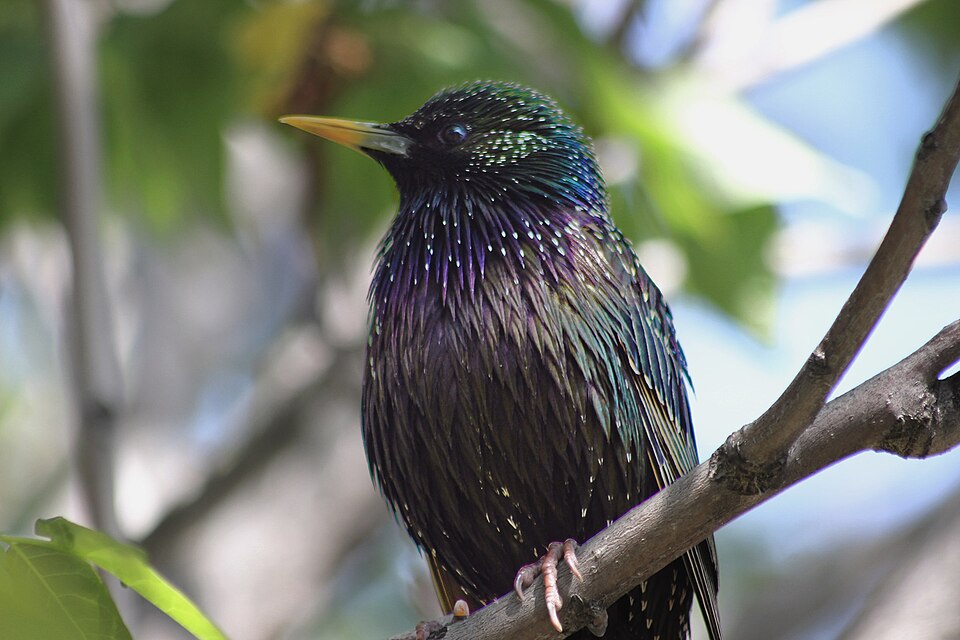 Étourneau sansonnet
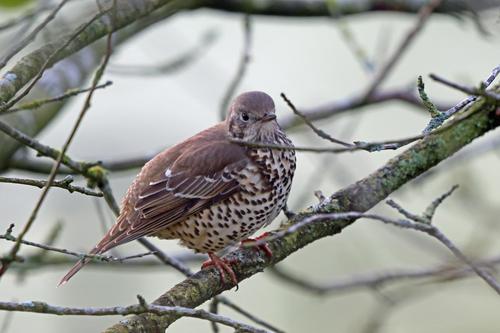 Grive draine
En bref
The most reliable field mark to separate Common Starling from Mistle Thrush is the overall plumage and structure: starlings are compact, short-tailed, and iridescent black with seasonal white speckling, while mistle thrushes are much larger, long-tailed, and pale below with bold, round black spots. Juvenile starlings are plain brownish-grey and lack the thrush's spotted underparts, but even immatures show a shorter tail and more pointed wings in flight. Starlings have a sharp, blade-like bill and pinkish legs, while mistle thrushes have a more typical thrush shape, upright stance, and yellowish-brown legs. In flight, starlings appear dark and triangular-winged, often in tight flocks, while mistle thrushes show pale underwings and a bounding, undulating flight.
Conseils d’identification
- Size and shape: Mistle Thrush is much larger, bulkier, and longer-tailed than Common Starling. If both are present, the difference is striking; starlings look compact and short-tailed by comparison. Size alone is not always reliable at a distance, but the thrush's upright stance and long tail are good clues.
- Bill: Starlings have a sharp, blade-like bill that is yellow in breeding season and dark in winter; mistle thrushes have a more typical thrush bill, blackish with a yellowish base, never bright yellow. Bill color is most useful in spring/summer.
- Leg color: Starlings show pinkish or greyish-red legs, especially in breeding season; mistle thrushes have yellowish-brown legs. This is subtle but can help at close range.
- Plumage (adult, winter): Starlings are glossy black with extensive white speckling, especially on the breast and flanks. Mistle Thrushes are pale below with bold, round black spots and a yellowish-buff breast. The thrush never shows iridescence or uniform dark plumage.
- Plumage (adult, breeding): Starlings lose most white spots and become more uniformly glossy blackish with a metallic sheen, while mistle thrushes remain pale and heavily spotted below.
- Juvenile/first-winter: Juvenile starlings are plain grey-brown, lacking any spots below, while juvenile mistle thrushes have paler upperparts with creamy feather centers and always show at least some spotting on the underparts. By first winter, starlings may retain some brown on the head but never show the thrush's bold spots.
- Flight silhouette: Starlings have short tails and strongly pointed, triangular wings, giving a compact, dark appearance in flight. Mistle Thrushes show long tails with white outer tips, broad wings, and a paler, patterned look. The thrush's flight is undulating and bounding, while starlings fly strongly and directly.
- Flocking behavior: Starlings often occur in dense, synchronized flocks that wheel and turn in unison, especially in winter. Mistle Thrushes are more solitary or in loose groups, rarely forming tight flocks.
- Posture: On the ground, mistle thrushes stand upright and hop, while starlings walk or run with a more horizontal, waddling gait.
- Underwing pattern: In flight, mistle thrushes show white underwing coverts and a pale appearance; starlings appear dark below, lacking strong underwing contrast.
- Tail pattern: Mistle Thrushes have white tips on the outer tail feathers, visible in flight and sometimes when perched. Starlings have a short, dark tail without white tips.
- Sex differences: Starlings can be sexed by iris color and bill base color in breeding season, but this is subtle and not useful for separating from mistle thrush.
- Seasonal context: In winter, starlings are more likely to be seen in large, dense flocks, while mistle thrushes may gather in loose groups but are rarely as numerous or synchronized.
- Habitat: Starlings are common in urban/suburban settings and on lawns; mistle thrushes prefer open woodland, parkland, and larger gardens with mature trees.
- Vocalizations: Not diagnostic from the provided notes, but in practice, starlings are highly vocal with a wide range of whistles and clicks, while mistle thrushes have a loud, fluty song and harsh rattling calls.
Taille
Mistle Thrush is substantially larger: 27–28 cm in length with a 45 cm wingspan and average weight around 130 g [wikipedia], compared to Common Starling's 19–23 cm length, 31–44 cm wingspan, and 58–101 g weight [wikipedia, avonet]. The thrush is not only longer but also bulkier and more robust, with a notably longer tail. Starlings are mid-sized among passerines, but look noticeably smaller and more compact next to a mistle thrush.
Plumage
- Juvenile/First-winter: Juvenile Common Starlings are uniform grey-brown without spots, sometimes retaining brown on the head into first winter, while juvenile Mistle Thrushes are paler above with creamy 'teardrop' feather centers and smaller, but still present, round spots on yellowish underparts [wikipedia]. By first winter, mistle thrushes are similar to adults but with more buffy underparts, always showing spots below. Starlings never show the thrush's bold spotting at any age.
- Adult non-breeding (winter): Starlings are glossy black with a metallic sheen, heavily speckled with white, especially on the breast and flanks. Mistle Thrushes are pale grey-brown above, yellowish-buff on the breast, off-white on the belly, and marked with round black spots that are densest on the lower chest. The thrush's underparts are always pale and spotted, never iridescent or uniform.
- Adult breeding (spring/summer): Starlings lose much of their white spotting as feather tips wear off, becoming more uniformly glossy blackish with purple or green gloss. Mistle Thrushes retain their pale, spotted underparts year-round. Starlings' bills turn yellow (with blue-grey base in males, pink in females), while mistle thrushes' bills remain blackish with a yellowish base.
- Flight: Starlings show strongly pointed, triangular wings and a short tail, appearing dark overall. Mistle Thrushes show a long tail with white outer tips, white underwing coverts, and a paler, more patterned appearance in flight.
Comportement
Common Starlings walk or run on the ground with a somewhat waddling gait, often foraging in dense, synchronized flocks that take off and wheel in tight formations. Their flight is rapid, direct, and interspersed with short glides, with the whole flock moving as one. Mistle Thrushes are more solitary or in pairs for most of the year, sometimes forming loose flocks in late summer or autumn. They hop on the ground with an upright, alert posture, flicking wings and tail when agitated. Their flight is undulating, with bounding interspersed with glides, and they do not form the tight, swirling flocks typical of starlings.
Habitat
Both species can be found in open country, parks, and gardens, but starlings are more strongly associated with urban and suburban areas, often seen in large flocks on lawns or wires. Mistle Thrushes are more often found in open woodlands, parkland, and larger gardens, especially where there are mature trees. In winter, mistle thrushes may join loose flocks in open fields, but rarely reach the dense concentrations typical of starlings.