

Timalí Ventrirrufo vs Picaflores Ventrigualdo
Dumetia hyperythra frente a Pachyglossa melanozantha
Juega un quiz con Timalí Ventrirrufo y Picaflores Ventrigualdo
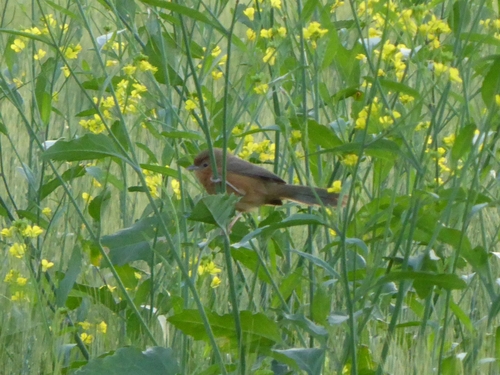 Timalí Ventrirrufo
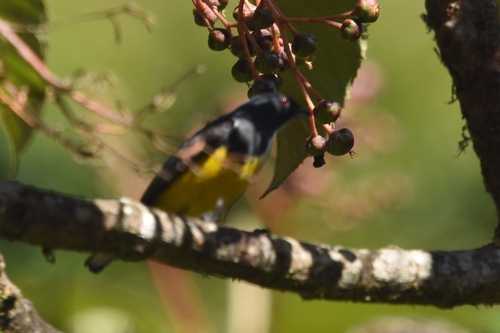 Picaflores Ventrigualdo
En breve
The most reliable way to separate Tawny-bellied Babbler from Yellow-bellied Flowerpecker is by overall structure and foraging behavior: the babbler is a soft-plumaged, long-tailed bird that moves in small groups low in dense scrub, while the flowerpecker is a tiny, compact, short-tailed bird typically seen alone or in pairs, often higher in foliage. The babbler shows a noticeably long, rounded tail with cross-rayed patterning and a rufous or tawny belly, while the flowerpecker is much more compact and lacks the babbler's fluffy, loose plumage. If you see a small, active bird with a very short tail and a stubby bill, especially in the canopy or mid-levels, it's almost certainly the flowerpecker. If the bird is foraging close to the ground in thick undergrowth, with a long tail and soft, brownish plumage, it's the babbler.
Consejos de identificación
- Tail length and shape: Tawny-bellied Babbler has a long, rounded tail with cross-rayed markings, often held cocked or fanned; Yellow-bellied Flowerpecker's tail is very short and barely projects beyond the undertail coverts.
- Bill structure: Babbler's bill is slender, slightly decurved, and longer; flowerpecker's bill is short, thick, and stubby, suited for eating fruit and nectar.
- Overall shape and posture: Babbler appears elongated and soft-plumaged, often with a loose, fluffy look; flowerpecker is compact, ball-like, and tight-feathered.
- Foraging height: Babbler stays low in dense scrub or grass, rarely above waist height; flowerpecker is usually higher in shrubs or trees, rarely on the ground.
- Group size: Babblers are often in small, noisy groups; flowerpeckers are usually solitary or in pairs.
- Underpart color: Babbler is orange-buff to tawny below (sometimes white-throated, depending on subspecies); flowerpecker is distinctly yellow-bellied, but may be confused with paler babbler forms in poor light—always check tail and structure.
- Crown and face: Babbler has a rufous-grey crown and sometimes a white throat; flowerpecker lacks these features and has a plainer head.
- Flight style: Babbler's flight is weak and fluttery, rarely sustained; flowerpecker is more direct and rapid in flight.
- Vocalizations: Listen for the babbler's group chatter and cheeping; flowerpecker is quieter, with thin, high-pitched calls.
- Habitat context: Dense, low scrub or grassland strongly favors babbler; open woodland, gardens, or canopy foraging points to flowerpecker.
- Behavior: Babblers move mouse-like through undergrowth, sometimes described as pig-like; flowerpeckers hop and flit quickly between food sources.
- Plumage texture: Babbler's plumage is soft and fluffy; flowerpecker's is smooth and glossy.
- Pitfalls: White-throated babbler subspecies can be mistaken for flowerpecker in brief views, but always check for the long tail and brown upperparts.
- Size impression: Both are small, but babbler feels longer and more elongated; flowerpecker is tiny and stubby.
- Seasonal variation: No strong seasonal or age-related differences in either species that would confuse the main field marks.
Tamaño
Tawny-bellied Babbler is slightly larger and noticeably longer-tailed, with a body mass of about 12.9g [wikidata]. The Yellow-bellied Flowerpecker is even smaller and more compact, with a much shorter tail and a stubbier build overall. The babbler appears elongated due to its long, rounded tail, while the flowerpecker is more ball-shaped and lacks any tail extension.
Plumaje
No distinctive juvenile or immature wing patterns are described for either species in the available sources. For adults, the Tawny-bellied Babbler is dark brown above with a rufous-grey crown and orange-buff to tawny underparts; some populations have a white throat, while others are uniformly brown below. The tail is long, olive-brown, and shows cross-rayed markings. The Yellow-bellied Flowerpecker, by contrast, is named for its yellow belly and is generally much more compact, lacking the babbler's fluffy appearance and long tail. The babbler's plumage is soft and loose, while the flowerpecker is tighter-feathered and more glossy. The babbler's white throat (in some subspecies) can be a pitfall, but is always paired with a long tail and brown upperparts, unlike the flowerpecker.
Comportamiento
Tawny-bellied Babblers are usually in small, noisy groups, foraging low in dense scrub or tall grass, often moving through undergrowth in a manner reminiscent of mice or even pigs. Their flight is weak and fluttery, rarely sustained or high above the vegetation. Yellow-bellied Flowerpeckers are typically solitary or in pairs, highly active, and often seen flitting quickly between flowers or berries, usually higher in the foliage. Their movements are more direct and less skulking than the babbler's, and they rarely spend much time on or near the ground.
Hábitat
Tawny-bellied Babbler is almost always found in low scrub, tall grassland, or dense undergrowth, rarely venturing into open areas or high in trees. Yellow-bellied Flowerpecker is found in a wider range of wooded habitats, including forest edges, gardens, and higher up in trees and shrubs, often in the mid to upper levels of vegetation. If the bird is seen foraging near the ground in thick cover, babbler is far more likely; if in the canopy or on exposed twigs, flowerpecker is favored.
Voz
Tawny-bellied Babbler produces cheeping, twittering, or harsh chattering notes while foraging, often in a group chorus. No specific vocalization is described for Yellow-bellied Flowerpecker in the available notes, but flowerpeckers generally have thin, high-pitched calls, often single or double notes, and are less likely to produce the babbler's group chatter.
Timalí Ventrirrufo · Picaflores Ventrigualdo · Mis aves difíciles