

Faisán de Swinhoe vs Pavo Real Cuelliverde
Lophura swinhoii frente a Pavo muticus
Juega un quiz con Faisán de Swinhoe y Pavo Real Cuelliverde
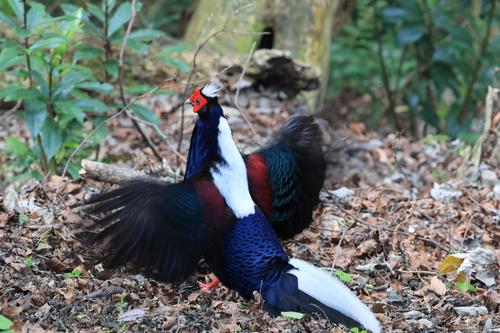 Faisán de Swinhoe
 Pavo Real Cuelliverde
En breve
The most reliable field mark is the male Swinhoe's Pheasant's white nape and crest, glossy blue-purple body, and red legs, which are never seen on Green Peafowl. In contrast, Green Peafowl males are much larger, with a long, iridescent green neck and breast, and (when not in molt) a spectacular train with eyespots. Immature Swinhoe's Pheasants show dark blue with brown and yellow wing markings, while Green Peafowl juveniles closely resemble females with scaly green necks and barred backs. In flight, Green Peafowl appear long-winged and heavy, with pale primaries visible, unlike the more compact, short-tailed Swinhoe's. Habitat and range are also strong clues: Swinhoe's is endemic to Taiwan's forests, while Green Peafowl occur in Southeast Asia and southern China.
Consejos de identificación
- Size is a major clue: Green Peafowl are huge, with males reaching up to 3 m (including train) and females over 1 m, while Swinhoe's Pheasant maxes out at 79 cm. If the bird looks turkey-sized or larger, it's a Green Peafowl.
- Male Swinhoe's Pheasant has a white nape and crest: This is never seen on Green Peafowl. Look for the sharp white contrast at the back of the head and a white crest.
- Leg color: Swinhoe's Pheasant has red legs, visible when walking or displaying. Green Peafowl legs are not red.
- Male Green Peafowl train: If present, the long, eyespotted train is diagnostic for Green Peafowl. However, after molt, males lack the train and sexes are harder to separate.
- Neck and breast color: Swinhoe's Pheasant males are glossy blue-purple; Green Peafowl of both sexes have iridescent green, scaly-looking neck and breast.
- Wing coverts: Green Peafowl males have blue scapular, median, and greater coverts, with green lesser coverts forming a triangle at the shoulder. Swinhoe's lacks this pattern.
- Female/immature confusion: Swinhoe's Pheasant females are brown with yellow arrow-shaped spots and maroon tail edges. Green Peafowl females and immatures are green-scaled on the neck, with copper fringes and more barring on the back and wings.
- Juvenile Swinhoe's Pheasant: Look for dark blue body with brown and yellow wing patterns. Green Peafowl juveniles lack blue and have more uniform scaly green and barring.
- Crest shape: Both have crests, but Swinhoe's is white and fluffy, Green Peafowl's is thin and tall (male) or broader (female), and never white.
- Facial skin: Green Peafowl shows double-striped facial skin (white-blue and yellow-orange) and a colored triangle below the eye (bluish-green in males, brown in females). Swinhoe's Pheasant lacks these facial marks.
- Tail shape: Swinhoe's Pheasant has white tail feathers (male), while Green Peafowl's tail is hidden by the train in males, and females have short green coverts.
- Flight silhouette: Green Peafowl is long-tailed, heavy, and shows pale primaries in flight. Swinhoe's is compact, with no pale wing panels.
- Display behavior: Swinhoe's Pheasant displays with hopping, circling, and wing-whirring. Green Peafowl males display by fanning their train (if present) and calling loudly.
- Vocalizations: Loud, far-carrying calls indicate Green Peafowl. Swinhoe's Pheasant is mostly silent.
- Habitat and range: Swinhoe's Pheasant is only in Taiwan forests. Green Peafowl is found in Southeast Asia and southern China, usually in more open or grassy habitats.
Tamaño
Green Peafowl are dramatically larger than Swinhoe's Pheasant. Adult male Green Peafowl reach 1.8–3 m in total length (including their train), with a wingspan up to 1.6 m, and females are about 1–1.1 m long. Swinhoe's Pheasant males reach up to 79 cm in length, making them less than half the size of even a female Green Peafowl. In the field, Green Peafowl look imposing and long-legged, while Swinhoe's Pheasant is much more compact and chicken-like.
Plumaje
- Juveniles/immatures: Swinhoe's Pheasant juvenile males are dark blue with brown and yellow wing patterns, while Green Peafowl juveniles resemble females, with scaly green necks and more barring on the back, primaries, and alula. Green Peafowl young lack the blue and white contrasts of Swinhoe's.
- Adult males: Swinhoe's Pheasant males have a glossy blue-purple chest, belly, and rump, a white nape and crest, white tail feathers, and red wattles and legs. Green Peafowl males have an iridescent green neck and breast, blue scapular and wing coverts, and (outside molt) a long train with eyespots. Their facial skin is double-striped with white-blue and yellow-orange, and their crest is tall and thin.
- Adult females: Swinhoe's Pheasant females are brown with yellow arrow-shaped spots and maroon outer tail feathers. Green Peafowl females are green-scaled on the neck, blue lesser wing coverts, copper fringes on neck scales, and more barring overall. Both sexes of Green Peafowl have a crest, but the female's is broader.
- In flight: Green Peafowl show pale vermilion or buff primaries and a long, heavy silhouette. Swinhoe's Pheasant is shorter-tailed and more compact, lacking pale flight feathers.
Comportamiento
Green Peafowl are often seen on the ground in tall grasses and sedges, but are capable of strong, sustained flight and frequently roost high in trees (10–15 m). Males are solitary and territorial, sometimes forming harems, but do not display in leks. Swinhoe's Pheasant males display by hopping, running in circles, fanning their tail, and wing-whirring, usually on the ground. Swinhoe's is less likely to be seen in open areas and more tied to forest undergrowth.
Hábitat
Swinhoe's Pheasant is endemic to Taiwan and found only in its forests. Green Peafowl are native to Southeast Asia and southern China, inhabiting tropical forests, tall grasslands, and open woodlands. If seen in Taiwan, the bird is almost certainly Swinhoe's; elsewhere in Southeast Asia, especially in open or grassy habitats, Green Peafowl is much more likely.
Voz
Green Peafowl are highly vocal, with males giving a loud, repeated 'ki-wao' at dawn and dusk, and females calling 'AOw-aa' with emphasis on the first syllable. Swinhoe's Pheasant's display is mostly visual and includes wing-whirring, but no distinctive loud calls are noted in the sources. Thus, a loud, far-carrying call points to Green Peafowl.
Faisán de Swinhoe · Pavo Real Cuelliverde · Mis aves difíciles