
Hawaiibussard vs Präriebussard
Buteo solitarius gegen Buteo swainsoni
Ein Quiz mit Hawaiibussard und Präriebussard spielen
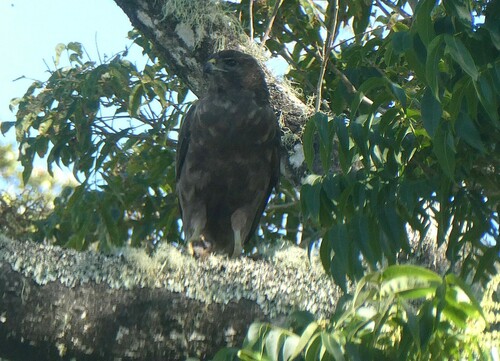 Hawaiibussard
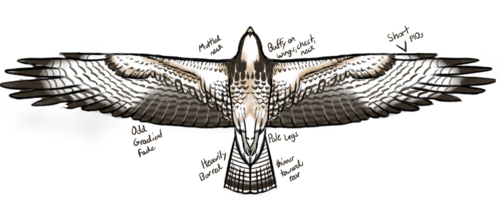 Präriebussard
Kurz gesagt
The most reliable field separation between Hawaiian Hawk and Swainson's Hawk is the underwing pattern in flight: Swainson's Hawk (especially light-morph adults and juveniles) shows strikingly pale underwing coverts with a contrasting dark trailing edge to the flight feathers, while Hawaiian Hawk (both morphs) lacks this sharp contrast. Swainson's Hawk is also noticeably larger and longer-winged, with a slimmer, more buoyant flight style. Plumage variation in both species can cause confusion, especially with dark morphs, but careful attention to underwing pattern, tail banding, and overall structure will separate them. Geographic context is also crucial: Hawaiian Hawk is endemic to the Big Island of Hawaiʻi, while Swainson's Hawk is a widespread migrant in North America and never occurs in Hawaiʻi.
Bestimmungstipps
- Underwing pattern in flight (all ages): Swainson's Hawk shows pale underwing coverts with a sharply contrasting dark trailing edge (flight feathers), a unique feature among North American Buteos. Hawaiian Hawk lacks this; both morphs have more uniform underwings without a bold trailing edge.
- Tail pattern: Swainson's Hawk has a gray-brown tail with several narrow dark bands and a broad subterminal band. Hawaiian Hawk's tail is less distinctly banded and more uniform.
- Plumage morphs: Both species have light and dark morphs, but Swainson's light morph always shows a white throat and face patch and a rufous chest 'bib', while Hawaiian Hawk's light morph has a dark head and pale underparts but lacks the bib and face patch.
- Juvenile marks: Juvenile Swainson's Hawks are paler below with mottled flanks and chest, and the tail bands are less crisp but still visible. Hawaiian Hawk juveniles resemble adults in their respective morphs but have greenish legs and feet.
- Leg and foot color: Adult Hawaiian Hawks have yellow legs and feet; juveniles have greenish legs. Swainson's Hawk legs are yellow in all ages but are less likely to be seen in the field.
- Size and structure: Swainson's Hawk is larger, longer-winged, and longer-tailed, with a slimmer, more elongated silhouette. Hawaiian Hawk is more compact and broad-winged, appearing stockier both perched and in flight.
- Flight style: Swainson's Hawk soars with wings in a shallow dihedral and has a buoyant, gliding flight. Hawaiian Hawk soars on flat wings and appears heavier and more direct in flight.
- Facial pattern: Swainson's Hawk (light morph) shows a white face and throat, contrasting with the rufous bib. Hawaiian Hawk (light morph) has a dark head and lacks the white face.
- Yellow forecap (breeding season): Breeding Hawaiian Hawks may show a yellow patch above the bill, not present in Swainson's Hawk.
- Habitat and range: Hawaiian Hawk is endemic to the Big Island of Hawaiʻi and found in native forests. Swainson's Hawk is a migrant of open country in North and South America and never occurs in Hawaiʻi.
- Behavior: Swainson's Hawk often perches on the ground, follows farm equipment, and forms flocks during migration. Hawaiian Hawk is solitary or in pairs, rarely perches on the ground, and is not seen in flocks.
- Dark morph confusion: Both species have dark morphs, but Swainson's dark morph retains a pale patch under the tail and tail banding, while Hawaiian Hawk's dark morph is more uniformly dark.
- Seasonal context: Swainson's Hawk is present in North America during the breeding season and migrates to South America in winter; Hawaiian Hawk is resident year-round on the Big Island.
- Perched posture: Swainson's Hawk appears longer-legged and more upright when perched, while Hawaiian Hawk is more compact and squat.
- Voice: Not diagnostic with available information.
Größe
Swainson's Hawk is significantly larger and heavier than Hawaiian Hawk, with an average body mass of about 958.5 g compared to the Hawaiian Hawk's average female mass of 605 g and male mass of 441 g. Swainson's Hawk also has a longer, more slender build and proportionally longer wings and tail, giving it a rangier silhouette both perched and in flight. Hawaiian Hawk is more compact and broad-winged, with a stockier appearance.
Gefieder
Juvenile and adult Swainson's Hawks (especially light morphs) show a diagnostic underwing pattern in flight: pale underwing coverts (the 'linings') sharply set off from dark flight feathers, forming a bold contrast and a dark trailing edge. The tail is gray-brown with several narrow dark bands and a wider subterminal band, visible in all ages but less crisp in juveniles. Light-morph adults have a white underside with a rufous chest 'bib' and a white throat and face patch. Juveniles are paler overall, with mottling on the chest and flanks, and the head can appear pale due to feather wear. Dark morphs are mostly dark brown but retain a pale patch under the tail and similar tail banding. Hawaiian Hawk comes in two color morphs: dark phase (all dark brown) and light phase (dark head, pale breast and underwings), but neither morph shows the sharp underwing contrast of Swainson's. Hawaiian Hawk's tail is less distinctly banded, and adults have yellow legs and feet (juveniles greenish). During breeding, one member (likely the female) may have a yellow forecap above the bill, a feature not found in Swainson's.
Verhalten
Swainson's Hawk often soars with wings held in a shallow dihedral and is highly migratory, forming large flocks during migration and often foraging on insects in open country, sometimes on the ground. It frequently perches on poles, trees, or even the ground, and may be seen following farm equipment or fires for prey. Hawaiian Hawk is more sedentary, territorial, and typically solitary or in pairs. It is mostly seen soaring or perched in native forests, rarely in open country, and does not form flocks.
Lebensraum
Hawaiian Hawk is strictly limited to the Big Island of Hawaiʻi, breeding in native ʻōhiʻa lehua forests and not found outside this range. Swainson's Hawk inhabits open country, grasslands, and agricultural areas across western North America, and migrates to South America for the winter. Habitat alone is usually diagnostic: a Buteo seen in Hawaiʻi is almost certainly a Hawaiian Hawk, while Swainson's Hawk is never found there.