

Heckenkuckuck vs Asienkoel
Centropus sinensis gegen Eudynamys scolopaceus
Ein Quiz mit Heckenkuckuck und Asienkoel spielen
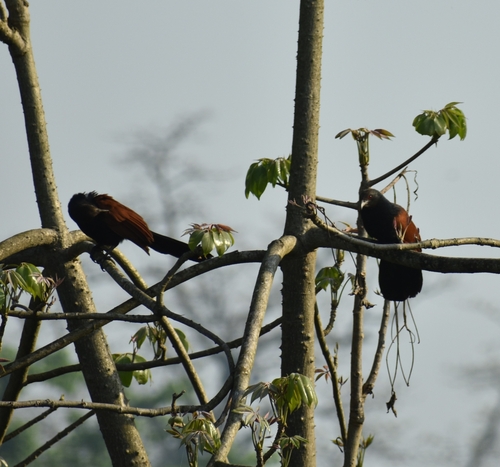 Heckenkuckuck
 Asienkoel
Kurz gesagt
The most reliable field mark to separate Greater Coucal from Asian Koel is the wing and back color: Greater Coucal of all ages shows rich chestnut or coppery-brown wings contrasting with a black head and body, while Asian Koel males are glossy blue-black all over and females are heavily spotted and streaked brown above with pale underparts. Juvenile Greater Coucal is duller but still shows chestnut wings, whereas juvenile Asian Koel resembles the female with prominent spotting and streaking. In flight or perched, the Coucal’s chestnut wings stand out, while Koel never shows this contrast. Both are large, long-tailed cuckoos, but Coucal is heavier and bulkier, often moving clumsily in dense vegetation, while Koel is slimmer and more arboreal. Voice and behavior also differ, but the wing and body color are most reliable at all ages.
Bestimmungstipps
- Chestnut wings (all ages, all sexes): Only Greater Coucal shows rich chestnut or coppery-brown wings and back contrasting with a black head and body. This is visible in all plumages, including juveniles. Asian Koel never shows chestnut wings—males are glossy black, females and juveniles are brown with white spots.
- Glossy all-black male (adult): Asian Koel male is glossy blue-black all over with no brown or chestnut anywhere. Greater Coucal male is black with chestnut wings—never all-black.
- Spotted/streaked female and juvenile: Asian Koel female and juvenile are brown above with white/buff spots and pale, heavily streaked underparts. Greater Coucal of any age never shows this pattern—always plain below, with chestnut wings.
- Juvenile confusion: If you see a large cuckoo with chestnut wings and dull black body, it is a juvenile Greater Coucal. If it is brown with heavy white spots and streaks, it is a juvenile Asian Koel.
- Bill color: Asian Koel male has a pale greenish-grey bill; juveniles have a black bill. Greater Coucal has a dark bill in all ages. This is subtle but can help with close views.
- Eye color: Both have red or crimson eyes as adults; not a reliable separator.
- Tail: Both are long-tailed, but Coucal’s tail is broader and often appears heavier. Koel’s tail is slimmer and more streamlined.
- Structure and jizz: Greater Coucal is heavyset, with a crow-like, clumsy appearance, especially on the ground or in dense cover. Asian Koel is slimmer, more arboreal, and moves with more agility in trees.
- Flight style: Coucal flies weakly and reluctantly, usually low and for short distances. Koel flies more readily and can move between treetops.
- Behavior: Coucal is secretive, often skulking in thick vegetation or sunning with wings spread. Koel is bold, vocal, and often perches conspicuously in fruiting trees.
- Habitat: Both can occur in gardens and edges, but Coucal prefers dense undergrowth, Koel is more often in open trees and canopy.
- Voice: If you hear a deep, resonant 'coop-coop-coop', it is Coucal. If you hear a loud, repetitive 'koo-Ooo' or shrill 'kik-kik-kik...', it is Koel.
- Sex differences: Coucal sexes are similar in plumage; Koel sexes are very different—males are all black, females are brown and spotted.
- Seasonal context: Koel is especially vocal and conspicuous during the breeding season (March–August); Coucal is more secretive year-round.
- Common pitfalls: Do not rely on size alone—both are large and long-tailed. Focus on wing color and body pattern, especially in flight or when perched in good light.
Größe
Greater Coucal is the heavier and bulkier bird, with an average body mass of 283 g [wikidata], compared to the Asian Koel’s variable but generally lighter mass (190–327 g, with most males at the lower end) [wikipedia]. Coucal is slightly longer (up to 48 cm) and has a more robust, crow-like build with a long, broad tail. Koel is long-tailed as well (39–46 cm), but slimmer, more streamlined, and less heavyset. In the field, Coucal often looks larger and heavier, especially when moving on the ground or in thick cover.
Gefieder
- Juvenile/immature: Juvenile Greater Coucal is dull black overall with chestnut-brown wings, sometimes with pale bars on the underside and tail (in northern races), but always lacks the heavy white spotting and streaking of juvenile Asian Koel. Juvenile Koel resembles the female: brown above with white and buff spots, heavily streaked pale underparts, and never shows chestnut wings.
- Adult male: Greater Coucal adult male is black with a purple gloss on the head and underparts, and rich chestnut wings and back. Asian Koel adult male is glossy blue-black all over, with no chestnut or brown on the wings or back.
- Adult female: Greater Coucal female is very similar to the male, only slightly larger; both sexes have chestnut wings. Asian Koel female is brownish above with rufous streaks, dark brown back and wing coverts with white/buff spots, and pale, heavily striped underparts.
- Iris: Both species have red or crimson eyes in adults, not a reliable separator.
- Bill: Koel has a pale greenish-grey bill (male), black in juveniles; Coucal has a dark bill.
Verhalten
Greater Coucal is often seen moving clumsily on the ground or low in dense vegetation, sometimes sunning with wings spread. It rarely flies far and appears heavy and slow in flight. Asian Koel is much more arboreal, often perching high in trees and moving with agility through the canopy. Koel is more likely to be seen flying between treetops or calling conspicuously from exposed perches. Coucal’s movements are secretive and sluggish compared to the more active, vocal Koel.
Lebensraum
Both species share a wide range across the Indian subcontinent and Southeast Asia, and can occur in similar habitats, including gardens, cultivation, and forest edges. However, Greater Coucal is more often found in dense undergrowth, tangles, bamboo clumps, or thick vegetation, while Asian Koel prefers open woodland, fruiting trees, and urban parks, often higher up in the canopy. Habitat alone is not diagnostic, but Coucal is more terrestrial and Koel more arboreal.
Stimme
Vocalizations are very different and can be diagnostic if heard. Greater Coucal gives deep, resonant 'coop-coop-coop' or 'boop-boop' calls, usually from cover or low perches. Asian Koel is famous for its loud, far-carrying 'koo-Ooo' song (male) and the female’s shrill 'kik-kik-kik...' calls, often repeated for long periods, especially in the breeding season. Koel is much more vocal and conspicuous by sound, especially in spring and summer.