

Zenaida Dove vs Eared Dove
Zenaida aurita versus Zenaida auriculata
Play a quiz with Zenaida Dove and Eared Dove
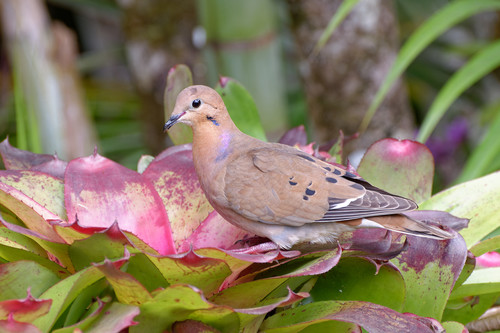 Zenaida Dove
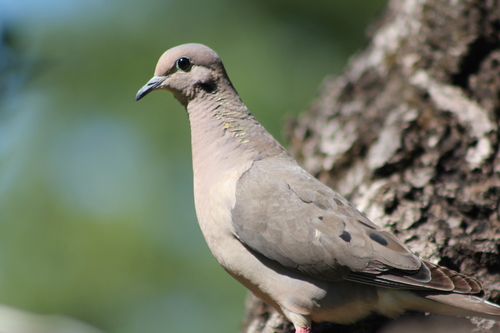 Eared Dove
In short
The most reliable field mark to separate Zenaida Dove from Eared Dove is the presence of a white trailing edge on the wings in flight in Zenaida Dove of all ages—a feature Eared Dove never shows. Structure also helps: Zenaida Dove is larger and heavier, with a shorter, more rounded tail, while Eared Dove is smaller, lighter, and has a longer, wedge-shaped tail. Adult plumage is similar overall, but Eared Dove males show a distinctive black mark behind the eye and on the lower ear coverts, lacking in Zenaida Dove. Immature Eared Doves are duller and more barred, but beware: both species can appear similar on the ground, especially females and juveniles. Listen for vocal differences, but prioritize flight and tail shape for quick field separation.
Identification tips
- White trailing edge in flight (all ages): Zenaida Dove always shows a white trailing edge on the wings in flight; Eared Dove never does. If you see this mark, it's Zenaida Dove.
- Tail shape: Zenaida Dove has a short, rounded tail; Eared Dove's tail is longer and wedge-shaped, with a cinnamon tip in adults. This is visible both perched and in flight.
- Size and bulk: Zenaida Dove is larger and heavier, appearing bulkier than the slimmer, lighter Eared Dove. This is most apparent when both species are seen together, but can be judged with experience.
- Facial pattern (adult males): Eared Dove males have a grey crown, a black line behind the eye, and a blue-black patch on the lower ear coverts ('ear' mark), which Zenaida Dove lacks. Zenaida Dove's face is plainer.
- Upperpart tone: Zenaida Dove is generally darker and more uniform above; Eared Dove is more olive-brown, especially in males.
- Underparts: Eared Dove adults have vinous (wine-colored) underparts; Zenaida Dove is more uniformly dark below.
- Immature plumage: Immature Eared Doves are greyish-brown with pale barring, especially on the upperparts. Zenaida Dove immatures are similar to adults and lack obvious barring.
- Flight style: Eared Dove flies high, fast, and direct, often in large flocks; Zenaida Dove's flight is strong but less likely to be in huge groups.
- Vocalizations: Zenaida Dove's call is faster and more mournful; Eared Dove's is deeper and softer. Use as supporting evidence, not primary ID.
- Habitat context: On Caribbean islands, Zenaida Dove is expected; in mainland South America, Eared Dove is dominant. On southern Caribbean islands (e.g., Trinidad, Grenadines), check all marks carefully.
- Perched confusion: Both species can look similar when perched, especially females and immatures. Rely on tail shape and, if seen, the white wing edge in flight.
- Flock size: Eared Dove is more likely to be in very large flocks, especially in agricultural areas; Zenaida Dove is more often solitary or in small groups.
- Bill and leg color: Eared Dove has a black bill and dark red legs; Zenaida Dove's bill and legs are less distinctly described but not diagnostic.
- Feeding behavior: Both species forage on the ground for seeds and grains, often near water, so behavior alone is not diagnostic.
- Seasonality: Both species can breed multiple times per year and are resident; do not use season as a primary separation.
Size
Zenaida Dove is noticeably larger and heavier (body mass ~159 g) compared to Eared Dove (typically ~112 g). Zenaida Dove measures about 28–30 cm in length, while Eared Dove is smaller at about 24 cm. In the field, Zenaida Dove appears bulkier and more robust, with a proportionally shorter tail. Eared Dove looks slimmer, more delicate, and has a longer, wedge-shaped tail that accentuates its smaller frame.
Plumage
-
Flight/wing pattern (all ages): Zenaida Dove shows a clear white trailing edge on the wings in flight, a highly visible and diagnostic mark. Eared Dove never shows this white edge.
-
Tail: Zenaida Dove's tail is shorter and more rounded; Eared Dove's is longer and wedge-shaped, with a cinnamon tip in adults.
-
Adult males: Eared Dove males have a grey crown, black line behind the eye, and blue-black lower ear coverts (the 'eared' mark), which Zenaida Dove lacks. Zenaida Dove is overall darker and more uniform.
-
Females and immatures: Eared Dove females are duller than males; immature Eared Doves are greyish-brown with pale barring, while Zenaida Dove immatures are not specifically described as barred but are generally similar to adults. Both species can appear drab and brownish when young, but the white wing edge in flight remains a Zenaida Dove feature at all ages.
-
Underparts: Eared Dove adults have vinous underparts; Zenaida Dove is more uniformly dark.
Behaviour
Both species forage on the ground, often in open areas and near water. Eared Dove is especially gregarious, forming large flocks outside the breeding season and flying in high, fast, direct patterns. Zenaida Dove is also social but may be seen singly or in pairs more often. Both species adapt well to human-modified habitats, but Eared Dove is more likely to be seen in massive flocks, especially in agricultural regions.
Habitat
Zenaida Dove is found throughout the Caribbean islands and the northern Yucatan, favoring lowlands, coastal plains, bushy scrublands, and even urban parks and gardens. Eared Dove is widespread in South America, from Colombia to Argentina and Chile, and on some Caribbean islands from the Grenadines south. Eared Dove is abundant in savannahs, open fields, and farmlands, and is very common in urban areas across its range. Zenaida Dove is more likely in the Caribbean, Eared Dove in mainland South America, but there is some overlap on southern Caribbean islands.
Voice
Zenaida Dove's call is a mournful, faster-paced coo, reminiscent of the Mourning Dove but more rapid. Eared Dove gives a deep, soft 'oo-ah-oo'. While both are classic dove calls and can be confusing, the pace and tone differ: Zenaida Dove is faster and more plaintive, Eared Dove deeper and more mellow. Vocalizations are helpful but less reliable than visual field marks.