

Zebra Finch vs Common Waxbill
Taeniopygia guttata versus Estrilda astrild
Play a quiz with Zebra Finch and Common Waxbill
 Zebra Finch
 Common Waxbill
In short
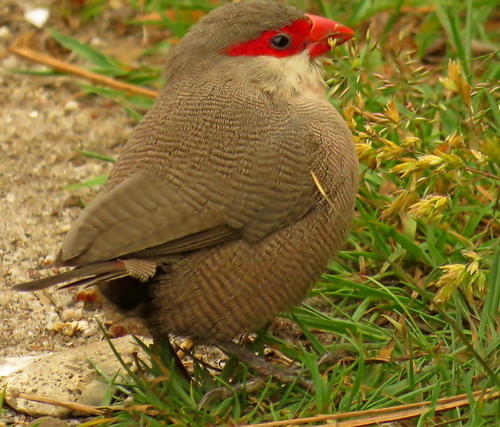
The most reliable field mark to separate Zebra Finch from Common Waxbill is the bill and face pattern: adult Common Waxbills have a bright red bill and a bold red eye-stripe, while Zebra Finches lack both. Juvenile Common Waxbills have a black bill and duller plumage, but still show a faint eye-stripe, whereas Zebra Finch juveniles are more uniformly plain. In all plumages, Common Waxbill is slimmer and longer-tailed, with a more subdued, finely barred brownish body and a pinkish or reddish belly stripe (variable). Zebra Finches are chunkier, with a more conical bill, and lack the red facial marks. These differences are visible both perched and in flight, but are especially clear at close range or with good light.
Identification tips
- Bill color (all ages): Adult Common Waxbill has a bright red bill; juveniles have a black bill. Zebra Finch never shows a red or black bill—adults have an orange, conical bill (males brighter), and juveniles are paler but still not red or black.
- Eye-stripe (all ages): Common Waxbill (adult and most juveniles) shows a bold or faint red stripe through the eye. Zebra Finch lacks any eye-stripe at all ages.
- Face pattern: Common Waxbill's face is marked by the red eye-stripe and pale cheeks/throat, while Zebra Finch's face is plain, lacking any red or strong facial markings.
- Belly stripe: Common Waxbill often shows a pinkish or reddish stripe down the center of the belly (variable by subspecies and sex), never present in Zebra Finch.
- Body barring: Common Waxbill is finely barred brownish-grey all over, with a subtle, scaly appearance. Zebra Finch is plainer, lacking the fine barring.
- Tail and rump: Common Waxbill has a long, graduated tail and a brown rump; Zebra Finch's tail is shorter and less graduated.
- Juvenile confusion: Juvenile Common Waxbill is dull with a black bill and faint eye-stripe; Zebra Finch juveniles are plain and lack both features. If you see a small, plain finch with a black bill and faint eye-stripe, it's a juvenile Common Waxbill.
- Sex differences: Female Common Waxbill is paler with less red on the belly but still shows the red bill and eye-stripe. Zebra Finch females are plainer than males but never develop red facial features.
- Flight style: Common Waxbill shows a bouncy, undulating flight with a longer tail; Zebra Finch is more direct and compact in flight.
- Group behavior: Common Waxbill is often in tight, coordinated flocks; Zebra Finch flocks are looser and more scattered.
- Habitat context: In the Lesser Sundas, Zebra Finch is the local species; in sub-Saharan Africa and introduced regions, Common Waxbill is more likely, especially in wetter grasslands and urban parks.
- Vocalizations: Listen for the Common Waxbill's high-pitched flight call and harsh, nasal song from flocks. Zebra Finch males sing individually, and their song is learned and variable.
- Size and shape: Common Waxbill is slightly heavier, longer, and slimmer with a longer tail; Zebra Finch is rounder and more compact.
- Perched jizz: Common Waxbill looks sleeker and more delicate; Zebra Finch appears stubby and robust.
- When in doubt: Focus on bill color and eye-stripe—these are the most reliable marks at all ages and seasons.
Size
Both species are small estrildid finches, but Common Waxbill is slightly heavier on average (body mass 8.2 g [wikidata]) and appears longer and slimmer due to its more elongated tail and body shape. Zebra Finch is more compact and stubby, with a relatively shorter tail. In the field, the difference is subtle but can be seen when both are side by side: Zebra Finch looks rounder and more robust, while Common Waxbill has a sleeker, more delicate appearance.
Plumage
- Juveniles: Common Waxbill juveniles are duller than adults, with little or no red on the belly, faint dark barring, and a black bill. They still often show a faint red eye-stripe, which Zebra Finch never shows. Zebra Finch juveniles are plain, lacking both the red bill and eye-stripe, and are generally more uniformly colored.
- Adults: Common Waxbill adults have a bright red bill, a bold red stripe through the eye, grey-brown finely barred plumage, a pinkish flush to the underparts, and a reddish belly stripe (variable by subspecies). Zebra Finch adults lack any red on the face or bill, and have a more conical, orange bill (males brighter), with no eye-stripe or belly stripe. The overall pattern is much plainer and less barred than Common Waxbill.
- Sex differences: Female Common Waxbills are paler than males, with less red on the belly, but still show the red bill and eye-stripe. Zebra Finch females are also plainer than males but do not acquire the red facial features of Common Waxbill at any age.
Behaviour
Both species are social and often seen in flocks, but Common Waxbill tends to move in tighter, more coordinated groups and is often seen feeding on grass seeds in open areas. Zebra Finch is also gregarious but may appear more scattered and is often associated with drier, more open habitats. In flight, Common Waxbill shows a more undulating, bouncy flight with a longer tail, while Zebra Finch appears more direct and compact.
Habitat
Zebra Finch (Taeniopygia guttata) is native to the Lesser Sundas, while Common Waxbill (Estrilda astrild) is native to sub-Saharan Africa but has been widely introduced to many warm regions, including islands and parts of Europe and the Americas. In areas of overlap, Common Waxbill is more likely in wetter grasslands and urban parks, while Zebra Finch prefers drier, open country. However, both can be found in grass-rich habitats where seeds are abundant.
Voice
Only male Zebra Finches sing, and each has an individual song learned in youth. Common Waxbill has a variety of twittering and buzzing calls, a distinctive high-pitched flight call, and a simple, harsh, nasal song that descends at the end. In the field, the Common Waxbill's calls are more likely to be heard from flocks, while Zebra Finch vocalizations are more individual and less likely to be heard in large groups.