

Yellowhead vs North Island Robin
Mohoua ochrocephala versus Petroica longipes
Play a quiz with Yellowhead and North Island Robin
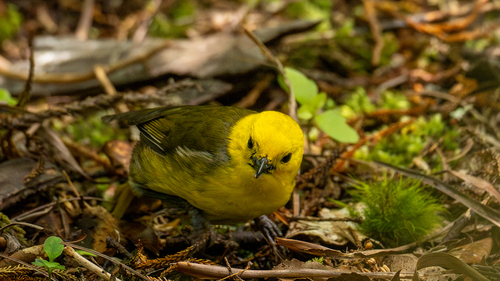 Yellowhead
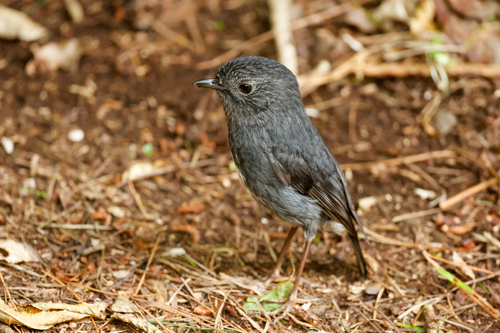 North Island Robin
In short
The most reliable field mark to separate Yellowhead (Mohoua ochrocephala) from North Island Robin (Petroica longipes) is overall plumage: Yellowhead is bright yellow on the head and underparts, while North Island Robin is dark grey-black with only a small pale belly patch. Even immatures and females of both species show this basic color difference. Yellowhead is a small, active flocking bird, often in noisy groups, while North Island Robin is solitary or in pairs and has a more upright, robin-like stance. If you see a small, bright yellow bird in a mixed flock, it's a Yellowhead; a larger, dark bird with a pale belly patch, often alone and perching upright, is a North Island Robin.
Identification tips
- Overall color: Yellowhead is bright yellow on the head and underparts, with olive-brown upperparts; North Island Robin is dark grey-black with a small pale belly patch and no yellow at all. This is the most reliable mark at all ages and sexes.
- Flocking behavior: Yellowhead often occurs in noisy, active flocks, sometimes with other small forest birds. North Island Robin is usually solitary or in pairs, rarely in flocks.
- Posture and movement: North Island Robin perches upright, often on trunks or low branches, and hops on the ground. Yellowhead is more active in the canopy, moving quickly through foliage.
- Hidden white patch: North Island Robin has a concealed white patch at the base of the bill, sometimes flashed during social interactions, but not visible at rest. Yellowhead lacks this feature.
- Sexual dimorphism: North Island Robin males are slightly darker and larger than females, but both sexes are dark overall. Yellowhead shows little sexual dimorphism; both sexes are yellow.
- Juvenile/immature plumage: No distinctive juvenile wing or flight patterns are noted for either species; separation relies on overall color and structure.
- Size and structure: North Island Robin is slightly larger and bulkier, with longer legs and a more upright stance. Yellowhead is smaller, more compact, and more active.
- Range: Yellowhead is found only in the South Island; North Island Robin only in the North Island. If you know your location, this is a strong clue, but not always reliable for vagrants or translocated populations.
- Habitat: Yellowhead prefers mature native (especially beech) forests and is now rare and local. North Island Robin is more adaptable to different forest types on the North Island.
- Association with other birds: Yellowhead often leads mixed-species flocks; North Island Robin is less likely to join such groups.
- Foraging height: Yellowhead typically forages higher in the canopy; North Island Robin is often seen at lower levels or on the ground.
- Behavior near people: North Island Robin is confiding and may approach closely; Yellowhead is more wary and stays higher in trees.
- No yellow in robin: Any sign of yellow on the head or underparts rules out North Island Robin.
- No dark, robin-like birds among mohua: Any bird with a dark, robin-like appearance among a flock of Yellowhead is likely a different species.
- No distinctive flight marks: Neither species has a unique wing or flight pattern for field separation; rely on plumage and behavior.
Size
Yellowhead is a small passerine with a body mass of about 27.75g [wikidata]. North Island Robin is slightly larger and bulkier, with males being a bit bigger than females, though exact mass is not provided here. In the field, robins appear more robust and longer-legged, while Yellowhead is more compact and active.
Plumage
Plumage differences are stark in all ages and sexes. Yellowhead is bright yellow on the head and underparts, with olive-brown upperparts. This yellow is obvious even in immatures. North Island Robin is dark grey-black overall, with a small pale patch on the belly and breast, and pale streaking on the upperparts. Males are darker than females, but both sexes lack any yellow. North Island Robin has a hidden white patch at the base of the bill, sometimes flashed in social interactions, but this is not visible at rest. No distinctive juvenile or immature upperwing patterns are noted for either species, so separation relies on overall color and pattern rather than wing markings.
Behaviour
Yellowhead is often seen in noisy, active flocks, especially outside the breeding season, sometimes leading mixed-species groups through the forest. They are fast-moving and forage high in the canopy. North Island Robin is usually solitary or in pairs, perching upright on trunks or low branches, and is less likely to join mixed flocks. Robins are more confiding, often hopping on the ground or perching at eye-level, and may approach observers closely.
Habitat
Yellowhead is restricted to the South Island and prefers mature native forests, especially beech forests. They are now rare and local due to predation, and are most often found in protected or predator-free areas. North Island Robin is found only on the North Island, in a range of native forests, and is more adaptable to different forest types. Their ranges do not overlap, so location is a strong clue, but not diagnostic in isolation.