

Yellow-throated Sandgrouse vs White-winged Flufftail
Pterocles gutturalis versus Sarothrura ayresi
Play a quiz with Yellow-throated Sandgrouse and White-winged Flufftail
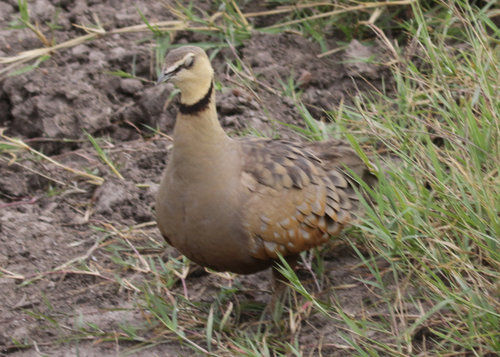 Yellow-throated Sandgrouse
 White-winged Flufftail
In short
The most reliable field mark between these two is the presence of distinctive white secondary feathers in flight on both sexes of White-winged Flufftail, which are absent in Yellow-throated Sandgrouse. Sandgrouse males show a bright yellow throat and black underwing coverts, while females and juveniles are more cryptic but still lack any white wing panels. Structurally, Yellow-throated Sandgrouse is much larger, heavier, and longer-winged, with a strong sandgrouse jizz, while White-winged Flufftail is a small, secretive rail-like bird. Their habitats rarely overlap: sandgrouse are found in open, arid country, while flufftails are restricted to dense, wet sedge marshes. If you see a bird with white flashing in the wings over a wetland, it's the flufftail; a large, flocking, long-winged bird at a waterhole in dry country is the sandgrouse.
Identification tips
- White secondary feathers in flight: If you see a small bird flush from marsh vegetation and show a strong white panel in the wings, it's White-winged Flufftail. Sandgrouse never show white in the wing at any age or sex.
- Yellow throat and black underwing (male sandgrouse): A bright yellow throat and black underwing coverts are unique to adult male Yellow-throated Sandgrouse. Flufftail never shows these features.
- Cryptic, dull plumage with dark crown (flufftail): Both sexes and all ages of White-winged Flufftail are dull brownish with a dark crown, lacking any bright or contrasting marks except the white in the wing.
- Sexual dimorphism (sandgrouse): Sandgrouse show strong sexual dimorphism: males are brighter with yellow and black, females and juveniles are paler and more mottled. Flufftail shows little sexual dimorphism; both sexes are dull.
- Size and structure: Sandgrouse are much larger and bulkier, with long, pointed wings and a pigeon-like jizz. Flufftail is tiny, round-bodied, and short-tailed, more like a small rail.
- Flocking vs. solitary: Sandgrouse are often seen in large flocks, especially at waterholes. Flufftails are solitary or in pairs, never flocking.
- Habitat: Sandgrouse are found in open, dry country and at waterholes; flufftails are restricted to dense, wet sedge marshes. If you are in a wetland, expect flufftail; in dry open country, expect sandgrouse.
- Behavior at water: Sandgrouse walk into shallow water to drink, often in groups. Flufftail remains hidden in marsh vegetation and rarely comes into the open.
- Flight style: Sandgrouse fly strongly and directly, often covering long distances. Flufftail flies weakly and only briefly, usually dropping back into cover.
- Juvenile confusion: Juvenile sandgrouse may be mistaken for dull marsh birds due to their cryptic plumage, but they never show white in the wing. Juvenile flufftail always shows the white secondaries in flight.
- Underwing color: Only male sandgrouse show black underwing coverts; flufftail underwing is not described as contrasting.
- Crown color: Flufftail has a dark crown; sandgrouse do not have a contrasting crown.
- Drinking behavior: Sandgrouse immerse their bills and suck water, often lifting their heads to swallow; flufftails are rarely seen drinking.
- Geographic context: Both species can occur in Ethiopia and South Africa, but their habitats do not overlap locally.
- Vocalization: Not diagnostic from the notes, but flufftail may call at dawn/dusk in marshes; sandgrouse are generally quiet at waterholes.
Size
Yellow-throated Sandgrouse is a much larger bird, averaging 339 g in mass and about 30 cm in length [wikidata, wikipedia]. It is robust, with long, pointed wings and a strong, pigeon-like build. White-winged Flufftail is much smaller (exact mass not given, but all flufftails are tiny rails), with a compact, short-tailed, and round-bodied appearance. In the field, the size gap is dramatic: sandgrouse are nearly the size of a pigeon, while flufftails are sparrow-sized and much more delicate.
Plumage
- Juvenile/Immature/Non-breeding birds:
- White-winged Flufftail: Both sexes and all ages show distinctive white secondary feathers in the wing, visible in flight as a strong white panel; otherwise, plumage is dull and cryptic, with a dark crown.
- Yellow-throated Sandgrouse: Juveniles resemble females, with paler, finely mottled cryptic plumage and no white in the wing. Both sexes lack any white wing panel at all ages. Males are brighter overall, with a yellow throat and black underwing coverts; females are more muted and camouflaged.
- Adult males:
- Sandgrouse males have a striking yellow throat, black lores, and black underwing coverts, but no white in the wing.
- Flufftail adults remain dull, with no bright throat or underwing, but always show the white secondaries in flight.
- Adult females:
- Sandgrouse females are cryptic, sandy, and finely patterned, but still lack any white in the wing.
- Flufftail females are similarly dull, but again show white secondaries in flight.
In summary, white in the wing is diagnostic for flufftail at all ages and sexes; yellow throat and black underwing for male sandgrouse only.
Behaviour
Yellow-throated Sandgrouse is highly gregarious, often seen in large flocks, especially at waterholes at dawn or dusk. They fly strongly and directly, with long, pointed wings, and walk into shallow water to drink. In contrast, White-winged Flufftail is extremely secretive and solitary or in pairs, skulking in dense marsh vegetation and rarely seen in the open. Flufftails are reluctant fliers, usually running through cover, and only flush briefly when disturbed, showing their white wing panels. Sandgrouse are obligate drinkers and travel long distances; flufftails are tied to small, wet patches and do not flock.
Habitat
Yellow-throated Sandgrouse inhabits arid and semi-arid open country, often far from dense vegetation, and is seen at open waterholes or pans in dry savanna or grassland. White-winged Flufftail is restricted to dense, wet sedge marshes and high-altitude wetlands, often with thick cover and standing water. The two species almost never overlap in habitat: sandgrouse avoid marshes, and flufftails avoid open, dry ground.
Voice
No direct comparison is possible from the notes. White-winged Flufftail is noted to call at dawn and dusk, sometimes in duet, but details are lacking. Sandgrouse are generally quiet at waterholes, and no vocal field marks are described here.
Yellow-throated Sandgrouse · White-winged Flufftail · My Tricky Birds