

Yellow-legged Gull vs Armenian Gull
Larus michahellis versus Larus armenicus
Play a quiz with Yellow-legged Gull and Armenian Gull
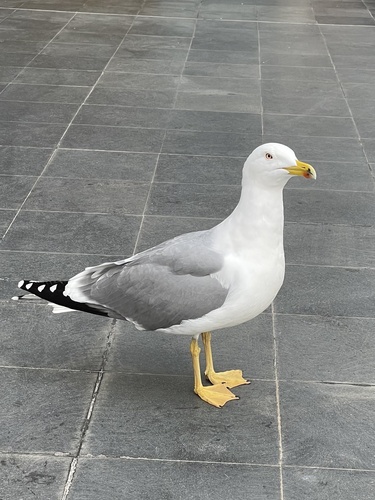 Yellow-legged Gull
 Armenian Gull
In short
The most reliable field mark to separate Yellow-legged Gull from Armenian Gull is the bill pattern in adults: Armenian Gull shows a short bill with a strong black subterminal band, while Yellow-legged Gull has a longer bill with a red spot but no black band. For first-winter birds, both have a narrow, sharply defined black tail band, but Armenian Gull is overall darker brown with a paler rump and pale inner primaries. Armenian Gull is slightly smaller, with a darker mantle and more extensive black on the wingtips, plus a dark eye in adults. Both species can be confusing in the Middle East, but careful attention to bill pattern, mantle shade, and eye color will usually clinch the ID.
Identification tips
- Bill pattern (adults): Armenian Gull has a short, stubby bill with a prominent black subterminal band; Yellow-legged Gull has a longer bill with a red spot but no black band. This is the single best mark in adults.
- Bill shape: Armenian's bill is shorter and more compact at all ages, while Yellow-legged's is longer and heavier, especially in males.
- Eye color (adults): Armenian Gull has a dark eye; Yellow-legged Gull usually has a pale yellow eye with a red orbital ring. This is reliable in breeding adults.
- Mantle color: Armenian Gull's mantle is slightly darker grey than Yellow-legged's, but lighter than Lesser Black-backed. This is best judged side-by-side or with experience.
- Wingtip pattern (adults): Armenian Gull has more extensive black on the wingtips with smaller white spots; Yellow-legged Gull has less black and larger white mirrors. This is subtle but can be seen in good flight views or perched birds with spread wings.
- Head color (autumn): Yellow-legged Gull is much whiter-headed in autumn, while Armenian Gull retains more streaking.
- Leg color: Both have yellowish legs as adults, but Armenian's can be duller or more flesh-toned. Not always reliable, especially in poor light.
- First-winter/juvenile plumage: Armenian Gull is overall darker brown with a paler rump and pale inner primaries; Yellow-legged Gull is paler on the head, rump, and underparts. Both have a narrow, sharply defined black tail band.
- Second-winter birds: Armenian retains a dark eye and black bill band; Yellow-legged is paler, with a red spot on the bill and paler legs.
- Size and structure: Armenian Gull is smaller and more compact, with a shorter bill and less bulky build; Yellow-legged can appear larger and longer-winged, especially in males.
- Habitat context: Armenian Gull is most likely at large inland lakes in the Caucasus and Middle East; Yellow-legged is more coastal and urban in Europe and the Mediterranean. If far from typical range, check all marks carefully.
- Tail band (immatures): Both show a sharply defined black tail band in first-winter, but Armenian's is often narrower and more sharply demarcated.
- Primary pattern (immatures): Armenian has pale inner primaries, which can contrast with the rest of the wing in flight; Yellow-legged's are darker overall.
- Confusion risk: Both species can be confused with Herring and Lesser Black-backed Gulls; always check multiple features, especially bill pattern and eye color, before concluding.
- Seasonal changes: Some marks (like head streaking and leg color) vary with season and age; prioritize bill pattern, eye color, and wingtip pattern for the most consistent separation.
Size
Armenian Gull is the smaller of the two, though both are large gulls. Armenian Gull measures 52–62 cm in length and 120–145 cm in wingspan, with a typical adult mass around 1000 g. Yellow-legged Gull is larger on average, ranging from 52–68 cm in length and 120–155 cm in wingspan, with a broader mass range (550–1600 g). In the field, the size difference may be subtle and is often less useful than bill or plumage features, but Armenian Gull tends to look more compact and less bulky, especially compared to large male Yellow-legged Gulls.
Plumage
- First-winter/juvenile: Both species show a narrow, sharply defined black tail band, but Armenian Gull is overall darker brown, with a paler rump and pale inner primaries. Yellow-legged Gull juveniles have a paler head, rump, and underparts, and resemble Great Black-backed Gulls more than Armenian. Both have dark bills and eyes at this age, but Armenian's bill is shorter and stubbier.
- Second winter: Armenian Gull begins to show a short bill with a black band, and the dark eye persists. Yellow-legged Gull is paler overall, with a longer bill that develops a red spot but lacks a black band; legs become light yellow-flesh.
- Adult: Armenian Gull has a slightly darker grey back, more extensive black on the wingtips with smaller white spots, a short bill with a strong black band before the tip, and a dark eye. Yellow-legged Gull has a paler grey back (darker than Herring, lighter than Lesser Black-backed), a longer bill with a red spot (no black band), yellow legs, and a red orbital ring. Armenian's head is less white in autumn than Yellow-legged.
Behaviour
Both species are omnivorous and opportunistic, foraging at rubbish tips, harbors, and coastlines, and can be predatory if needed. There are no strong behavioral differences in foraging or flight style noted in the sources. Both breed in colonies and can nest on buildings in urban areas, but this is more frequently noted for Yellow-legged Gull in Western Europe.
Habitat
Yellow-legged Gull is widespread in Europe, the Middle East, and North Africa, often found along coasts, harbors, and increasingly in urban settings. Armenian Gull is restricted to the Caucasus and Middle East, mainly around large inland lakes and reservoirs. Their ranges do not typically overlap, but vagrancy and winter movements can bring them into contact, especially in the eastern Mediterranean and Middle East.