

Yellow-crowned Euphonia vs Yellow-throated Euphonia
Euphonia luteicapilla versus Euphonia hirundinacea
Play a quiz with Yellow-crowned Euphonia and Yellow-throated Euphonia
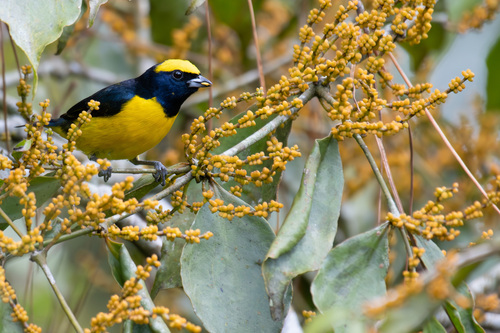 Yellow-crowned Euphonia
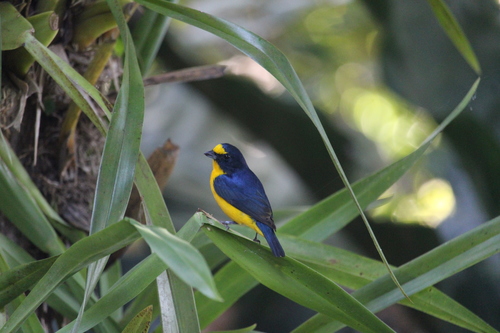 Yellow-throated Euphonia
In short
The most reliable field mark between Yellow-crowned and Yellow-throated Euphonias is the extent and placement of yellow on the male's head: Yellow-crowned males show a large, bright yellow crown extending well past the eye, while Yellow-throated males have only a small yellow forehead patch reaching to about mid-eye. Female separation hinges on underpart color: Yellow-crowned females are olive-yellow below, while Yellow-throated females have a whitish or pale gray throat and belly with yellowish flanks. Immature and juvenile males of Yellow-throated Euphonia transition through patchy, olive and yellow plumages before attaining adult colors, sometimes resembling females. Both species are similar in size and structure, but subtle differences in underwing and undertail coloration, especially in flight, can help clinch the ID if seen well.
Identification tips
- Adult male head pattern is the quickest check: Yellow-crowned has a large, bright yellow crown extending well past the eye; Yellow-throated shows only a small yellow forehead patch reaching about mid-eye. This works year-round for adult males.
- Female underparts are key: Yellow-crowned females are olive-yellow below with no strong contrast, while Yellow-throated females have a whitish or pale gray throat, breast, and belly, with yellowish flanks. Look for this pale central underpart in perched birds or good views from below.
- Juvenile/immature Yellow-throated males: These birds pass through stages with olive-green upperparts and patchy yellow on the throat and belly before developing black on the head. They may resemble females but will show uneven yellow and olive as they molt. Yellow-crowned immatures are not described in detail but likely resemble adults early.
- Underwing pattern in flight: Yellow-throated Euphonia shows a large white oval on the underwing (from the inner webs of the outer 2–3 primaries) and white underwing coverts. Yellow-crowned lacks this, having uniformly dark wings below. This is best seen in birds flying overhead or preening.
- Undertail coverts: Yellow-crowned has bright yellow undertail coverts; Yellow-throated's are dull grayish or pale olive-yellowish (female). This can help if the bird is facing away or flicking its tail.
- Bill and structure: Both have short, stubby bills and compact bodies; structure is not a reliable separator.
- Upperparts: Both males have glossy blue-black upperparts, but the yellow crown/forehead pattern is the main difference. Females of both are olive above, but Yellow-throated is described as faintly glossy metallic.
- Size: Both are similar in size and weight; do not rely on this for identification.
- Habitat and range: If in southeastern Mexico or northern Central America, only Yellow-throated occurs. In Costa Rica and Panama, both may be present, so do not use range alone in these areas.
- Voice: If you hear a rapid, choppy, high-pitched song or a 'pidgel-eece' or 'chi-bib-bib-bib-bib' call, suspect Yellow-throated. Absence of these calls is not diagnostic for Yellow-crowned.
- Sexual dimorphism: Both species are sexually dimorphic, but the female underpart color is more useful than upperpart tone.
- Pitfall: Overlapping yellow: In poor light, the yellow crown of Yellow-crowned can appear smaller, and the yellow forehead of Yellow-throated can look more extensive if the bird is fluffed or at an angle. Always try for a direct side or front view of the head.
- Pitfall: Immature confusion: Immature Yellow-throated males may look like females of either species; check for patchy yellow on the throat and belly and any black starting on the head.
- Pitfall: Underwing flash: The white underwing patch of Yellow-throated is only visible in flight or when preening; do not expect to see it on perched birds.
- Context: Both species may join mixed flocks, but this is not a separator. Focus on plumage and head pattern.
Size
Both species are small, short-billed finches, with Yellow-crowned Euphonia averaging about 13.0 g and 9–10 cm in length, and Yellow-throated Euphonia slightly heavier at 14.0 g and 10–12 cm long. The difference is minor and not reliable for field identification. Both have short tails and compact builds.
Plumage
Juvenile and immature Yellow-throated Euphonias resemble females, with olive-green upperparts and loose-textured plumage; as they mature, yellow appears on the throat and belly before black develops on the head and crown. In contrast, Yellow-crowned Euphonia immatures are not described in detail, but adult-like plumage is expected early.
Adult males are best separated by head pattern: Yellow-crowned has a large, bright yellow crown extending well past the eye, with the rest of the head, nape, and throat glossy blue-black. Yellow-throated males have a much smaller yellow patch limited to the forehead, only reaching to about mid-eye, and the rest of the head and upperparts are glossy blue-black. Both have yellow underparts, but Yellow-throated has white underwing coverts and a large white oval on the underwing (from the inner webs of the outer 2–3 primaries), plus dark dull gray undertail coverts, while Yellow-crowned has bright yellow underparts including undertail coverts.
Females: Yellow-crowned females are olive above and olive-yellow below, with a yellowish tinge on the forehead and no strong contrast on the underparts. Yellow-throated females are olive-green above but have a distinctly whitish to grayish-white throat, center of breast, and belly, with yellowish-olive flanks and pale olive-yellowish undertail coverts. This pale central underpart is the key field mark for separating females.
Behaviour
Both species are arboreal and tend to forage in the canopy or at forest edge, often in pairs or small groups. No strong behavioral differences are noted in the sources for field separation.
Habitat
Yellow-crowned Euphonia is found mainly in Costa Rica, Nicaragua, and Panama, while Yellow-throated Euphonia ranges from southeastern Mexico through Central America to western Panama. Both use forest edges, open woodlands, and shaded plantations, but Yellow-throated is more widespread and can be found in both humid and dry regions. In areas of overlap (western Panama, southwestern Costa Rica), both may occur, so range alone is not always diagnostic.
Voice
Yellow-throated Euphonia males have a varied song with high-pitched, shrill, and squeaky notes, often in rapid, choppy patterns of 2–4 notes, sometimes mimicking other birds. Calls include a rapid 'pidgel-eece,' 'chi-bib-bib-bib-bib,' 'tuck-a-tuck,' 'weet,' and 'gleer.' Females give thin, high-pitched, almost trilled calls. No detailed vocal description is available for Yellow-crowned Euphonia in these notes, so voice is not a reliable separator unless Yellow-throated's distinctive calls are heard.
Yellow-crowned Euphonia · Yellow-throated Euphonia · My Tricky Birds