

Motmot

Yellow-crowned Bishop vs Grosbeak Weaver

Euplectes afer versus Amblyospiza albifrons

Play a quiz with Yellow-crowned Bishop and Grosbeak Weaver
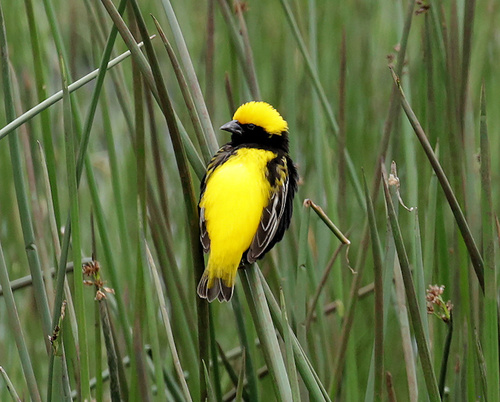
Yellow-crowned Bishop (Euplectes afer) Yellow-crowned Bishop
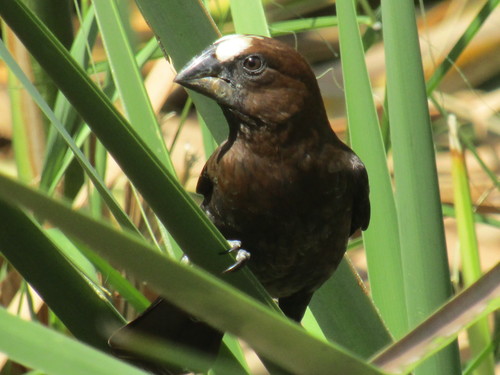
Grosbeak Weaver (Amblyospiza albifrons) Grosbeak Weaver

Media

Loading…

In short

The most reliable field mark between Yellow-crowned Bishop and Grosbeak Weaver is overall structure and bill size: the Grosbeak Weaver is much larger and bulkier, with a massive, thick bill, while the Yellow-crowned Bishop is a small, compact bird with a short, conical bill. In breeding season, male bishops are strikingly yellow and black, with a bright yellow crown, while Grosbeak Weavers are never this vividly colored. Non-breeding bishops and females are streaky brown and can be confused with other weavers, but the Grosbeak Weaver still stands out by its size and especially its huge bill. In flight or perched, the bishop is noticeably smaller and more delicate, while the weaver is robust and heavy-billed.

Identification tips

  1. Bill size and shape: Grosbeak Weaver has a massive, thick, finch-like bill, much larger and heavier than the short, conical bill of the Yellow-crowned Bishop. This is the most reliable mark in all plumages and ages.
  2. Body size and structure: The bishop is a small, compact bird (about 14.5 g), while the weaver is much bulkier and longer. If you see both together, the size difference is obvious.
  3. Breeding male plumage: Male Yellow-crowned Bishop in breeding season is bright yellow with a black face, throat, and underparts, and a vivid yellow crown. Grosbeak Weaver never shows this color combination or intensity.
  4. Crown color: Only the bishop (breeding male) has a bright yellow crown; the weaver never shows this feature.
  5. Non-breeding/female plumage: Female and non-breeding bishops are brown above with dark streaks and a pale eyebrow, off-white below with fine streaks. Grosbeak Weaver is plainer, lacking strong streaking or a pale eyebrow, and appears more uniform.
  6. Bill color: Breeding male bishop has a black bill; non-breeding and female bishops have a horn-colored bill, as does the weaver. Bill color is not diagnostic except in breeding male bishops.
  7. Wing and tail: Bishop has brown wings and tail, but these are not distinctive compared to the weaver. No unique upperwing pattern is described for either species.
  8. Behavior: Grosbeak Weavers often fan and flick their tails and use their bill to crack seeds in a noticeably forceful way. Bishops are more likely to be seen feeding on grass seeds or flitting through grass.
  9. Habitat: If seen in dense reedbeds or marshes, especially near distinctive globe-shaped nests, suspect Grosbeak Weaver. In open grassland, weedy fields, or agricultural areas, bishop is more likely.
  10. Flight style: Bishop is quick and agile in flight, while weaver is heavier and more direct.
  11. Vocalizations: If you hear a harsh, unmusical song, it may be Grosbeak Weaver, but this is not a primary field mark.
  12. Sexual dimorphism: Bishop is highly sexually dimorphic in breeding season; weaver is less so, with both sexes lacking bright yellow or black plumage.
  13. Plumage confusion: Non-breeding bishops and females can be confused with other weavers, but the weaver's huge bill and bulk should prevent confusion with bishops.
  14. Context: If you see a bird in a colony with globe-shaped nests in reeds, it's likely Grosbeak Weaver. Bishops do not build such nests.
  15. Pitfalls: Immature and female bishops may be mistaken for small weavers, but always check bill size and overall body structure—bishops are dainty, weavers are robust.

Size

Yellow-crowned Bishop is a small passerine, weighing about 14.5 g [wikidata], and measures 95–105 mm in length [wikipedia]. In contrast, while no precise mass is given for Grosbeak Weaver here, it is described as a large, robust weaver with a particularly thick bill [wikipedia]. In the field, the bishop will appear much smaller, lighter, and more agile, while the weaver is noticeably bulkier and heavier-set, with a disproportionately large head and bill.

Plumage

Breeding male Yellow-crowned Bishops are unmistakable: they show a brilliant yellow crown, forehead, and hindcrown, with a black lower face, throat, breast, and belly, plus a wide black collar on the nape, yellow rump, back, and shoulder patch, and brown wings and tail [wikipedia]. Females and non-breeding males are pale brown above with darker streaking, a pale eyebrow, and off-white underparts with fine dark streaks on breast and flanks. By contrast, Grosbeak Weavers do not show any bright yellow or black patterning; their plumage is more muted and lacks the sharp contrast or yellow crown of the bishop. No age-specific upperwing pattern is described for either species, so separation relies on overall coloration and structure. In all plumages, the bishop is more colorful (in breeding males) or more finely streaked (in females/non-breeding), while the weaver is plainer and defined by its massive bill.

Behaviour

Grosbeak Weavers are often seen fanning and flicking their tails and are known for their robust, seed-cracking behavior using their strong mandibles [wikipedia]. They also build distinctive, globe-shaped nests in reedbeds. Yellow-crowned Bishops are more likely to be seen flitting about grasslands or perched on stalks, with less obvious bill use or tail-flicking. In flight, bishops are quick and agile, while weavers appear heavier and more deliberate.

Habitat

Yellow-crowned Bishop favors grasslands, wetlands, and agricultural fields (especially wheat and sorghum), often in weedy vegetation near water [wikipedia]. Grosbeak Weaver is more closely tied to reedy wetlands, marshes, and forest edges, and is often found in reedbeds where it nests colonially [wikipedia]. While both can occur near water, the bishop is more likely in open grassy or agricultural areas, and the weaver is more strictly associated with dense reeds and wetlands.

Voice

Grosbeak Weaver's song is described as unmusical and harsh [wikipedia], while no specific vocal description is given for Yellow-crowned Bishop in these notes. If heard, a harsh, unmusical series of notes would suggest Grosbeak Weaver, but this is not a primary field mark for separation.

Submit a better description

Use the same sections as the comparison. Your text is published immediately.

The most reliable field mark between Yellow-crowned Bishop and Grosbeak Weaver is overall structure and bill size: the Grosbeak Weaver is much larger and bulkier, with a massive, thick bill, while the Yellow-crowned Bishop is a small, compact bird with a short, conical bill. In breeding season, male bishops are strikingly yellow and black, with a bright yellow crown, while Grosbeak Weavers are never this vividly colored. Non-breeding bishops and females are streaky brown and can be confused with other weavers, but the Grosbeak Weaver still stands out by its size and especially its huge bill. In flight or perched, the bishop is noticeably smaller and more delicate, while the weaver is robust and heavy-billed.

  1. Bill size and shape: Grosbeak Weaver has a massive, thick, finch-like bill, much larger and heavier than the short, conical bill of the Yellow-crowned Bishop. This is the most reliable mark in all plumages and ages.
  2. Body size and structure: The bishop is a small, compact bird (about 14.5 g), while the weaver is much bulkier and longer. If you see both together, the size difference is obvious.
  3. Breeding male plumage: Male Yellow-crowned Bishop in breeding season is bright yellow with a black face, throat, and underparts, and a vivid yellow crown. Grosbeak Weaver never shows this color combination or intensity.
  4. Crown color: Only the bishop (breeding male) has a bright yellow crown; the weaver never shows this feature.
  5. Non-breeding/female plumage: Female and non-breeding bishops are brown above with dark streaks and a pale eyebrow, off-white below with fine streaks. Grosbeak Weaver is plainer, lacking strong streaking or a pale eyebrow, and appears more uniform.
  6. Bill color: Breeding male bishop has a black bill; non-breeding and female bishops have a horn-colored bill, as does the weaver. Bill color is not diagnostic except in breeding male bishops.
  7. Wing and tail: Bishop has brown wings and tail, but these are not distinctive compared to the weaver. No unique upperwing pattern is described for either species.
  8. Behavior: Grosbeak Weavers often fan and flick their tails and use their bill to crack seeds in a noticeably forceful way. Bishops are more likely to be seen feeding on grass seeds or flitting through grass.
  9. Habitat: If seen in dense reedbeds or marshes, especially near distinctive globe-shaped nests, suspect Grosbeak Weaver. In open grassland, weedy fields, or agricultural areas, bishop is more likely.
  10. Flight style: Bishop is quick and agile in flight, while weaver is heavier and more direct.
  11. Vocalizations: If you hear a harsh, unmusical song, it may be Grosbeak Weaver, but this is not a primary field mark.
  12. Sexual dimorphism: Bishop is highly sexually dimorphic in breeding season; weaver is less so, with both sexes lacking bright yellow or black plumage.
  13. Plumage confusion: Non-breeding bishops and females can be confused with other weavers, but the weaver's huge bill and bulk should prevent confusion with bishops.
  14. Context: If you see a bird in a colony with globe-shaped nests in reeds, it's likely Grosbeak Weaver. Bishops do not build such nests.
  15. Pitfalls: Immature and female bishops may be mistaken for small weavers, but always check bill size and overall body structure—bishops are dainty, weavers are robust.

Yellow-crowned Bishop is a small passerine, weighing about 14.5 g [wikidata], and measures 95–105 mm in length [wikipedia]. In contrast, while no precise mass is given for Grosbeak Weaver here, it is described as a large, robust weaver with a particularly thick bill [wikipedia]. In the field, the bishop will appear much smaller, lighter, and more agile, while the weaver is noticeably bulkier and heavier-set, with a disproportionately large head and bill.

Breeding male Yellow-crowned Bishops are unmistakable: they show a brilliant yellow crown, forehead, and hindcrown, with a black lower face, throat, breast, and belly, plus a wide black collar on the nape, yellow rump, back, and shoulder patch, and brown wings and tail [wikipedia]. Females and non-breeding males are pale brown above with darker streaking, a pale eyebrow, and off-white underparts with fine dark streaks on breast and flanks. By contrast, Grosbeak Weavers do not show any bright yellow or black patterning; their plumage is more muted and lacks the sharp contrast or yellow crown of the bishop. No age-specific upperwing pattern is described for either species, so separation relies on overall coloration and structure. In all plumages, the bishop is more colorful (in breeding males) or more finely streaked (in females/non-breeding), while the weaver is plainer and defined by its massive bill.

Grosbeak Weavers are often seen fanning and flicking their tails and are known for their robust, seed-cracking behavior using their strong mandibles [wikipedia]. They also build distinctive, globe-shaped nests in reedbeds. Yellow-crowned Bishops are more likely to be seen flitting about grasslands or perched on stalks, with less obvious bill use or tail-flicking. In flight, bishops are quick and agile, while weavers appear heavier and more deliberate.

Yellow-crowned Bishop favors grasslands, wetlands, and agricultural fields (especially wheat and sorghum), often in weedy vegetation near water [wikipedia]. Grosbeak Weaver is more closely tied to reedy wetlands, marshes, and forest edges, and is often found in reedbeds where it nests colonially [wikipedia]. While both can occur near water, the bishop is more likely in open grassy or agricultural areas, and the weaver is more strictly associated with dense reeds and wetlands.

Grosbeak Weaver's song is described as unmusical and harsh [wikipedia], while no specific vocal description is given for Yellow-crowned Bishop in these notes. If heard, a harsh, unmusical series of notes would suggest Grosbeak Weaver, but this is not a primary field mark for separation.

Discard your changes?

You have unsaved edits. If you leave now, those changes will be lost.

Yellow-crowned Bishop · Grosbeak Weaver · My Tricky Birds