

Yellow-crowned Bishop vs Baltimore Oriole
Euplectes afer versus Icterus galbula
Play a quiz with Yellow-crowned Bishop and Baltimore Oriole
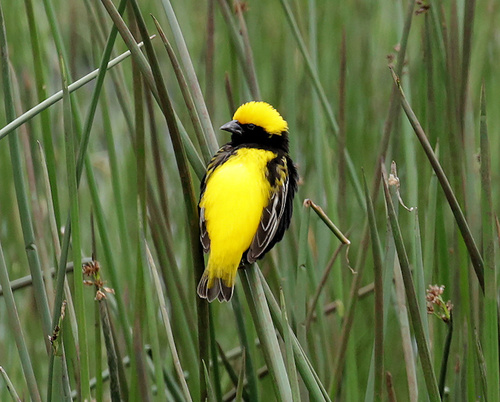 Yellow-crowned Bishop
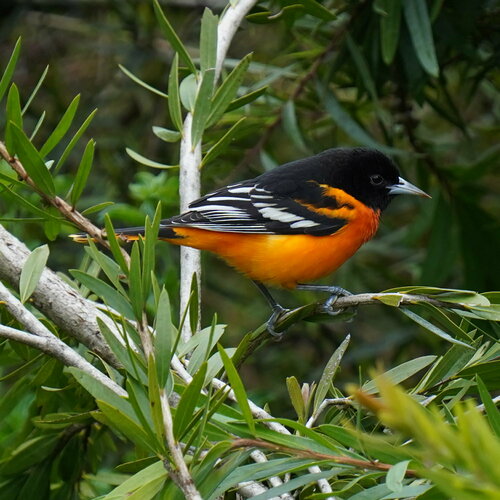 Baltimore Oriole
In short
The most reliable field mark to separate Yellow-crowned Bishop from Baltimore Oriole is the presence of a bright yellow crown and black underparts in breeding male bishops, which Baltimore Orioles never show. Immature and female bishops, however, are brown and streaky, easily confused with young or female orioles at a distance. Baltimore Orioles are much larger, with a longer, more pointed bill and a distinctive orange-and-black plumage in adult males, plus always show white wingbars regardless of age or sex—these are absent in bishops. If you see a small, sparrow-sized bird with a short, conical bill and no wingbars, it's a bishop; a larger, robin-sized bird with a pointed bill and clear white wingbars is an oriole.
Identification tips
- White wingbars: Baltimore Orioles of all ages and sexes have prominent white wingbars on dark wings; Yellow-crowned Bishops never do. This is the single most reliable mark for separating non-breeding and immature birds in flight or at rest.
- Bill shape: Orioles have a long, pointed, slightly downcurved bill; bishops have a short, thick, conical bill. This is visible even at a distance with binoculars.
- Size: Orioles are robin-sized (17–22 cm, ~34 g); bishops are sparrow-sized (9.5–10.5 cm, ~15 g). Use nearby birds for scale when possible.
- Breeding male bishop: Look for a brilliant yellow crown, forehead, and nape, with black underparts and collar. Orioles never show this pattern.
- Adult male oriole: Deep orange underparts, black head and back, and white wingbars. Never shows a yellow crown or solid black belly.
- Female/immature bishop: Pale brown above with streaks, pale eyebrow, off-white underparts with fine streaks, and plain brown wings. No orange or white wingbars.
- Female/immature oriole: Yellow-brown above, dull orange-yellow below, always with white wingbars. May be confused with bishop at a distance, but wingbars are key.
- Wing pattern in flight: Orioles flash white wingbars and a larger, more elongated silhouette; bishops show plain brown wings and a compact, sparrow-like shape.
- Tail: Orioles have a longer, more graduated tail; bishops have a short, square tail.
- Habitat: Orioles are usually in trees or at feeders; bishops are in grasslands, fields, or marsh edges, often low or on the ground.
- Behavior: Orioles forage in trees, sometimes hanging or probing fruit; bishops feed low or on the ground, often in flocks outside breeding season.
- Vocalizations: Orioles sing clear, whistled songs; bishops do not. If you hear a melodious, flute-like song, it's an oriole.
- Seasonal change: Male bishops only show the yellow crown and black underparts in breeding season; outside this, they resemble females and are easily confused with other streaky brown birds.
- Pitfalls: Non-breeding bishops and female/immature orioles can look similar from a distance, but check for wingbars and bill shape. Lighting can make oriole orange look yellowish, but the wingbars remain visible.
- Context: If you see a small, streaky bird in a grassland or field, think bishop; a larger, orange or black bird in a treetop or at a feeder is almost certainly an oriole.
Size
Baltimore Oriole is substantially larger, measuring 17–22 cm in length and averaging about 34 g in weight [wikipedia][wikidata]. In contrast, Yellow-crowned Bishop is much smaller at 9.5–10.5 cm and 14.5–15 g [wikidata][wikipedia]. The oriole has a more robust, elongated body, a longer tail, and a noticeably longer, pointed bill, while the bishop is compact with a short, conical bill typical of weavers.
Plumage
- Juvenile and female bishops are pale brown above with darker streaking, a pale eyebrow, and off-white underparts with fine streaks on breast and flanks. Their wings and tail are plain brown, lacking any wingbars or strong patterning. Non-breeding males look similar to females.
- Juvenile and female Baltimore Orioles are yellow-brown above with darker wings and dull orange-yellow below. Crucially, all ages and sexes of oriole show white wingbars on dark wings, which are never present in bishops.
- Breeding male bishop is unmistakable: brilliant yellow crown, forehead, hindcrown, rump, and back; black lower face, throat, breast, belly, and a wide black collar on the nape. Wings and tail are brown.
- Adult male oriole is deep orange on underparts, shoulder, and rump, with the rest of the plumage black and always with white wingbars. No yellow crown or solid black underparts.
- In flight, the oriole's white wingbars and larger size are obvious; bishops show plain brown wings with no contrasting marks.
Behaviour
Baltimore Orioles are often seen foraging in trees, sometimes hanging upside down or probing fruit and flowers with their pointed bills. They are more arboreal and may visit feeders for fruit or nectar. Yellow-crowned Bishops are typically found in grasslands or weedy fields, often low in vegetation or on the ground, and exhibit more sparrow-like, flocking behavior outside the breeding season. Male bishops may display conspicuously during breeding, but otherwise their habits are more secretive and terrestrial.
Habitat
Yellow-crowned Bishop prefers open grasslands, marsh edges, and agricultural fields, especially near water, and is rarely found in mature trees [wikipedia]. Baltimore Oriole is a bird of open woodlands, parks, and gardens, often high in deciduous trees, and is common in suburban areas with large shade trees. Their habitats rarely overlap except in highly disturbed or edge areas, and context can help: a small, streaky bird in tall grass is likely a bishop, while a bright orange oriole in a treetop is unmistakable.
Voice
Baltimore Oriole has a clear, whistled song with paired, repeated notes, and a variety of chattering calls, sometimes including a flutter-drum sound in flight [wikipedia]. Yellow-crowned Bishop's vocalizations are not described in detail in the notes, but as a weaver, it is unlikely to produce the oriole's rich, whistled song. If you hear a strong, melodious whistle, it's almost certainly an oriole.