

Motmot

Yellow-billed Tern vs Chami Antpitta

Sternula superciliaris versus Grallaria alvarezi

Play a quiz with Yellow-billed Tern and Chami Antpitta

Yellow-billed Tern (Sternula superciliaris) Yellow-billed Tern
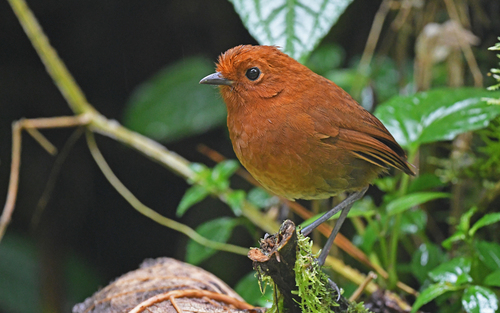
Chami Antpitta (Grallaria alvarezi) Chami Antpitta

Media

Loading…

In short

The most reliable field mark to separate these two species is overall shape and structure: Yellow-billed Tern is a slim, long-winged, white-and-grey waterbird with a bright yellow bill, while Chami Antpitta is a plump, round, short-tailed terrestrial bird with rich reddish-brown plumage and a dark bill. Juvenile Yellow-billed Terns lack the adult's black cap but still show a pale, aquatic look, while Chami Antpitta of all ages is earth-toned and never shows white or grey. In flight or perched, the tern's pointed wings and streamlined body contrast sharply with the antpitta's stubby wings and upright, ball-like stance. Habitat is also a strong clue: tern is seen over open water or sandbanks, antpitta on the forest floor.

Identification tips

  1. Structure and shape are the fastest clues: Yellow-billed Tern is slim, long-winged, and pointed with a long tail; Chami Antpitta is round, short-tailed, and upright. This works for all ages and in both perched and flight views.
  2. Bill color and shape: Tern has a bright yellow, slender bill; antpitta has a stout, dark bill with a buffy base and pale tip. Bill color is visible even at a distance in good light.
  3. Leg color: Tern has yellow feet; antpitta's legs are grayish blue. Useful if seen well on the ground.
  4. Plumage contrast: Adult tern is mostly white below and silvery grey above with a black cap and eyeline; antpitta is entirely reddish brown with a lighter, slightly scaly belly and no white or grey anywhere.
  5. Juvenile confusion: Juvenile tern is brown and white, lacking the black cap but still pale and aquatic-looking; antpitta juveniles are not described, but all ages are earth-toned and never show white or grey. If you see a brownish, pale-bellied bird near water, consider juvenile tern; a uniformly rufous, round bird in forest is antpitta.
  6. Wing and tail: Tern's wings are long and pointed, tail is long and forked; antpitta's wings are short and rounded, tail is very short and barely extends beyond the body.
  7. Flight vs. perched: Tern is graceful and buoyant in flight, often hovering or gliding; antpitta is rarely seen flying, moves by hopping or running on the ground.
  8. Habitat: Tern is always near open water, often in groups or colonies; antpitta is solitary or in pairs, always on the forest floor, never near open water.
  9. Vocalization: Antpitta gives rapid trills and purring songs, mostly at dawn from low perches; tern (by family) gives sharp, high-pitched calls, but no details are given here.
  10. Behavior: Tern often perches on sandbanks or flies over water; antpitta is secretive, foraging in leaf litter and rarely perching in the open.
  11. Geographic range: Tern is widespread across South America; antpitta is endemic to Colombia. If outside Colombia, antpitta is ruled out.
  12. Sex and season: Both species have similar plumage in both sexes; no seasonal variation is described for either. This means field marks are reliable year-round.
  13. Pitfalls: In poor light, a juvenile tern might appear brownish and could be mistaken for a terrestrial bird if seen on a sandbank, but its shape and habitat still differ from antpitta. Antpitta is never seen in open, aquatic habitats.
  14. Group context: Tern is often in colonies or flocks; antpitta is solitary or in pairs.
  15. Upperwing pattern: No distinctive upperwing patterns are described for either species, but the tern's silvery grey wings and pointed shape are unlike the antpitta's dusky, rounded wings.

Size

Yellow-billed Tern is larger, measuring about 23–25 cm in length and weighing 40–57 g [wikipedia]. Chami Antpitta is smaller and much more compact, at 14.5–15 cm in length [wikipedia]. The tern is slender and elongated, with long wings and tail, while the antpitta is notably round-bodied and short-tailed. In the field, the tern will appear much longer and more streamlined, especially in flight, while the antpitta looks squat and almost ball-shaped.

Plumage

Juvenile Yellow-billed Terns are brown and white, lacking the adult's black cap, but still show a pale, aquatic look with white underparts and silvery grey wings. Adults have a striking black crown, nape, and eyeline, with a white forehead and underbody, and yellow bill and feet. In contrast, Chami Antpitta of all ages is almost entirely reddish brown, deeper on the breast, with a lighter buffy brown belly and a slight scaly pattern on the lower belly. Its vent and outer tail feathers are only slightly lighter than the body. The antpitta's bill is dark with a buffy base and pale tip, and its legs are grayish blue. There is no white or grey in the antpitta's plumage, and no black cap or eyeline. The antpitta's plumage is earth-toned and uniform, while the tern's is crisp, high-contrast, and largely white and grey.

Behaviour

Yellow-billed Tern is almost always seen in open areas near water, flying, hovering, or perching on sandbanks, often in groups. It forages by hovering and picking prey from the water's surface. Chami Antpitta is strictly terrestrial, foraging alone or in pairs on the forest floor by hopping or running, flipping leaf litter, and probing the soil for invertebrates. The antpitta is rarely seen in flight and is typically secretive, moving low to the ground and perching upright. The tern is active and conspicuous in open areas, while the antpitta is shy and elusive in dense undergrowth.

Habitat

Yellow-billed Tern is found in open aquatic habitats: rivers, swamps, freshwater lakes, sandbanks, and coastal lagoons across much of South America [wikipedia]. It is rarely found away from water. Chami Antpitta is endemic to Colombia and restricted to forested habitats, foraging on the ground in dense forest. It is never found in open aquatic environments. Thus, location and habitat are strong clues: a small bird on a sandbank or over water is almost certainly the tern, while a round, reddish bird on the forest floor is the antpitta.

Voice

Chami Antpitta has a distinctive vocal repertoire: its long song is a rapid, slightly descending trill lasting 2.5–3.5 seconds, and its short song is a quick, stuttering trill with a purring quality, mostly given at dawn from a low perch [wikipedia]. No vocalization details are provided for Yellow-billed Tern, but terns typically give sharp, high-pitched calls, quite unlike the antpitta's trills. If you hear a rapid trill or purr from the undergrowth, it's likely the antpitta; sharp, piercing calls over water suggest the tern.

Submit a better description

Use the same sections as the comparison. Your text is published immediately.

The most reliable field mark to separate these two species is overall shape and structure: Yellow-billed Tern is a slim, long-winged, white-and-grey waterbird with a bright yellow bill, while Chami Antpitta is a plump, round, short-tailed terrestrial bird with rich reddish-brown plumage and a dark bill. Juvenile Yellow-billed Terns lack the adult's black cap but still show a pale, aquatic look, while Chami Antpitta of all ages is earth-toned and never shows white or grey. In flight or perched, the tern's pointed wings and streamlined body contrast sharply with the antpitta's stubby wings and upright, ball-like stance. Habitat is also a strong clue: tern is seen over open water or sandbanks, antpitta on the forest floor.

  1. Structure and shape are the fastest clues: Yellow-billed Tern is slim, long-winged, and pointed with a long tail; Chami Antpitta is round, short-tailed, and upright. This works for all ages and in both perched and flight views.
  2. Bill color and shape: Tern has a bright yellow, slender bill; antpitta has a stout, dark bill with a buffy base and pale tip. Bill color is visible even at a distance in good light.
  3. Leg color: Tern has yellow feet; antpitta's legs are grayish blue. Useful if seen well on the ground.
  4. Plumage contrast: Adult tern is mostly white below and silvery grey above with a black cap and eyeline; antpitta is entirely reddish brown with a lighter, slightly scaly belly and no white or grey anywhere.
  5. Juvenile confusion: Juvenile tern is brown and white, lacking the black cap but still pale and aquatic-looking; antpitta juveniles are not described, but all ages are earth-toned and never show white or grey. If you see a brownish, pale-bellied bird near water, consider juvenile tern; a uniformly rufous, round bird in forest is antpitta.
  6. Wing and tail: Tern's wings are long and pointed, tail is long and forked; antpitta's wings are short and rounded, tail is very short and barely extends beyond the body.
  7. Flight vs. perched: Tern is graceful and buoyant in flight, often hovering or gliding; antpitta is rarely seen flying, moves by hopping or running on the ground.
  8. Habitat: Tern is always near open water, often in groups or colonies; antpitta is solitary or in pairs, always on the forest floor, never near open water.
  9. Vocalization: Antpitta gives rapid trills and purring songs, mostly at dawn from low perches; tern (by family) gives sharp, high-pitched calls, but no details are given here.
  10. Behavior: Tern often perches on sandbanks or flies over water; antpitta is secretive, foraging in leaf litter and rarely perching in the open.
  11. Geographic range: Tern is widespread across South America; antpitta is endemic to Colombia. If outside Colombia, antpitta is ruled out.
  12. Sex and season: Both species have similar plumage in both sexes; no seasonal variation is described for either. This means field marks are reliable year-round.
  13. Pitfalls: In poor light, a juvenile tern might appear brownish and could be mistaken for a terrestrial bird if seen on a sandbank, but its shape and habitat still differ from antpitta. Antpitta is never seen in open, aquatic habitats.
  14. Group context: Tern is often in colonies or flocks; antpitta is solitary or in pairs.
  15. Upperwing pattern: No distinctive upperwing patterns are described for either species, but the tern's silvery grey wings and pointed shape are unlike the antpitta's dusky, rounded wings.

Yellow-billed Tern is larger, measuring about 23–25 cm in length and weighing 40–57 g [wikipedia]. Chami Antpitta is smaller and much more compact, at 14.5–15 cm in length [wikipedia]. The tern is slender and elongated, with long wings and tail, while the antpitta is notably round-bodied and short-tailed. In the field, the tern will appear much longer and more streamlined, especially in flight, while the antpitta looks squat and almost ball-shaped.

Juvenile Yellow-billed Terns are brown and white, lacking the adult's black cap, but still show a pale, aquatic look with white underparts and silvery grey wings. Adults have a striking black crown, nape, and eyeline, with a white forehead and underbody, and yellow bill and feet. In contrast, Chami Antpitta of all ages is almost entirely reddish brown, deeper on the breast, with a lighter buffy brown belly and a slight scaly pattern on the lower belly. Its vent and outer tail feathers are only slightly lighter than the body. The antpitta's bill is dark with a buffy base and pale tip, and its legs are grayish blue. There is no white or grey in the antpitta's plumage, and no black cap or eyeline. The antpitta's plumage is earth-toned and uniform, while the tern's is crisp, high-contrast, and largely white and grey.

Yellow-billed Tern is almost always seen in open areas near water, flying, hovering, or perching on sandbanks, often in groups. It forages by hovering and picking prey from the water's surface. Chami Antpitta is strictly terrestrial, foraging alone or in pairs on the forest floor by hopping or running, flipping leaf litter, and probing the soil for invertebrates. The antpitta is rarely seen in flight and is typically secretive, moving low to the ground and perching upright. The tern is active and conspicuous in open areas, while the antpitta is shy and elusive in dense undergrowth.

Yellow-billed Tern is found in open aquatic habitats: rivers, swamps, freshwater lakes, sandbanks, and coastal lagoons across much of South America [wikipedia]. It is rarely found away from water. Chami Antpitta is endemic to Colombia and restricted to forested habitats, foraging on the ground in dense forest. It is never found in open aquatic environments. Thus, location and habitat are strong clues: a small bird on a sandbank or over water is almost certainly the tern, while a round, reddish bird on the forest floor is the antpitta.

Chami Antpitta has a distinctive vocal repertoire: its long song is a rapid, slightly descending trill lasting 2.5–3.5 seconds, and its short song is a quick, stuttering trill with a purring quality, mostly given at dawn from a low perch [wikipedia]. No vocalization details are provided for Yellow-billed Tern, but terns typically give sharp, high-pitched calls, quite unlike the antpitta's trills. If you hear a rapid trill or purr from the undergrowth, it's likely the antpitta; sharp, piercing calls over water suggest the tern.

Discard your changes?

You have unsaved edits. If you leave now, those changes will be lost.

Yellow-billed Tern · Chami Antpitta · My Tricky Birds