

Yellow-billed Pintail vs White-faced Ibis
Anas georgica versus Plegadis chihi
Play a quiz with Yellow-billed Pintail and White-faced Ibis
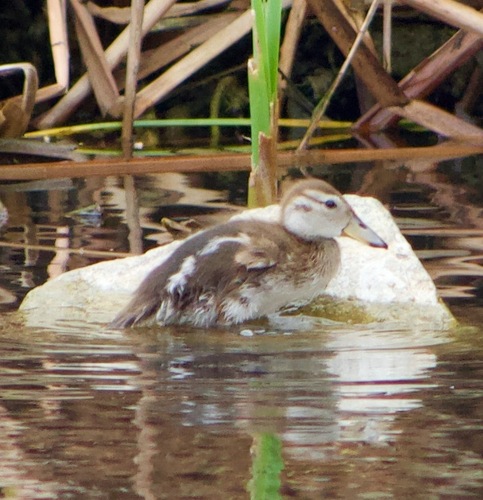 Yellow-billed Pintail
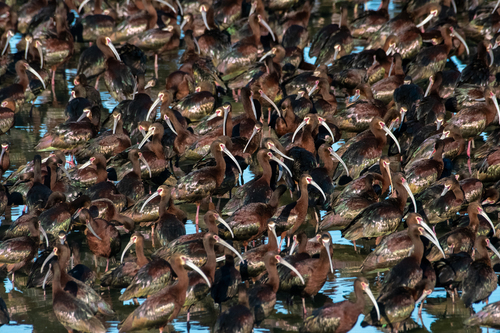 White-faced Ibis
In short
The most reliable way to separate Yellow-billed Pintail from White-faced Ibis is by overall structure and bill shape: the pintail is a classic dabbling duck with a short neck and broad, flat yellow bill, while the ibis is a long-legged wader with a slender, strongly decurved gray bill. In flight or at rest, the pintail shows a brownish, pointed tail and a grayish-brown upperwing with blackish-green secondaries, contrasting with the ibis’s uniform dark, iridescent plumage and long trailing legs. Juvenile and non-breeding ibises lack the white facial border of breeding adults, but their shape and feeding behavior remain distinctive. Both species may occur in South American wetlands, but their foraging styles and posture are dramatically different.
Identification tips
- Bill shape and color: Yellow-billed Pintail has a broad, flat yellow bill with a black tip and central stripe; White-faced Ibis has a long, slender, decurved gray bill. This is the most immediate field mark at any age or season.
- Leg length and posture: Ibises have very long legs, often visible well beyond the tail when walking or flying; pintails have short legs tucked under the body, never trailing in flight.
- Neck length and carriage: Ibises have long necks held outstretched in flight and while feeding; pintails have short necks, both on water and in flight.
- Tail shape: Yellow-billed Pintail shows a pointed, brownish tail, especially obvious in flight or when preening. Ibises have short, rounded tails, often obscured by long legs.
- Wing and body pattern: Pintail upperwing is grayish-brown with blackish-green secondaries, and the body is buff-brown with black spots. Ibises are overall dark with a subtle brownish iridescence, lacking any wing panels or contrasting secondaries.
- Facial pattern (adults, breeding): Breeding White-faced Ibis has a pink bare face with a white feather border and red eyes; pintail always has a feathered brown head with no bare skin or white border.
- Plumage (all ages): Pintail is mottled and spotted, never iridescent. Ibis is uniform dark brownish with a metallic sheen in good light, never spotted or streaked.
- Flight silhouette: Ibises fly with neck and legs extended, forming a long, stretched outline. Pintails fly with neck retracted and a pointed tail, giving a compact, duck-like shape.
- Feeding behavior: Pintails dabble or tip-up on water; ibises probe in mud or shallow water, rarely swimming.
- Group size: Pintails are usually seen singly or in small groups; ibises often feed and fly in larger, loosely organized flocks.
- Habitat context: If the bird is wading in dense marsh vegetation, especially with others, ibis is more likely. If floating on open water, pintail is expected.
- Leg color: Breeding ibises have redder legs, but this is less reliable than structure for ID.
- Eye color (adults): White-faced Ibis adults have red eyes year-round; pintail has dark eyes.
- Juvenile confusion: Juvenile ibises lack the white face but are still structurally distinct from pintail by bill, legs, and posture.
- When marks fail: At extreme distance or in poor light, rely on structure (bill, neck, legs) and behavior (dabbling vs. probing) rather than subtle plumage or color.
Size
White-faced Ibis is notably heavier (adult mass ~613g [wikidata]) and longer (46–56 cm length, 90–93 cm wingspan [wikipedia]) than a typical dabbling duck, but the Yellow-billed Pintail is still a medium-sized duck and may appear similar in bulk at a distance. The ibis’s long legs and neck make it appear lankier and taller, especially when walking or wading, while the pintail is compact with a horizontal carriage. In flight, the ibis’s long neck and legs project well beyond the body, unlike the pintail’s short neck and tail-projected silhouette.
Plumage
- Juvenile/immature wing pattern: No sources describe distinctive juvenile upperwing patterns for either species, so separation relies on overall plumage and structure at all ages.
- Yellow-billed Pintail: Shows a brownish, pointed tail, grayish-brown upperwing, and blackish-green secondaries. The body is buff-brown with black spots, and the head/neck are brown. The bill is yellow with a black tip and central stripe. No seasonal or sex-based plumage differences are noted.
- White-faced Ibis: Adult breeding birds have a pink bare face bordered with white feathers, red eyes, and redder legs. Non-breeding and juvenile birds lack the white facial border and are overall dark, with a warmer brownish iridescence compared to Glossy Ibis. The bill is long, slender, and gray. Juveniles are nearly identical to Glossy Ibis but still differ from pintail by structure and color. No distinctive upperwing markings are described for any age.
Behaviour
Yellow-billed Pintail behaves like a typical dabbling duck: it floats on the water, tips up to feed, and walks awkwardly on land. It rarely forms large flocks. White-faced Ibis is a classic wader, feeding by probing in mud with its long bill, walking gracefully through shallow water, and often seen in groups. In flight, ibises fly with neck and legs outstretched, often in loose lines or V-formations, while pintails have a more compact, duck-like flight profile with rapid wingbeats and a pointed tail.
Habitat
Both species use wetlands, but their preferred microhabitats and foraging styles differ. Yellow-billed Pintail is found in a range of wetland types from high-elevation lakes to lowland rivers and open coasts, usually in open water or marshy edges. White-faced Ibis breeds and forages in marshes with dense emergent vegetation, often nesting in bushes or low trees, and is more likely to be seen wading in shallow water or mudflats. Overlap is possible in South American marshes, but their behavior and microhabitat use are distinct.