

Motmot

Yellow-bellied Flowerpecker vs Orange-bellied Flowerpecker

Pachyglossa melanozantha versus Dicaeum trigonostigma

Play a quiz with Yellow-bellied Flowerpecker and Orange-bellied Flowerpecker
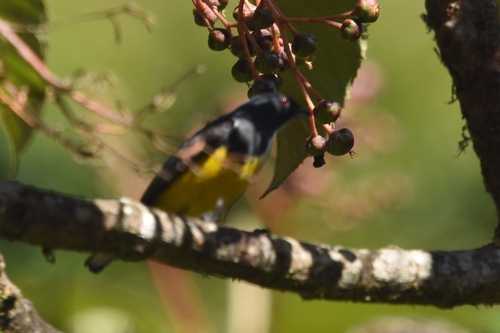
Yellow-bellied Flowerpecker (Pachyglossa melanozantha) Yellow-bellied Flowerpecker
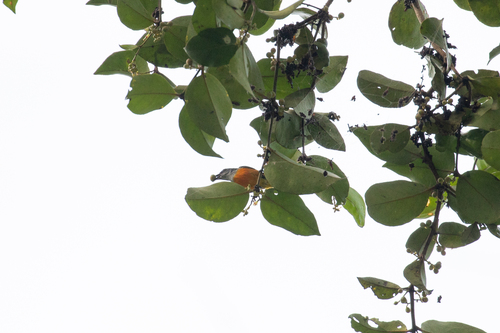
Orange-bellied Flowerpecker (Dicaeum trigonostigma) Orange-bellied Flowerpecker

Media

Loading…

In short

The most reliable way to separate Yellow-bellied Flowerpecker from Orange-bellied Flowerpecker is by focusing on the underpart coloration and upperpart contrast, especially in males. Orange-bellied Flowerpecker males show a striking slaty-blue upperpart with a bright orange breast and yellow vent, while females are drab olive with a pale orange rump and yellow belly. Yellow-bellied Flowerpecker lacks the slaty-blue and orange combination. Structural differences like bill shape and overall jizz are subtle but can help with experience. Both species overlap in range in parts of South and Southeast Asia, so careful attention to plumage is essential.

Identification tips

  1. Male Orange-bellied Flowerpecker is unmistakable: Look for the combination of slaty-blue upperparts and a large orange patch on the mantle, with a fiery orange lower breast fading to yellow on the vent. No other flowerpecker in the region shows this pattern.
  2. Yellow-bellied Flowerpecker lacks blue and orange: If the bird is missing both slaty-blue upperparts and a strong orange breast/mantle patch, suspect Yellow-bellied, especially if the underparts are plain yellow.
  3. Female Orange-bellied Flowerpecker is dull olive-brown: Females are mostly drab olive-brown with a pale orange rump and yellow belly. This can be confused with Yellow-bellied, but the orange rump is a subtle clue.
  4. Bill shape is subtly different: Orange-bellied Flowerpecker has a fairly thin, short bill that is slightly downcurved at the tip. If you see a noticeably downcurved bill, this supports Orange-bellied.
  5. Underpart gradient in Orange-bellied: In males, the transition from fiery orange (lower breast) to yellow (vent) is distinctive; Yellow-bellied lacks this gradient.
  6. No slaty-blue in Yellow-bellied: Any hint of blue on the crown, nape, or wings points away from Yellow-bellied.
  7. Juvenile/immature birds are tricky: Since detailed juvenile plumages are not described, rely on the absence of blue and orange for Yellow-bellied, and look for any orange or blue hints in Orange-bellied.
  8. Perched vs. in flight: Both species are active and often seen in the canopy, but flight views may obscure subtle color differences; try to get a good look at the mantle and underparts.
  9. Range overlap: If birding in Bangladesh, Myanmar, or Thailand, both species are possible. In the Philippines, Brunei, Indonesia, Malaysia, or Singapore, only Orange-bellied is expected; in Bhutan, China, India, Laos, Nepal, or Vietnam, only Yellow-bellied is likely.
  10. Size is not helpful: Both are tiny, compact birds; do not rely on size for separation.
  11. Habitat is only weakly diagnostic: Both use similar habitats where their ranges overlap.
  12. No strong vocal differences noted: If you hear a flowerpecker call, it is unlikely to help with this pair.
  13. Beware of lighting and molt: Poor light or molt can obscure the blue and orange tones of Orange-bellied, making it resemble Yellow-bellied. Always look for multiple field marks.
  14. Check for orange rump in females: If you see a pale orange rump on a drab olive flowerpecker, lean toward Orange-bellied female.
  15. Use a combination of marks: Especially with females and immatures, use as many features as possible—bill shape, underpart color, and any hint of blue or orange.

Size

Only Orange-bellied Flowerpecker has a published adult mass (7.0 g [wikidata]); Yellow-bellied Flowerpecker's mass is not provided, but both are very small, compact birds typical of the flowerpecker family. In the field, size is not a reliable separator between these two, as both appear similarly tiny and active.

Plumage

Plumage differences are most pronounced in adult males. Orange-bellied Flowerpecker males have slaty-blue upperparts (including crown, nape, wings, and tail) and a large, triangular orange patch on the mantle, with a gradient from fiery orange on the lower breast to yellow on the vent. Their throat and upper breast are lighter greyish-blue. Females are mostly dull olive-brown with a pale orange rump and yellow belly. Yellow-bellied Flowerpecker does not show the slaty-blue or orange breast/patch; its underparts are yellow but lack the intense orange gradient and blue contrast. Juvenile and immature plumages are not described in detail for either species, so caution is needed with non-adult birds, but the absence of blue and orange in Yellow-bellied is a key clue at all ages.

Behaviour

Both species are active, restless canopy feeders, typical of flowerpeckers. Their foraging style and movement are similar, making behavior alone unreliable for separation.

Habitat

Both species occur in overlapping regions of South and Southeast Asia, including Bangladesh, Myanmar, and Thailand. Orange-bellied Flowerpecker also ranges into Brunei, Indonesia, Malaysia, the Philippines, and Singapore, while Yellow-bellied Flowerpecker extends further north into Bhutan, China, India, Laos, Nepal, and Vietnam. Habitat preferences are not detailed in the notes, so context is only weakly diagnostic.

Submit a better description

Use the same sections as the comparison. Your text is published immediately.

The most reliable way to separate Yellow-bellied Flowerpecker from Orange-bellied Flowerpecker is by focusing on the underpart coloration and upperpart contrast, especially in males. Orange-bellied Flowerpecker males show a striking slaty-blue upperpart with a bright orange breast and yellow vent, while females are drab olive with a pale orange rump and yellow belly. Yellow-bellied Flowerpecker lacks the slaty-blue and orange combination. Structural differences like bill shape and overall jizz are subtle but can help with experience. Both species overlap in range in parts of South and Southeast Asia, so careful attention to plumage is essential.

  1. Male Orange-bellied Flowerpecker is unmistakable: Look for the combination of slaty-blue upperparts and a large orange patch on the mantle, with a fiery orange lower breast fading to yellow on the vent. No other flowerpecker in the region shows this pattern.
  2. Yellow-bellied Flowerpecker lacks blue and orange: If the bird is missing both slaty-blue upperparts and a strong orange breast/mantle patch, suspect Yellow-bellied, especially if the underparts are plain yellow.
  3. Female Orange-bellied Flowerpecker is dull olive-brown: Females are mostly drab olive-brown with a pale orange rump and yellow belly. This can be confused with Yellow-bellied, but the orange rump is a subtle clue.
  4. Bill shape is subtly different: Orange-bellied Flowerpecker has a fairly thin, short bill that is slightly downcurved at the tip. If you see a noticeably downcurved bill, this supports Orange-bellied.
  5. Underpart gradient in Orange-bellied: In males, the transition from fiery orange (lower breast) to yellow (vent) is distinctive; Yellow-bellied lacks this gradient.
  6. No slaty-blue in Yellow-bellied: Any hint of blue on the crown, nape, or wings points away from Yellow-bellied.
  7. Juvenile/immature birds are tricky: Since detailed juvenile plumages are not described, rely on the absence of blue and orange for Yellow-bellied, and look for any orange or blue hints in Orange-bellied.
  8. Perched vs. in flight: Both species are active and often seen in the canopy, but flight views may obscure subtle color differences; try to get a good look at the mantle and underparts.
  9. Range overlap: If birding in Bangladesh, Myanmar, or Thailand, both species are possible. In the Philippines, Brunei, Indonesia, Malaysia, or Singapore, only Orange-bellied is expected; in Bhutan, China, India, Laos, Nepal, or Vietnam, only Yellow-bellied is likely.
  10. Size is not helpful: Both are tiny, compact birds; do not rely on size for separation.
  11. Habitat is only weakly diagnostic: Both use similar habitats where their ranges overlap.
  12. No strong vocal differences noted: If you hear a flowerpecker call, it is unlikely to help with this pair.
  13. Beware of lighting and molt: Poor light or molt can obscure the blue and orange tones of Orange-bellied, making it resemble Yellow-bellied. Always look for multiple field marks.
  14. Check for orange rump in females: If you see a pale orange rump on a drab olive flowerpecker, lean toward Orange-bellied female.
  15. Use a combination of marks: Especially with females and immatures, use as many features as possible—bill shape, underpart color, and any hint of blue or orange.

Only Orange-bellied Flowerpecker has a published adult mass (7.0 g [wikidata]); Yellow-bellied Flowerpecker's mass is not provided, but both are very small, compact birds typical of the flowerpecker family. In the field, size is not a reliable separator between these two, as both appear similarly tiny and active.

Plumage differences are most pronounced in adult males. Orange-bellied Flowerpecker males have slaty-blue upperparts (including crown, nape, wings, and tail) and a large, triangular orange patch on the mantle, with a gradient from fiery orange on the lower breast to yellow on the vent. Their throat and upper breast are lighter greyish-blue. Females are mostly dull olive-brown with a pale orange rump and yellow belly. Yellow-bellied Flowerpecker does not show the slaty-blue or orange breast/patch; its underparts are yellow but lack the intense orange gradient and blue contrast. Juvenile and immature plumages are not described in detail for either species, so caution is needed with non-adult birds, but the absence of blue and orange in Yellow-bellied is a key clue at all ages.

Both species are active, restless canopy feeders, typical of flowerpeckers. Their foraging style and movement are similar, making behavior alone unreliable for separation.

Both species occur in overlapping regions of South and Southeast Asia, including Bangladesh, Myanmar, and Thailand. Orange-bellied Flowerpecker also ranges into Brunei, Indonesia, Malaysia, the Philippines, and Singapore, while Yellow-bellied Flowerpecker extends further north into Bhutan, China, India, Laos, Nepal, and Vietnam. Habitat preferences are not detailed in the notes, so context is only weakly diagnostic.

Discard your changes?

You have unsaved edits. If you leave now, those changes will be lost.

Yellow-bellied Flowerpecker · Orange-bellied Flowerpecker · My Tricky Birds