

Woodlark vs White-winged Lark
Lullula arborea versus Alauda leucoptera
Play a quiz with Woodlark and White-winged Lark
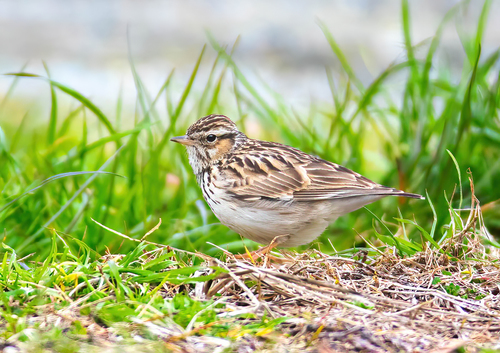 Woodlark
 White-winged Lark
In short
The most reliable field mark to separate Woodlark from White-winged Lark is the wing pattern in flight: White-winged Lark shows bold, flashing white wing patches with black outer flight feathers and chestnut elsewhere, while Woodlark lacks any white in the wings and shows only a small white tip to the tail. Woodlark is distinctly smaller and more compact, with a short tail and broad wings, and has a unique white supercilium that meets at the nape. White-winged Lark is larger, with a more robust build and a chestnut crown in adult males. Both species are streaked above and pale below, but their structure and especially their flight appearance are very different. Habitat and range also help: Woodlark is a resident or short-distance migrant of European heaths and open woods, while White-winged Lark is a steppe bird of Russia and Central Asia, only rarely appearing in western Europe.
Identification tips
- Wing pattern in flight (all ages): White-winged Lark shows bold, flashing white wing patches with black outer primaries and chestnut elsewhere; this is diagnostic and visible at a distance. Woodlark never shows white in the wings—only a small white tip to the tail.
- Tail shape and pattern: Woodlark has a short tail with a white tip but no white edges; White-winged Lark's tail is not described as white-tipped or edged, but its wing pattern dominates the flight impression.
- Head pattern: Woodlark has a unique white supercilium that meets at the nape, forming a pale 'headband'—look for this in perched birds. White-winged Lark lacks this, but adult males have a chestnut crown (not always visible in the field).
- Crest: Woodlark has a small, often inconspicuous crest; White-winged Lark does not have a notable crest.
- Overall structure: Woodlark is compact, with a short tail and broad wings, giving a rounded, stubby look in flight. White-winged Lark is larger, more robust, and longer-winged.
- Size: White-winged Lark is about 20–30% larger than Woodlark and much heavier; this is obvious if both are seen together but less so in isolation.
- Body coloration: Both are streaked above and pale below, but Woodlark is browner and plainer; White-winged Lark is more grey above with a whiter belly and darker streaks.
- Flight style: Woodlark's flight is fluttery and buoyant, often circling or spiraling during song; White-winged Lark flies with strong, direct wingbeats and is more likely to be seen in flocks in winter.
- Song: Woodlark sings a soft, repetitive lū-lū-lū or toolooeet from the ground, a perch, or in a circling song flight. White-winged Lark's song is more like a Skylark's but even more melodious; not usually a primary field mark unless familiar with Skylark.
- Habitat: Woodlark is found in open woods, heaths, and clearings in Europe and western Asia; White-winged Lark is a steppe specialist of Russia and Central Asia, only rarely appearing in western Europe.
- Range: If seen in western Europe, White-winged Lark is a major rarity; Woodlark is widespread in suitable habitat.
- Flock size: White-winged Lark can be gregarious in winter, forming flocks; Woodlark is usually solitary or in pairs, sometimes small groups.
- Perched appearance: Woodlark's white nape band and compact build are best seen when perched; White-winged Lark appears larger, with a more robust body and, in males, a chestnut crown.
- Pitfalls: Do not confuse Woodlark's white nape band with the white wing flashes of White-winged Lark; only the latter shows white in the wings in flight.
- Age/sex variation: The key wing pattern in White-winged Lark is present in all ages and sexes; Woodlark's main marks are also consistent across ages.
Size
White-winged Lark is much larger and heavier: 17–19 cm in length with a 35 cm wingspan and about 44 g in weight [wikipedia], compared to Woodlark's 13.5–15 cm length (about 20% shorter than Skylark) [wikipedia]. The Woodlark is noticeably more compact, with a shorter tail and smaller overall bulk. In the field, the size difference is striking if seen side by side, but may be harder to judge at a distance unless other larks are present for comparison.
Plumage
-
Flight/wing pattern (all ages): White-winged Lark is instantly recognized in flight by its bold white wing patches: black outer flight feathers, white inner flight feathers, and chestnut elsewhere on the wing. This pattern is unique among larks and visible at great distance. Woodlark, by contrast, shows no white in the wings; its flight feathers are brown, and the only white is a small tip to the tail. The tail sides and rear wing edge are not white in Woodlark, unlike Skylark.
-
Head pattern: Woodlark has a distinctive white supercilium that meets at the nape, forming a pale 'headband' effect, and a small, often inconspicuous crest. White-winged Lark adult males have a chestnut crown, but otherwise both sexes are similar and lack the Woodlark's nape mark.
-
Body coloration: Both are streaked above and pale below, but Woodlark is browner, while White-winged Lark is greyish above with darker streaks and a whiter underside. The Woodlark's underparts are plainer, while White-winged Lark may appear more contrasting due to its paler belly.
-
Tail: Woodlark has a short tail with a white tip but no white edges; White-winged Lark's tail is not described as having white, but the focus is on the wing pattern.
Behaviour
Woodlark often sings from the ground or a perch, and its song flight is fluttering and spiraling, circling at a fairly constant height. Its flight is buoyant, with short, broad wings and a short tail, giving a compact, rounded impression. White-winged Lark is gregarious in winter, often forming flocks, and is a bird of open steppe, usually seen on the ground or flying with strong, direct wingbeats. Its song flight is not described in detail, but its robust build and striking wing pattern dominate its appearance in flight.
Habitat
Woodlark prefers heathland, open pine woods, and clearings with scattered trees, especially in sandy or grassy areas of Europe and western Asia. It is mainly resident in the west of its range. White-winged Lark is a bird of dry, open steppe and plains, breeding from southwestern Russia through Kazakhstan to western China. It is only a rare vagrant to western Europe. Habitat alone can be a strong clue: Woodlark is rarely found in true steppe, while White-winged Lark avoids wooded or heathland areas.
Voice
Woodlark's song is a melodious, warbling series of lū-lū-lū or toolooeet notes, often delivered in a fluttering, circling song flight or from a perch. White-winged Lark's song is described as a more melodious version of the Eurasian Skylark's, but specifics are not detailed. Both are musical, but Woodlark's song is softer and more repetitive, while White-winged Lark's is likely more varied and complex, similar to Skylark.