

Wood Warbler vs Yellow-browed Warbler
Phylloscopus sibilatrix versus Phylloscopus inornatus
Play a quiz with Wood Warbler and Yellow-browed Warbler
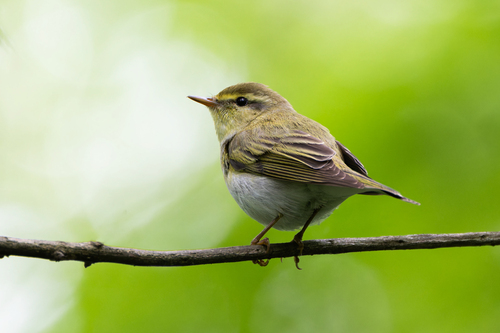 Wood Warbler
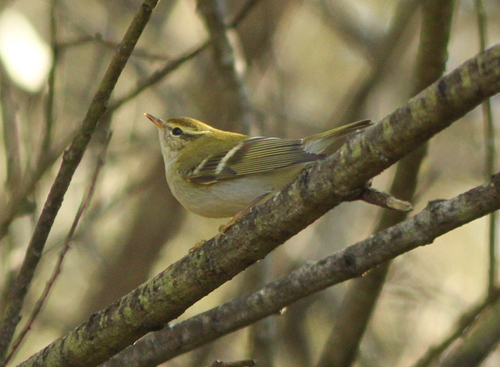 Yellow-browed Warbler
In short
The most reliable way to separate Wood Warbler from Yellow-browed Warbler is by overall structure and wing pattern: Wood Warbler is larger, longer-winged, and lacks the bold double wing bars and strong yellow supercilium of Yellow-browed. In any plumage, Wood Warbler shows a cleaner, more uniform look with a bright lemon throat and breast, while Yellow-browed always has two pale wing bars and a strong yellow eyebrow. In flight or perched, Wood Warbler’s longer primary projection and broader tail stand out against the more compact, short-tailed, and active Yellow-browed. Voice and habitat can help, but plumage and structure are usually decisive.
Identification tips
- Double wing bars: Yellow-browed Warbler always has two pale wing bars (on greater and median coverts); Wood Warbler never shows wing bars at any age. This is the single most reliable mark in any view.
- Supercilium (eyebrow): Yellow-browed has a strong, long yellowish-white supercilium extending well behind the eye; Wood Warbler’s supercilium is yellow but less sharply defined and does not contrast as much with the face.
- Tertial edges: Both have pale tertial edges, but Yellow-browed’s are yellow-margined and more obvious, while Wood Warbler’s are paler and less contrasting.
- Face pattern: Yellow-browed may show a faint pale crown stripe (not always visible), adding to its patterned look. Wood Warbler’s crown is plain green.
- Underparts: Wood Warbler shows a bright lemon-yellow throat and upper breast, fading to white below; Yellow-browed is white below with little or no yellow on the throat or breast.
- Upperparts: Both are greenish above, but Wood Warbler is a brighter, cleaner green, while Yellow-browed can appear duller and more olive.
- Size and shape: Wood Warbler is larger, longer-winged, and broader-tailed; Yellow-browed is smaller, more compact, and short-tailed. This is especially noticeable in flight or side-by-side.
- Primary projection: Wood Warbler has a noticeably long primary projection (wing tips extending well beyond tertials), giving a long-winged look; Yellow-browed’s wings are shorter and rounder.
- Tail shape: Wood Warbler’s tail is broader and shorter relative to its body length; Yellow-browed’s is narrower and more squared-off.
- Behavior: Yellow-browed is more restless, flicking and moving rapidly through foliage; Wood Warbler is more deliberate and may sing from exposed perches.
- Voice: Wood Warbler’s song is a metallic trill or descending piping notes; its call is a soft, single note. Yellow-browed’s call is a sharp, loud 'tseeweest'—very different from Wood Warbler.
- Habitat and season: In Europe, Wood Warbler is a summer breeder in mature woodland; Yellow-browed is a scarce autumn migrant or winter visitor, often in smaller woods, parks, or gardens.
- Pitfalls: Do not confuse Wood Warbler’s yellow breast for a wing bar in poor light. Always look for the double wing bars on Yellow-browed, which are never present on Wood Warbler.
- Age and molt: All age classes of Yellow-browed show wing bars; Wood Warbler never does, even in juveniles or immatures.
- Direct comparison: If you see both together, Wood Warbler will stand out as larger, longer-winged, and much plainer-winged, while Yellow-browed will look smaller, more patterned, and more active.
Size
Wood Warbler is distinctly larger and heavier (about 10g, 11–12.5 cm long) compared to the smaller, lighter Yellow-browed Warbler (4–9g, 9.5–11 cm). Wood Warbler also appears longer-winged and bulkier, with a broader tail, while Yellow-browed is more petite and compact. These differences are often visible in direct comparison or with experience, but can be subtle if seen alone.
Plumage
- Juvenile/immature and adult Yellow-browed Warbler always show two distinct pale wing bars (on median and greater coverts), a strong yellow supercilium, and yellow edges to the tertials. Some may show a faint pale crown stripe. The underparts are white, and the upperparts are greenish. These wing bars are present year-round and are a key feature at all ages.
- Wood Warbler (all ages) lacks wing bars entirely, instead showing a clean, unmarked wing with pale tertial edges. The face is plainer, but the supercilium is yellow and less sharply defined than in Yellow-browed. The throat and upper breast are washed bright lemon-yellow, fading to white on the belly and flanks, and the upperparts are green. The overall look is much cleaner and less patterned than Yellow-browed.
- In flight, Wood Warbler's wings look longer and more pointed, with no wing bars, while Yellow-browed’s shorter wings show the double wing bars clearly.
Behaviour
Yellow-browed Warbler is almost constantly in motion, flicking through foliage and rarely sitting still, which can make its field marks harder to see. Wood Warbler is also active but tends to move more deliberately, often pausing to sing from exposed perches. In flight, Wood Warbler’s longer wings and broader tail give it a more graceful, gliding look, while Yellow-browed appears quicker and more fluttery.
Habitat
Wood Warbler breeds in mature, often deciduous woodland across northern and temperate Europe, favoring large tracts of forest. Yellow-browed Warbler breeds much further east (east Palearctic) and is a regular autumn migrant or winter visitor in western Europe, often found in a wider range of wooded habitats, including parks, gardens, and smaller woodlots. In Europe, finding a Yellow-browed Warbler in autumn is notable and often in less mature woodland or even urban settings, while Wood Warbler is a summer breeder in more extensive woods.
Voice
Wood Warbler has two distinctive song types: a high-pitched, accelerating metallic trill and a series of descending piping notes (piüü-piüü-piüü). Its contact call is a soft, single piping note. Yellow-browed Warbler’s song is a high-pitched medley of whistles, but in Europe it is more often detected by its loud, disyllabic 'tseeweest' call, which is much sharper and more piercing than any Wood Warbler note. The calls are quite different and can be diagnostic if heard well.