

Wood Warbler vs Western Bonelli's Warbler
Phylloscopus sibilatrix versus Phylloscopus bonelli
Play a quiz with Wood Warbler and Western Bonelli's Warbler
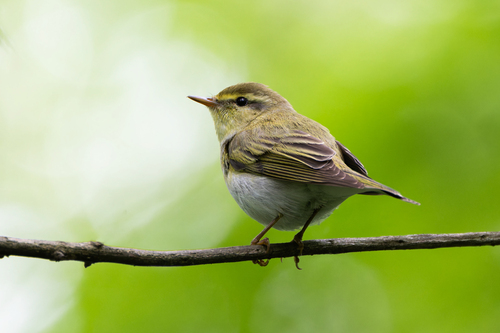 Wood Warbler
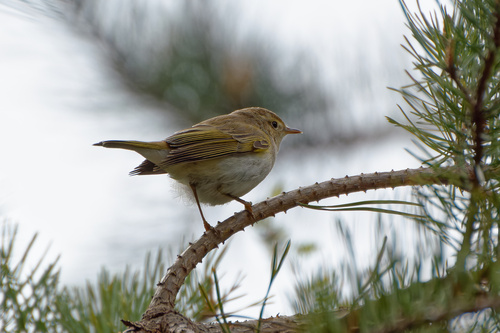 Western Bonelli's Warbler
In short
The most reliable field mark to separate Wood Warbler from Western Bonelli's Warbler is the Wood Warbler's bright yellow supercilium, throat, and upper breast, which contrast with its white belly and green upperparts. Western Bonelli's Warbler is plainer, with a grey-green back, green-toned rump and wings, and whitish underparts, lacking any strong yellow tones. Structural differences also help: Wood Warbler shows a longer primary projection and a broader, shorter tail, while Bonelli's is more compact and plain. Both species can be confused in poor light or quick views, but focusing on the yellow tones and wing structure is key. Vocalizations are similar in song but differ in calls, which can clinch an ID if heard well.
Identification tips
- Yellow supercilium and throat (Wood Warbler): Look for bright yellow on the supercilium, throat, and upper breast. Bonelli's never shows yellow in these areas. Works for all ages and seasons.
- Plain face and underparts (Bonelli's): Western Bonelli's Warbler has a plain, whitish face and underparts, with no yellow wash. If the face and throat are clean white or greyish, suspect Bonelli's.
- Upperparts color: Wood Warbler is green above, while Bonelli's is grey-green or brownish-green, often duller. In strong light, Wood Warbler looks more vibrant.
- Primary projection: Wood Warbler has a longer primary projection (the tips of the longest flight feathers extend well beyond the tertials), giving it a longer-winged look. Bonelli's has a shorter projection, making the wing look more compact. Best seen on perched birds with wings closed.
- Tail shape: Wood Warbler's tail is shorter and broader; Bonelli's is more evenly proportioned. Subtle, but can help in side-by-side comparison.
- Pale tertial edges (Wood Warbler): Subtle pale edges to the tertials can be seen on Wood Warbler, especially in fresh plumage. Bonelli's tertials are less contrasting.
- No wing bars in either: Both lack the strong wing bars of some other Phylloscopus warblers, so don't use this mark.
- Song differences: Both sing fast trills, but Wood Warbler's is metallic and accelerates, sometimes alternating with descending piping notes. Bonelli's is more monotone. Use with caution, as they can sound similar.
- Call notes: Wood Warbler gives a single soft 'piü'; Bonelli's gives a disyllabic 'hu-it'. Calls are diagnostic if heard well.
- Habitat and range: In central/northern Europe, Wood Warbler is expected; in southwest Europe/North Africa, Bonelli's is likely. Out-of-range records do occur, so don't rely solely on location.
- Behavior: Wood Warbler may seem more restless and flick its wings more, sometimes showing its longer primaries. Bonelli's is active but less showy.
- Bill and leg color: Both have small, pointed bills and brown legs; not a useful separator.
- Sexes alike: Both species show no sexual dimorphism in plumage, so all marks apply to both males and females.
- Juvenile/immature plumage: No strong age-specific upperwing patterns in either species; separation relies on the same marks as for adults.
- Lighting pitfalls: In poor light, Wood Warbler's yellow can look subdued and Bonelli's can appear greener; always try for a clear, direct view.
Size
Wood Warbler is slightly larger, with a body mass around 10g [wikidata], but both species are small leaf warblers and size is rarely diagnostic in the field. Both have similar overall proportions, but Wood Warbler may appear a bit longer-winged due to its longer primary projection.
Plumage
Wood Warbler (all ages) is green above and white below, but stands out with its lemon-yellow supercilium, throat, and upper breast. The yellow is brightest in fresh adults but is present in all plumages. Its tertials have pale edges, and the wings are longer and more pointed. Western Bonelli's Warbler is plainer: adults and immatures have a plain grey-green back, green-toned rump and wings, and clean whitish underparts. There is no yellow on the face or breast. The upperparts are less vibrant, with a browner or grey-green cast. Both species lack wing bars, but Wood Warbler's pale tertial edges can be a subtle clue. In flight, Wood Warbler's longer wings and broader tail may be apparent, but neither species shows strong age-specific upperwing patterns like some other Phylloscopus warblers.
Behaviour
Both species are active, insectivorous foragers in woodland, often flitting through foliage. Wood Warbler may appear more restless, with a tendency to sally and flick its wings, sometimes showing its longer primary projection. Bonelli's Warbler is also active but may seem more methodical and less showy. Both can be difficult to observe for long periods as they move quickly through cover.
Habitat
Wood Warbler breeds in northern and temperate European woodlands, especially mature deciduous forests with a well-developed understory. Western Bonelli's Warbler is found in southwest Europe and North Africa, preferring open woodland and forest, often in drier, more Mediterranean habitats. Their breeding ranges do not overlap, so context can help: in central/northern Europe, Wood Warbler is expected; in Iberia or North Africa, Bonelli's is the default. Both winter in sub-Saharan Africa.
Voice
Songs are similar: both give a fast, high-pitched trill, but Wood Warbler's song is a fluid metallic trill that accelerates, sometimes alternating with a series of descending piping notes (piüü-piüü-piüü). Bonelli's song is a fast monotone trill, less variable. The best vocal difference is in the call: Wood Warbler gives a soft, single piping note (piü), while Western Bonelli's Warbler gives a disyllabic 'hu-it'. Calls are the most reliable vocal separator, as songs can be confusingly similar.