

Wilson's Storm-Petrel vs White-faced Storm-Petrel
Oceanites oceanicus versus Pelagodroma marina
Play a quiz with Wilson's Storm-Petrel and White-faced Storm-Petrel
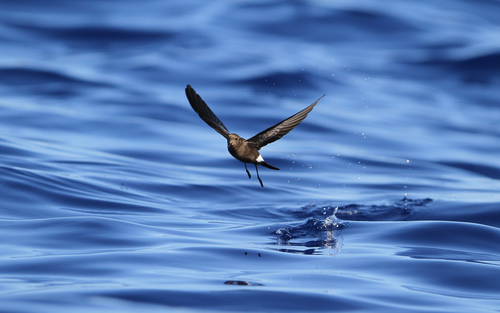 Wilson's Storm-Petrel
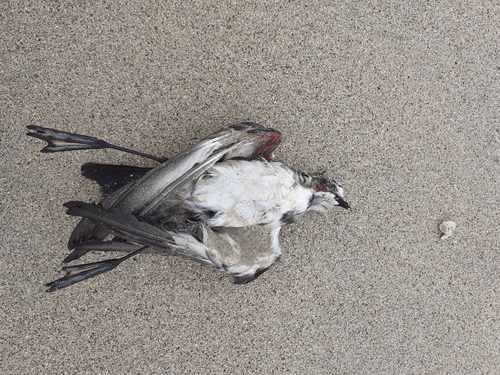 White-faced Storm-Petrel
In short
The most reliable field mark between Wilson's Storm-Petrel and White-faced Storm-Petrel is the striking white face and underparts of the White-faced, which are never shown by Wilson's. In flight, Wilson's is uniformly dark brown above with a white rump, while White-faced has a pale grey-brown back and a distinctive white face with a black eye mask. Juveniles of White-faced Storm-Petrel may show more extensive pale fringes above, but always keep the white face. Both species patter on the water, but White-faced does so almost constantly and with a unique, bouncing gait. Structure and behavior also differ: White-faced appears longer-legged and often shows a square or forked tail depending on subspecies, while Wilson's has a square-ended tail and feet that just project beyond it.
Identification tips
- White face and underparts (all ages): Only White-faced Storm-Petrel shows a bright white face with a black eye mask and white underparts. Wilson's is always dark-faced and dark below.
- Upperwing pattern (all ages): Wilson's Storm-Petrel is uniformly dark brown above with a white rump and flanks; White-faced is paler grey-brown above, sometimes with a white or pale grey rump depending on subspecies.
- Tail shape: Wilson's has a square-ended tail; White-faced can show a square or forked tail depending on subspecies and age (juveniles may have a shallower fork).
- Feet projection: In Wilson's, the feet project just beyond the tail in flight; this is less obvious in White-faced, which has longer legs but does not show the same projection.
- Flight style: White-faced Storm-Petrel bounces or 'skips' across the water with stiff wings and frequent pattering, often swinging side-to-side. Wilson's has a more direct, gliding flight and less exaggerated pattering.
- Underparts color: White-faced is always white below; Wilson's is always dark below except for the white rump and flanks.
- Face pattern: The black eye mask on a white face is unique to White-faced; Wilson's has a plain dark face.
- Rump color: Both can show a white rump, but in White-faced this may be pure white or pale grey depending on subspecies, while in Wilson's it is always white and sharply contrasts with the dark back.
- Leg color: Wilson's pre-breeding birds have yellow webbing with black spots between the toes (rarely visible in the field); White-faced has dark tarsi, toes, and claws.
- Bill: Both have dark bills; bill shape is not a strong field mark in binocular views.
- Size: White-faced is slightly larger and heavier, but this is subtle and unreliable in the field.
- Juvenile marks: Juvenile White-faced may show more extensive pale fringes above, but the white face and underparts remain obvious; Wilson's juveniles are similar to adults.
- Vocalizations: Not reliably separable at sea; Wilson's may give a soft peeping, but this is rarely heard and not diagnostic.
- Context: Both species are pelagic and may occur together, so do not rely on location alone.
- Pitfalls: Do not confuse the diffuse pale upperwing covert bar of Wilson's for the white underwing lining of European Storm-Petrel; neither species here shows that mark. Always check for the white face and underparts for White-faced, and the all-dark face for Wilson's.
Size
White-faced Storm-Petrel is slightly larger and heavier than Wilson's Storm-Petrel: 40 g vs 34 g in body mass [wikidata], and 19–21 cm length vs 16–18.5 cm for Wilson's [wikipedia]. The wingspan is also marginally greater in White-faced (41–44 cm) compared to Wilson's (38–42 cm). In the field, this difference is subtle and often masked by posture and flight style, so size alone is rarely diagnostic.
Plumage
-
Juveniles and immatures: White-faced Storm-Petrel juveniles resemble adults but may have larger pale fringes and tips to upperparts feathers, and a shallower tail fork (in New Zealand subspecies). The white face and underparts remain obvious at all ages. Wilson's Storm-Petrel is uniformly dark brown above with a white rump and flanks at all ages; it lacks any white on the face or underparts. Wilson's may show a diffuse pale band along the upperwing coverts but never the white underwing lining of European Storm-Petrel (not relevant here).
-
Adults: White-faced Storm-Petrel always shows a white face with a black eye mask, white underparts, and a pale grey-brown back and rump (with some subspecific variation: some have a white rump, others pale grey). The tail can be square or forked depending on subspecies. Wilson's Storm-Petrel is dark brown overall with a white rump and flanks, square-ended tail, and no white on the face or underparts. The feet of Wilson's project just beyond the tail in flight, and pre-breeding birds show yellow webbing with black spots between the toes (rarely visible in the field).
Behaviour
Both species use pattering flight over the water, but White-faced Storm-Petrel does so almost continuously, using its long legs to bounce or 'skip' across the surface in a distinctive, side-to-side, pendulum-like motion. Wilson's Storm-Petrel also patters but with a more direct, gliding flight and less exaggerated bouncing. White-faced rarely uses dynamic soaring, while Wilson's may glide more frequently. White-faced often holds its wings stiff and extended, sometimes with one leg lowered, while moving between feeding spots. Both are gregarious and may follow ships, but the flight style of White-faced is more unique and diagnostic.
Habitat
Both species are pelagic and can be seen far from land, often in association with productive oceanic waters. Wilson's Storm-Petrel is one of the most abundant seabirds globally and is widespread in southern oceans, extending into the northern hemisphere in summer. White-faced Storm-Petrel has a similarly broad range but is especially common around southern Australia, New Zealand, and islands in the Atlantic and Indian Oceans. Habitat overlap is possible in some regions, but context is rarely diagnostic between the two.
Voice
Wilson's Storm-Petrel gives a soft peeping noise while feeding, but vocalizations are rarely heard at sea and are not a reliable field separation from White-faced Storm-Petrel, whose calls are not described as distinctive in the available notes.
Wilson's Storm-Petrel · White-faced Storm-Petrel · My Tricky Birds