

Motmot

White-vented Plumeleteer vs Violet-capped Hummingbird

Chalybura buffonii versus Goldmania violiceps

Play a quiz with White-vented Plumeleteer and Violet-capped Hummingbird
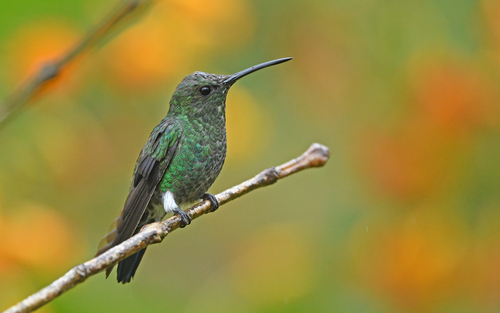
White-vented Plumeleteer (Chalybura buffonii) White-vented Plumeleteer
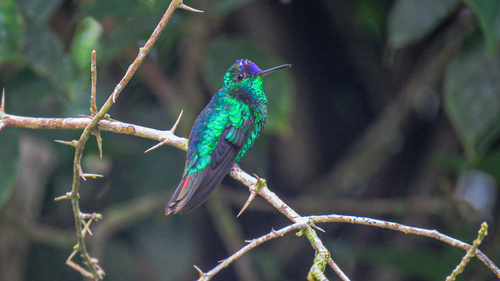
Violet-capped Hummingbird (Goldmania violiceps) Violet-capped Hummingbird

Media

Loading…

In short

The most reliable field mark between White-vented Plumeleteer and Violet-capped Hummingbird is the presence of a bold violet-blue crown on the male Violet-capped Hummingbird, which is never shown by the Plumeleteer. In all plumages, the Plumeleteer is larger and bulkier, with a dark metallic green body and a distinctive long white undertail (vent) patch, while the Violet-capped is smaller, with a maroon tail edged or tipped white. Female Violet-capped shows a spotted throat and maroon tail with white tips, contrasting with the Plumeleteer's more uniform grayish underparts and white vent. Bill color and tail structure also help: Plumeleteer has a black bill (except some with pinkish base), while Violet-capped always shows a pink base to the mandible. These differences are visible both perched and in flight, but the crown and tail pattern are especially helpful at a distance.

Identification tips

  1. Male Violet-capped Hummingbird always shows a brilliant violet-blue crown—if you see this, it is diagnostic and rules out Plumeleteer of any age or sex.
  2. White-vented Plumeleteer never has a colored crown; males have a bronzy tinge but not a distinct patch, and females are plain above.
  3. Tail color and pattern are key at all ages: Violet-capped has a maroon tail with broad white edges or tips (slightly forked), while Plumeleteer has a blue-black tail with a bronze gloss and, in females, dull gray tips on outer feathers.
  4. White vent/undertail coverts: Plumeleteer of both sexes shows a long, conspicuous white vent patch, especially obvious when perched or hovering—Violet-capped never shows this.
  5. Bill color: Plumeleteer usually has an all-black bill (except subspecies intermedia, which may show a pinkish base), while Violet-capped always has a pink base to the mandible; check closely if the bird is facing you or feeding.
  6. Size and structure: Plumeleteer is larger and bulkier, with a heavier build and longer bill; Violet-capped is noticeably smaller and more delicate.
  7. Female underparts: Violet-capped female is whitish below with gray throat spots and green spots on the sides; Plumeleteer female is gray below with green speckling on the sides but lacks the distinct throat spotting.
  8. Tail shape: Violet-capped's tail is slightly forked; Plumeleteer's tail is more squared off, with central feathers bronze-glossed in males.
  9. Uppertail coverts: Plumeleteer males have coppery-bronze uppertail coverts, which may show as a rufous or bronze patch above the tail—Violet-capped lacks this.
  10. Subspecies variation in Plumeleteer: Some subspecies (e.g., caeruleogaster) show a blue breast and bluish-green belly, but still lack the violet crown and maroon tail of Violet-capped.
  11. Habitat and range: If in Panama or NW Colombia, both are possible, but Violet-capped is much rarer and more localized; elsewhere, Plumeleteer is far more likely.
  12. Juvenile/immature birds: No specific upperwing or flight marks are described for either species, so rely on tail, vent, and head pattern.
  13. Perched vs. in-flight: The white vent of Plumeleteer is often most obvious when the bird is hovering or perched with the tail slightly fanned; Violet-capped's tail pattern is best seen in flight or when the bird fans its tail.
  14. At feeders: Plumeleteer may dominate due to size; Violet-capped, if present, will appear smaller and more delicate.
  15. If in doubt: Focus on the combination of crown color, tail pattern, and vent patch—these three together will separate all ages and sexes in the field.

Size

White-vented Plumeleteer is noticeably larger, at 10.5–12 cm in length and typically 6–7.3 g for males (females up to 7.9 g), while Violet-capped Hummingbird is smaller, at 8.5–9.5 cm and around 3.9 g for adults. This size difference is often obvious in direct comparison or when seen at feeders, with Plumeleteer appearing bulkier and longer-billed.

Plumage

No age-specific upperwing or flight pattern marks are described for either species. Instead, focus on head, tail, and vent area. Adult male Violet-capped Hummingbird is unique in having a striking iridescent violet-blue crown, which is never present in Plumeleteer of any age or sex. The rest of the Violet-capped male is metallic green with a maroon, slightly forked tail edged broadly in white. Females have green upperparts, whitish underparts with gray throat spots and green side spots, and a maroon tail with white tips. White-vented Plumeleteer males are dark metallic green with a bronzy crown and coppery uppertail coverts, a bluish upper breast, bright metallic green lower breast, and a long, conspicuous white undertail (vent) patch. Females are paler green above, gray below with green speckles on the side, and a tail similar to the male but with dull gray tips on the outer feathers. Subspecies variation in Plumeleteer can affect underpart and tail color, but the white vent and lack of a violet crown are consistent. Juvenile/immature-specific marks are not described for either species.

Behaviour

Both species are typical hummingbirds in behavior, but the larger Plumeleteer may appear more robust and less delicate in flight and at feeders. The Violet-capped, being smaller and lighter, may seem more agile or dainty. No distinctive behavioral differences are noted in the sources.

Habitat

White-vented Plumeleteer is found in a broader range across Colombia, Ecuador, Panama, Peru, and Venezuela, while Violet-capped Hummingbird is more restricted to Panama and far northwestern Colombia. Overlap is possible in Panama and NW Colombia, but Violet-capped is much more localized and Near Threatened, so is less likely in most areas. Both occur in lowland to foothill forests, but context and local abundance can help: Plumeleteer is generally more widespread.

Submit a better description

Use the same sections as the comparison. Your text is published immediately.

The most reliable field mark between White-vented Plumeleteer and Violet-capped Hummingbird is the presence of a bold violet-blue crown on the male Violet-capped Hummingbird, which is never shown by the Plumeleteer. In all plumages, the Plumeleteer is larger and bulkier, with a dark metallic green body and a distinctive long white undertail (vent) patch, while the Violet-capped is smaller, with a maroon tail edged or tipped white. Female Violet-capped shows a spotted throat and maroon tail with white tips, contrasting with the Plumeleteer's more uniform grayish underparts and white vent. Bill color and tail structure also help: Plumeleteer has a black bill (except some with pinkish base), while Violet-capped always shows a pink base to the mandible. These differences are visible both perched and in flight, but the crown and tail pattern are especially helpful at a distance.

  1. Male Violet-capped Hummingbird always shows a brilliant violet-blue crown—if you see this, it is diagnostic and rules out Plumeleteer of any age or sex.
  2. White-vented Plumeleteer never has a colored crown; males have a bronzy tinge but not a distinct patch, and females are plain above.
  3. Tail color and pattern are key at all ages: Violet-capped has a maroon tail with broad white edges or tips (slightly forked), while Plumeleteer has a blue-black tail with a bronze gloss and, in females, dull gray tips on outer feathers.
  4. White vent/undertail coverts: Plumeleteer of both sexes shows a long, conspicuous white vent patch, especially obvious when perched or hovering—Violet-capped never shows this.
  5. Bill color: Plumeleteer usually has an all-black bill (except subspecies intermedia, which may show a pinkish base), while Violet-capped always has a pink base to the mandible; check closely if the bird is facing you or feeding.
  6. Size and structure: Plumeleteer is larger and bulkier, with a heavier build and longer bill; Violet-capped is noticeably smaller and more delicate.
  7. Female underparts: Violet-capped female is whitish below with gray throat spots and green spots on the sides; Plumeleteer female is gray below with green speckling on the sides but lacks the distinct throat spotting.
  8. Tail shape: Violet-capped's tail is slightly forked; Plumeleteer's tail is more squared off, with central feathers bronze-glossed in males.
  9. Uppertail coverts: Plumeleteer males have coppery-bronze uppertail coverts, which may show as a rufous or bronze patch above the tail—Violet-capped lacks this.
  10. Subspecies variation in Plumeleteer: Some subspecies (e.g., caeruleogaster) show a blue breast and bluish-green belly, but still lack the violet crown and maroon tail of Violet-capped.
  11. Habitat and range: If in Panama or NW Colombia, both are possible, but Violet-capped is much rarer and more localized; elsewhere, Plumeleteer is far more likely.
  12. Juvenile/immature birds: No specific upperwing or flight marks are described for either species, so rely on tail, vent, and head pattern.
  13. Perched vs. in-flight: The white vent of Plumeleteer is often most obvious when the bird is hovering or perched with the tail slightly fanned; Violet-capped's tail pattern is best seen in flight or when the bird fans its tail.
  14. At feeders: Plumeleteer may dominate due to size; Violet-capped, if present, will appear smaller and more delicate.
  15. If in doubt: Focus on the combination of crown color, tail pattern, and vent patch—these three together will separate all ages and sexes in the field.

White-vented Plumeleteer is noticeably larger, at 10.5–12 cm in length and typically 6–7.3 g for males (females up to 7.9 g), while Violet-capped Hummingbird is smaller, at 8.5–9.5 cm and around 3.9 g for adults. This size difference is often obvious in direct comparison or when seen at feeders, with Plumeleteer appearing bulkier and longer-billed.

No age-specific upperwing or flight pattern marks are described for either species. Instead, focus on head, tail, and vent area. Adult male Violet-capped Hummingbird is unique in having a striking iridescent violet-blue crown, which is never present in Plumeleteer of any age or sex. The rest of the Violet-capped male is metallic green with a maroon, slightly forked tail edged broadly in white. Females have green upperparts, whitish underparts with gray throat spots and green side spots, and a maroon tail with white tips. White-vented Plumeleteer males are dark metallic green with a bronzy crown and coppery uppertail coverts, a bluish upper breast, bright metallic green lower breast, and a long, conspicuous white undertail (vent) patch. Females are paler green above, gray below with green speckles on the side, and a tail similar to the male but with dull gray tips on the outer feathers. Subspecies variation in Plumeleteer can affect underpart and tail color, but the white vent and lack of a violet crown are consistent. Juvenile/immature-specific marks are not described for either species.

Both species are typical hummingbirds in behavior, but the larger Plumeleteer may appear more robust and less delicate in flight and at feeders. The Violet-capped, being smaller and lighter, may seem more agile or dainty. No distinctive behavioral differences are noted in the sources.

White-vented Plumeleteer is found in a broader range across Colombia, Ecuador, Panama, Peru, and Venezuela, while Violet-capped Hummingbird is more restricted to Panama and far northwestern Colombia. Overlap is possible in Panama and NW Colombia, but Violet-capped is much more localized and Near Threatened, so is less likely in most areas. Both occur in lowland to foothill forests, but context and local abundance can help: Plumeleteer is generally more widespread.

Discard your changes?

You have unsaved edits. If you leave now, those changes will be lost.

White-vented Plumeleteer · Violet-capped Hummingbird · My Tricky Birds